
Strelitzia
Tall South African plants with fan-shaped leaves and striking bird-like blooms
Strelitzia is a group of five perennial plants from South Africa, best known for their dramatic flowers that resemble birds in flight. These plants have large, banana-like leaves and are often grown as houseplants or garden features, especially S. reginae and S. nicolai.
- Native to South Africa and known as the crane flower there
- Flowers are pollinated by birds standing on the spathe
- Very low risk of causing allergies
- Named after Queen Charlotte of Mecklenburg-Strelitz
What does Strelitzia look like?
Strelitzia plants stand out for their large, evergreen leaves arranged in a fan pattern, much like banana plants but with longer leaf stalks. Their flowers grow from a sturdy, horizontal sheath and look like the head of a bird, with pointed petals in white and blue. S. nicolai is the tallest, reaching up to 10 meters, while most others are between 2 and 3.5 meters high.
Where does Strelitzia come from?
Native to South Africa, Strelitzia was named by Joseph Banks to honor Queen Charlotte of Mecklenburg-Strelitz. The genus includes five species, all adapted to the region’s climate. Over time, these plants have become popular in gardens and as indoor plants in many parts of the world.
When and how Strelitzia blooms
Strelitzia flowers appear from a thick, beak-like spathe. In the wild, sunbirds and blue-faced honeyeaters visit the flowers for nectar, and their weight opens the spathe, dusting their feet with pollen. In places without these birds, gardeners often pollinate the flowers by hand to produce seeds.


How Strelitzia is used
People grow Strelitzia for its unusual, decorative flowers and lush leaves, both outdoors and as houseplants. The plant is a symbol for some cities and appears in public spaces. Its low pollen count makes it suitable for those sensitive to allergies.
Kinds of Strelitzia
The genus includes five main species, with S. nicolai being the largest and S. reginae the most widely grown. S. juncea is closely related to S. reginae and may be a natural mutation. There is also an artificial hybrid, S. × kewensis, created from S. reginae and S. augusta.
What Strelitzia means
Strelitzia is an emblem for the city of Los Angeles. In South Africa, the plant is known as the crane flower and is familiar in gardens and public spaces. The name also appears in the title of a South African botanical journal.
Where Strelitzia is used and seen

Questions people ask about Strelitzia
Where does Strelitzia come from?
Strelitzia is native to South Africa, where all five species grow naturally. The plant has adapted to the region’s climate and is now also grown in gardens and homes worldwide.
What does the Strelitzia flower look like?
Its flowers are shaped like a bird’s head, with pointed petals in white and blue, emerging from a thick, horizontal sheath. The large, fan-like leaves are evergreen and resemble those of a banana plant.
How is Strelitzia pollinated?
In its native habitat, sunbirds and blue-faced honeyeaters perch on the flower’s spathe, which opens under their weight and dusts their feet with pollen. In areas without these birds, hand pollination is often needed.
Is Strelitzia safe for people with pollen allergies?
Yes, Strelitzia produces no wind-borne pollen and is rated very low for allergenicity, making it a good choice for those sensitive to pollen.
Does Strelitzia have any special meaning?
Strelitzia is a symbol for the city of Los Angeles and is widely recognized in South Africa as the crane flower. It is also the namesake of a South African botanical journal.
Good reading and sources
- Encyclopaedia BritannicaArticle
- USDA Plants DatabaseUS Department of Agriculture, Article
- Plants of the World OnlineRoyal Botanic Gardens, Kew, Plant database
- Where it has been recordedGBIF, Plant database
- Sightings and photos by naturalistsiNaturalist, Plant database
The facts on this page come from the Wikipedia article "Strelitzia", written by its contributors and used under the CC BY-SA 4.0 licence, and from its Wikidata record (CC0). Phool rewrote the text in its own words, with AI assistance, and compares every page with the article to make sure no passage is copied. It may be reused under the same CC BY-SA 4.0 licence with a link back.
It may contain mistakes. It is not medical or foraging advice: many flowers are poisonous, and traditional uses are reported, not recommended. If something is wrong, tell us. Last refreshed 2026-10-03.

More from South Africa
All the flowers of South Africa Eucalyptus
The tall, aromatic trees and shrubs known as gum trees or eucalypts
🇦🇺 Australia and 7 more · Flowering tree
Eucalyptus
The tall, aromatic trees and shrubs known as gum trees or eucalypts
🇦🇺 Australia and 7 more · Flowering tree
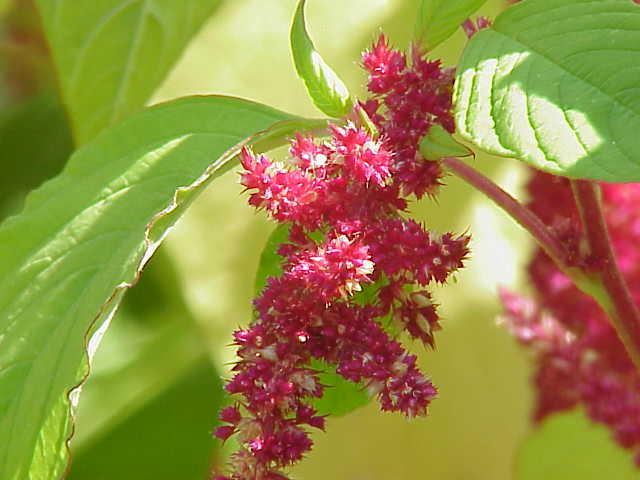 AmaranthAmaranthus
A tall, colourful plant grown for its flowers, leaves and edible seeds
🇲🇽 Mexico and 7 more · Wildflower
AmaranthAmaranthus
A tall, colourful plant grown for its flowers, leaves and edible seeds
🇲🇽 Mexico and 7 more · Wildflower
 Acacia
Shrubs and trees with golden or cream puffball flowers, native mostly to Australia
🇦🇺 Australia and 6 more · Wildflower
Acacia
Shrubs and trees with golden or cream puffball flowers, native mostly to Australia
🇦🇺 Australia and 6 more · Wildflower
 Sensitive PlantMimosa pudica
A touch-sensitive plant whose leaves fold up when disturbed
🇧🇷 Brazil and 8 more · Wildflower
Sensitive PlantMimosa pudica
A touch-sensitive plant whose leaves fold up when disturbed
🇧🇷 Brazil and 8 more · Wildflower