
Tulipa albanica
A rare wild tulip found only in northeastern Albania
Tulipa albanica is a small wild tulip native to a limited area near Surroj in Albania. Its single upright flower appears in either yellow or deep red shades, and the plant is critically endangered due to its tiny range and nearby mining.
- Found only near Surroj in northeastern Albania
- Single flower per stem, in yellow or deep red
- Distinctive wavy-edged leaves
- Critically endangered due to small range and mining
- Described as a new species in 2010
What does Tulipa albanica look like?
Tulipa albanica is a perennial plant growing from a bulb, reaching between 15 and 40 centimeters tall. It has three to five leaves, often with wavy edges, and a smooth, upright stem. Each plant produces a single, bell-shaped flower at the top, which can be either a bright yellow or a deep red to reddish-brown. The leaves and stem have a bluish-green hue.
Where does Tulipa albanica come from?
This tulip was discovered in 2010 near Surroj, in the Kukës region of northeastern Albania. It grows on rocky, serpentine hillsides among open woods and scrub. The species was described by botanists Kit Tan and Lulëzim Shuka, who named it after Albania. Its closest relatives are tulips from the western Balkans and Ukraine, but Tulipa albanica stands out for its wavy leaves and lack of a dark base on the flower.
When and how Tulipa albanica blooms
Tulipa albanica grows from a bulb and appears in the wild on stony slopes. It is adapted to serpentine soils and open woodland. The plant produces its single flower on an upright stem, with leaves spaced along the stem and the lowest leaves showing strong waves along the edges.
How Tulipa albanica is used
There are no records of Tulipa albanica being used in gardens, decoration, or traditional practices. Its main significance is as a rare wildflower, and conservationists are working to protect and spread it in its home region.
Kinds of Tulipa albanica
Tulipa albanica is closely related to Tulipa scardica and Tulipa suaveolens, but is set apart by its wavy lower leaves and the absence of a dark blotch at the flower’s base. It also has golden-yellow filaments and larger seeds than its relatives.
What Tulipa albanica means
The plant is critically endangered, with its entire population limited to a small area surrounded by mining. Conservation groups in Albania are monitoring the species and trying to establish new populations nearby. Its name highlights its importance as a unique part of Albania’s natural heritage.
Questions people ask about Tulipa albanica
Where does Tulipa albanica come from?
Tulipa albanica is native to a small area near Surroj in northeastern Albania, where it grows on rocky hillsides among open woods.
What does Tulipa albanica look like?
It is a small tulip with a single upright flower, which can be yellow or deep red. The plant has three to five bluish-green leaves, with the lower ones showing strong wavy edges.
Why is Tulipa albanica important?
It is a unique wild tulip found only in Albania and is critically endangered, making it a focus for conservation efforts.
Is Tulipa albanica used in gardens or for decoration?
There are no records of this species being grown in gardens or used for decoration. Its main significance is as a rare wildflower.
How is Tulipa albanica different from other tulips?
It is distinguished by its wavy lower leaves, lack of a dark spot at the flower base, golden-yellow filaments, and larger seeds compared to related tulips.
Good reading and sources
- New to Nature No 49: Tulipa albanicaThe Guardian, Article
- IUCN Red List of Threatened SpeciesIUCN Red List, Article
- Plants of the World OnlineRoyal Botanic Gardens, Kew, Plant database
- Where it has been recordedGBIF, Plant database
- Sightings and photos by naturalistsiNaturalist, Plant database
- Tulipa albanica on WikipediaEncyclopedia
- More photos on Wikimedia CommonsPhotos
- Wikidata recordOpen data
The facts on this page come from the Wikipedia article "Tulipa albanica", written by its contributors and used under the CC BY-SA 4.0 licence, and from its Wikidata record (CC0). Phool rewrote the text in its own words, with AI assistance, and compares every page with the article to make sure no passage is copied. It may be reused under the same CC BY-SA 4.0 licence with a link back.
It may contain mistakes. It is not medical or foraging advice: many flowers are poisonous, and traditional uses are reported, not recommended. If something is wrong, tell us. Last refreshed 2026-10-03.
Others in the family Liliaceae
The whole family TulipTulipa
Spring-blooming bulbs with showy, cup-shaped flowers in many colours
🇳🇱 Netherlands and 7 more · Wildflower
TulipTulipa
Spring-blooming bulbs with showy, cup-shaped flowers in many colours
🇳🇱 Netherlands and 7 more · Wildflower
 LilyLilium
Tall bulb flowers with large, colourful blooms in many gardens and cultures
Lilium · Wildflower
LilyLilium
Tall bulb flowers with large, colourful blooms in many gardens and cultures
Lilium · Wildflower
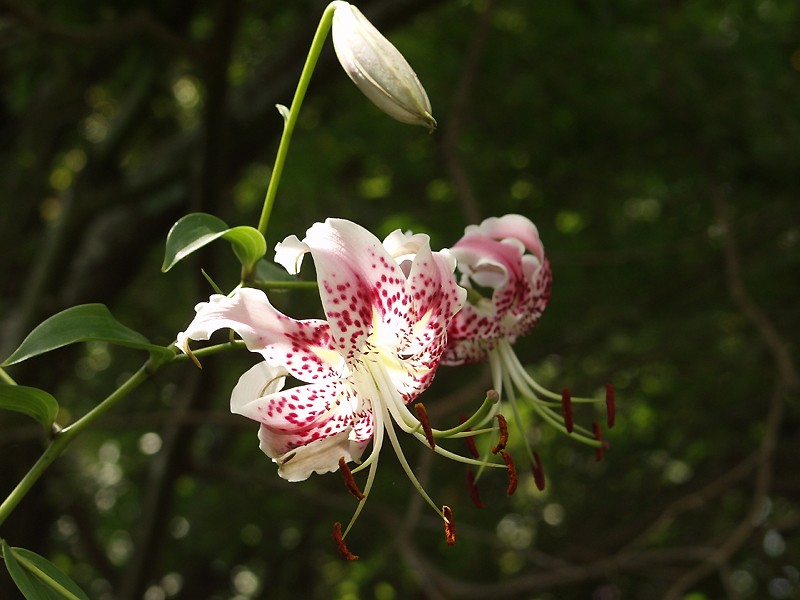 Lilium speciosum
A late-summer lily with fragrant white to pink flowers from East Asia
🇯🇵 Japan and 2 more · Wildflower
Lilium speciosum
A late-summer lily with fragrant white to pink flowers from East Asia
🇯🇵 Japan and 2 more · Wildflower
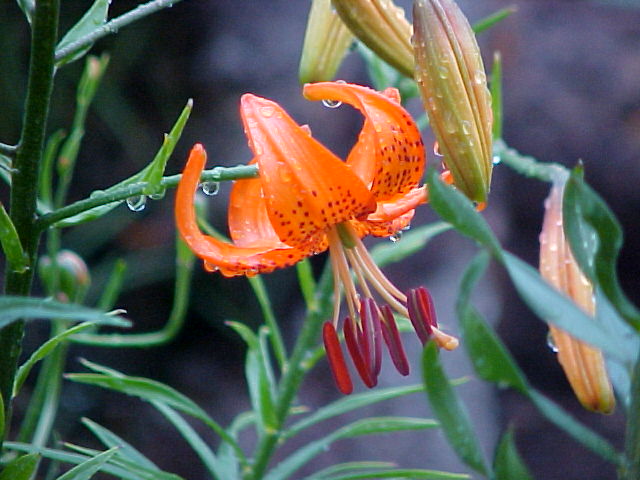 Lilium davidii
A tall Asian lily with edible bulbs and orange recurved flowers
🇨🇳 China and 1 more · Wildflower
Lilium davidii
A tall Asian lily with edible bulbs and orange recurved flowers
🇨🇳 China and 1 more · Wildflower
More from Albania
All the flowers of Albania Horse-chestnutAesculus hippocastanum
A large flowering tree known for its white spring blooms and shiny brown conkers
🇦🇱 Albania and 7 more · Flowering tree
Horse-chestnutAesculus hippocastanum
A large flowering tree known for its white spring blooms and shiny brown conkers
🇦🇱 Albania and 7 more · Flowering tree
 Common peonyPaeonia officinalis
A deep pink or red peony from the mountains of southern Europe
🇮🇹 Italy and 7 more · Wildflower
Common peonyPaeonia officinalis
A deep pink or red peony from the mountains of southern Europe
🇮🇹 Italy and 7 more · Wildflower
 Grecian foxgloveDigitalis lanata
A woolly-leaved foxglove of the Balkans, source of the heart drug digoxin
🇦🇱 Albania and 9 more · Wildflower
Grecian foxgloveDigitalis lanata
A woolly-leaved foxglove of the Balkans, source of the heart drug digoxin
🇦🇱 Albania and 9 more · Wildflower
 Poppy
Bright-petalled flowers grown for gardens, seeds, and remembrance
🇬🇧 United Kingdom and 7 more · Wildflower
Poppy
Bright-petalled flowers grown for gardens, seeds, and remembrance
🇬🇧 United Kingdom and 7 more · Wildflower