Veronicastrum
A group of upright flowering plants in the plantain family
Veronicastrum is a genus of tall, flowering plants in the Plantaginaceae family. The best-known species, Veronicastrum virginicum, comes from eastern North America and is grown in gardens. Other species are found in Asia. These plants are valued for their upright flower spikes.
- Veronicastrum is part of the plantain family, Plantaginaceae.
- Veronicastrum virginicum is native to eastern North America.
- Some species are found in Asia, such as Veronicastrum sibiricum.
- The genus was once grouped with Veronica but is now separate.
What does Veronicastrum look like?
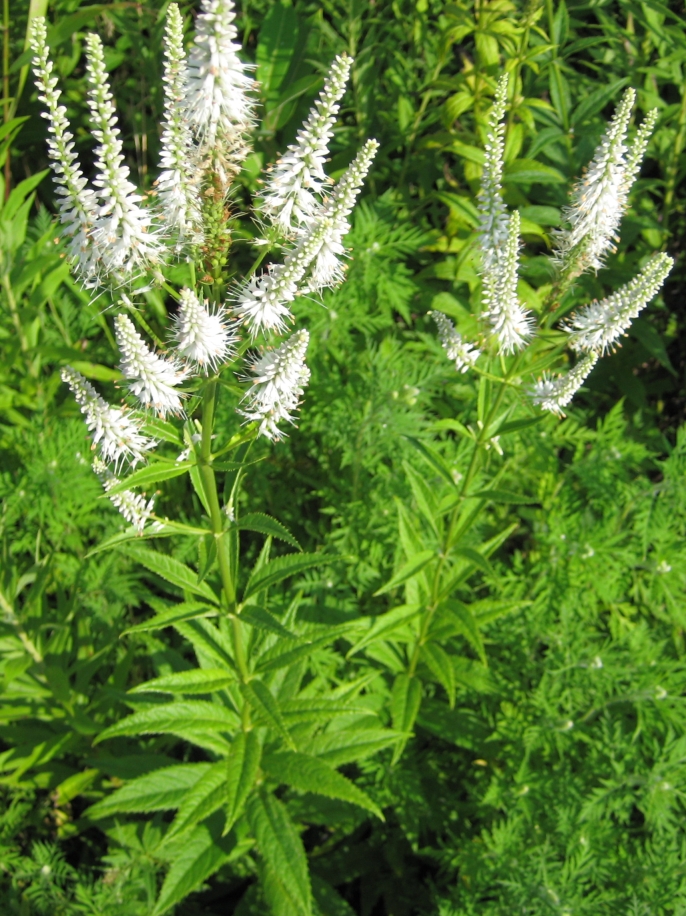
Veronicastrum plants are known for their tall, upright stems topped with narrow spikes of small flowers. The flowers are densely packed along the spike, giving a bottlebrush appearance. The leaves are usually arranged in whorls along the stem. While the sources do not list flower colours, garden forms are often grown for their showy spikes.
Where does Veronicastrum come from?
Veronicastrum belongs to the Plantaginaceae family, though it was once placed in the Scrophulariaceae family. The most widely grown species, Veronicastrum virginicum, is native to eastern North America. Other species are found in parts of Asia. The genus has sometimes been grouped with Veronica, but genetic studies now keep it separate.
When and how Veronicastrum blooms
These plants grow from seed or by division. They prefer open, sunny spots in gardens or wild meadows. Flowering occurs on tall stems, with narrow spikes forming at the top. The growing season and care details are not given in the sources, but they are often chosen for their upright habit and ornamental value.
How Veronicastrum is used
Veronicastrum species are mainly grown in gardens for their tall, spiky flowers. The sources do not mention specific uses in tradition, medicine, or ceremony. In cultivation, they are valued for adding height and structure to planting schemes.
Kinds of Veronicastrum
Several species belong to this genus, including Veronicastrum virginicum (Culver's root) from North America, and Veronicastrum sibiricum (Sibirian veronicastrum), V. borissovae, V. cerasifolium, V. sachalinense, V. tubiflorum, and V. wulingense from Asia. Veronicastrum virginicum is the most commonly grown in gardens.
What Veronicastrum means
There are no details in the sources about cultural symbolism, emblems, or religious uses for Veronicastrum. Its main role is as a garden plant, especially valued for its upright flower spikes. Some species have been studied and compared with the related genus Veronica.
Questions people ask about Veronicastrum
Where does Veronicastrum come from?
Veronicastrum virginicum is native to eastern North America, while other species are found in parts of Asia.
What does Veronicastrum look like?
It has tall, upright stems with narrow spikes of small, densely packed flowers and whorled leaves.
Is Veronicastrum used for anything special?
The sources only mention its use as a garden plant, valued for its tall, spiky flower clusters.
Are there different types of Veronicastrum?
Yes, species include Veronicastrum virginicum, V. sibiricum, V. borissovae, V. cerasifolium, V. sachalinense, V. tubiflorum, and V. wulingense.
What family does Veronicastrum belong to?
It belongs to the Plantaginaceae family, after being moved from the Scrophulariaceae family.
Good reading and sources
- USDA Plants DatabaseUS Department of Agriculture, Article
- Plants of the World OnlineRoyal Botanic Gardens, Kew, Plant database
- Where it has been recordedGBIF, Plant database
- Sightings and photos by naturalistsiNaturalist, Plant database
- Veronicastrum on WikipediaEncyclopedia
- More photos on Wikimedia CommonsPhotos
- Wikidata recordOpen data
The facts on this page come from the Wikipedia article "Veronicastrum", written by its contributors and used under the CC BY-SA 4.0 licence, and from its Wikidata record (CC0). Phool rewrote the text in its own words, with AI assistance, and compares every page with the article to make sure no passage is copied. It may be reused under the same CC BY-SA 4.0 licence with a link back.
It may contain mistakes. It is not medical or foraging advice: many flowers are poisonous, and traditional uses are reported, not recommended. If something is wrong, tell us. Last refreshed 2026-10-03.
Others in the family Plantaginaceae
The whole family FoxgloveDigitalis purpurea
Tall spikes of bell-shaped, spotted flowers in purple, pink, white or yellow
🇩🇪 Germany and 5 more · Wildflower
FoxgloveDigitalis purpurea
Tall spikes of bell-shaped, spotted flowers in purple, pink, white or yellow
🇩🇪 Germany and 5 more · Wildflower
 ToadflaxLinaria
A group of nearly 200 flowering plants called toadflax, found mainly around the Mediterranean
Linaria · Wildflower
ToadflaxLinaria
A group of nearly 200 flowering plants called toadflax, found mainly around the Mediterranean
Linaria · Wildflower
 Veronica
A large group of wild and garden flowers known as speedwell
Veronica · Wildflower
Veronica
A large group of wild and garden flowers known as speedwell
Veronica · Wildflower
 Alpine toadflaxLinaria alpina
A small violet-flowered plant of rocky European mountain slopes
🇦🇹 Austria and 7 more · Wildflower
Alpine toadflaxLinaria alpina
A small violet-flowered plant of rocky European mountain slopes
🇦🇹 Austria and 7 more · Wildflower