
Conservatory
A glass-walled room or building for growing and displaying plants
A conservatory is a structure with glass walls and roof, used to grow or showcase plants under shelter. Originally built by wealthy Europeans to protect citrus trees, it evolved into grand public greenhouses and domestic sunrooms across the world.
- Began as citrus shelters called limonaie in 16th-century Italy
- Victorian-era conservatories used iron and glass on a grand scale
- UK law defines a conservatory as over 50% glazed walls and 75% glazed roof
- Public conservatories appear in cities across six continents
- Modern versions use argon-filled or self-tinting glass for efficiency
What is Conservatory?
A conservatory is a room or freestanding building made mostly of glass in its walls and roof. It shelters tropical or delicate plants while letting in light. In private homes it often serves as a bright living space; in parks and botanic gardens it displays collections of exotic flora.
Where does Conservatory come from?
Conservatories began in 16th-century Italy as limonaie, sheltered spaces for potted citrus trees brought from the Mediterranean. Wealthy landowners in northern Europe later built orangeries, solid rooms with large south-facing windows. By the 1800s, advances in glass and iron led to grand public conservatories, especially in England.
How Conservatory is made
Traditional conservatories used wood, brick or stone frames with tall windows. Victorian versions employed iron and glass in sweeping curves or domes. Modern ones use aluminium, PVCu or timber with energy-efficient glazing, sometimes self-tinting, to control heat while maximizing daylight for plants and comfort.
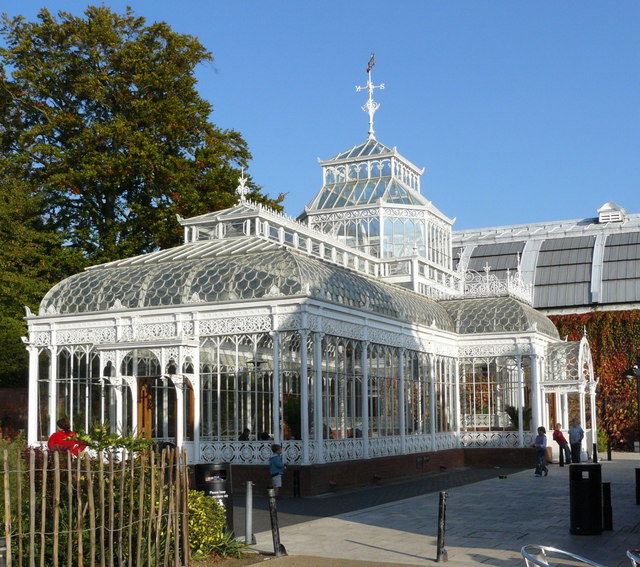


When and where Conservatory is used
People use conservatories both for horticulture and leisure. Public conservatories host flower shows and educational displays year-round. Domestic versions serve as sunrooms for relaxation or as protected gardens for tender plants, blending indoor living with outdoor greenery.
Forms of Conservatory
Early forms include Italian limonaie and European orangeries. Later came palm houses for tall trees, like Kew’s Great Palm House. Today’s styles range from ornate Victorian reproductions to minimalist solariums and geodesic domes such as Biosphere 2 or the Eden Project.
What Conservatory means
The conservatory reflects a blend of botanical interest and architectural ambition. In Britain, it became a symbol of domestic refinement. Grand municipal examples, like those in Belfast or San Francisco, are civic landmarks. The form endures as both a practical growing space and a cultural icon of light-filled design.
Questions people ask about Conservatory
What is a conservatory used for?
It shelters tender or tropical plants and often doubles as a bright living space. Public conservatories display plant collections and host flower exhibitions year-round.
Where did conservatories originate?
They began in 16th-century Italy as limonaie to protect potted citrus trees during winter, later evolving into orangeries across northern Europe.
How is a conservatory different from an orangery?
A conservatory has more than 75% of its roof glazed, while an orangery uses less glass and more solid walls and roofing materials like stone or brick.
When were conservatories most popular?
The 19th century was their golden age, especially in England, where new glass and heating technologies enabled large iron-and-glass public structures.
Are conservatories only for plants?
No, they are often dual-purpose. Many serve as sunrooms for social use, such as tea parties, while also housing plants under controlled conditions.
Good reading and sources
- Conservatory (greenhouse) on WikipediaEncyclopedia
- More photos on Wikimedia CommonsPhotos
- Wikidata recordOpen data
The facts on this page come from the Wikipedia article "Conservatory (greenhouse)", written by its contributors and used under the CC BY-SA 4.0 licence, and from its Wikidata record (CC0). Phool rewrote the text in its own words, with AI assistance, and compares every page with the article to make sure no passage is copied. It may be reused under the same CC BY-SA 4.0 licence with a link back.
It may contain mistakes. If something is wrong, tell us. Last refreshed 2026-10-03.
More of the same kind
 Decoration
Korean garden
A natural garden style shaped by rocks, ponds, and harmony with the land
🇰🇷 South Korea and 5 more · Garden style
Decoration
Korean garden
A natural garden style shaped by rocks, ponds, and harmony with the land
🇰🇷 South Korea and 5 more · Garden style
 Decoration
Islamic garden
A walled garden of water, shade and scent inspired by paradise
🇮🇷 Iran and 5 more · Garden style
Decoration
Islamic garden
A walled garden of water, shade and scent inspired by paradise
🇮🇷 Iran and 5 more · Garden style
 Decoration
Mughal garden
A formal garden style of pools, canals, and symmetry from the Mughal era
🇮🇳 India and 3 more · Garden style
Decoration
Mughal garden
A formal garden style of pools, canals, and symmetry from the Mughal era
🇮🇳 India and 3 more · Garden style
 Decoration
Bonsai盆栽
The Japanese art of shaping miniature trees in shallow pots
🇯🇵 Japan and 7 more · Art or design
Decoration
Bonsai盆栽
The Japanese art of shaping miniature trees in shallow pots
🇯🇵 Japan and 7 more · Art or design
More from the United Kingdom
All the flowers of the United Kingdom Decoration
Boutonnière
A single flower worn on a suit or tuxedo lapel for formal occasions
🇬🇧 United Kingdom · Worn flowers
Decoration
Boutonnière
A single flower worn on a suit or tuxedo lapel for formal occasions
🇬🇧 United Kingdom · Worn flowers
 Decoration
BeltaneBealtaine / Là Bealltainn / Boaltinn
The Gaelic May Day festival with bonfires and yellow flower decorations
🇮🇪 Ireland and 1 more · Custom, May
Decoration
BeltaneBealtaine / Là Bealltainn / Boaltinn
The Gaelic May Day festival with bonfires and yellow flower decorations
🇮🇪 Ireland and 1 more · Custom, May
 Decoration
Advent wreathAdventskranz
A ring of evergreens and candles marking each week of Advent
🇩🇪 Germany and 2 more · Worn flowers, Nov to Dec
Decoration
Advent wreathAdventskranz
A ring of evergreens and candles marking each week of Advent
🇩🇪 Germany and 2 more · Worn flowers, Nov to Dec
 Decoration
Rushbearing
An English festival of carrying rushes and flowers to church in decorated processions
🇬🇧 United Kingdom · Custom, Jul to Aug
Decoration
Rushbearing
An English festival of carrying rushes and flowers to church in decorated processions
🇬🇧 United Kingdom · Custom, Jul to Aug