
Aubrieta
A mat-forming perennial with violet, pink, or white spring flowers
Aubrieta is a group of low, evergreen plants from southeastern Europe and Western Asia. It forms dense mats on rocks and banks, producing small violet, pink, or white blossoms. Gardeners value it for its hardiness and ability to thrive in sunny or partly shaded spots.
- Forms dense mats of evergreen leaves
- Flowers in violet, pink, or white during spring
- Native to southeastern Europe and Western Asia
- Grows well on rocks, banks, and garden walls
- Includes over 20 species and several garden varieties
What does Aubrieta look like?
Aubrieta plants stay low to the ground, spreading out to form a carpet of leaves that stay green all year. Their flowers are small, with four petals each, and appear in shades of violet, pink, or white. These plants are often used to cover walls, rocks, or garden edges, where their bright blooms stand out in spring.
Where does Aubrieta come from?
Aubrieta comes from rocky areas in southeastern Europe and parts of Western Asia. Over time, it has been grown in gardens across Europe, and some species have escaped into the wild. The genus was named in honour of Claude Aubriet, a botanical illustrator from France.
When and how Aubrieta blooms
Aubrieta grows best in light, well-drained soil and can handle a range of soil pH. It does well in both full sun and partial shade. Gardeners often plant it in rock gardens or along borders, where it spreads naturally. It is a perennial, so it returns each year without replanting.

How Aubrieta is used
People mainly grow Aubrieta for its colourful spring flowers and evergreen foliage. It is popular in home gardens, especially for covering slopes, walls, and rocky spots. Its ability to thrive in tough spots makes it a favourite for adding colour early in the year.
Kinds of Aubrieta
There are over 20 species of Aubrieta, as well as several garden varieties. Some well-known cultivars include 'Argenteovariegata', 'Aureovariegata', 'Doctor Mules', and 'Red Cascade', which are valued for their leaf patterns or flower colours.
What Aubrieta means
Aubrieta is mainly appreciated for its decorative value in gardens. It is not tied to any particular symbolism or tradition, but its early spring flowers and evergreen leaves make it a reliable choice for gardeners seeking colour after winter.
Questions people ask about Aubrieta
Where does Aubrieta come from?
Aubrieta is native to southeastern Europe and Western Asia, where it grows on rocky slopes and banks.
What does Aubrieta look like?
It is a low, spreading plant with evergreen leaves and small four-petalled flowers in violet, pink, or white.
How is Aubrieta used in gardens?
Gardeners use Aubrieta as groundcover, especially in rock gardens, along walls, or on slopes for its colourful spring blooms.
Are there different types of Aubrieta?
Yes, there are more than 20 species and several popular cultivars with different leaf patterns and flower colours.
Does Aubrieta have any special meaning or use in tradition?
Aubrieta is mainly grown for its ornamental value and is not linked to any particular symbolism or tradition.
Good reading and sources
- Aubrieta 'Aureovariegata' (v)Royal Horticultural Society, Article
- USDA Plants DatabaseUS Department of Agriculture, Article
- Plants of the World OnlineRoyal Botanic Gardens, Kew, Plant database
- Where it has been recordedGBIF, Plant database
- Sightings and photos by naturalistsiNaturalist, Plant database
The facts on this page come from the Wikipedia article "Aubrieta", written by its contributors and used under the CC BY-SA 4.0 licence, and from its Wikidata record (CC0). Phool rewrote the text in its own words, with AI assistance, and compares every page with the article to make sure no passage is copied. It may be reused under the same CC BY-SA 4.0 licence with a link back.
It may contain mistakes. It is not medical or foraging advice: many flowers are poisonous, and traditional uses are reported, not recommended. If something is wrong, tell us. Last refreshed 2026-10-03.
Others in the family Brassicaceae
The whole family RapeseedBrassica napus
A yellow-flowered crop grown for its oil-rich seeds and protein meal
🇨🇳 China and 7 more · Wildflower
RapeseedBrassica napus
A yellow-flowered crop grown for its oil-rich seeds and protein meal
🇨🇳 China and 7 more · Wildflower
 Brown mustardBrassica juncea
A leafy mustard plant grown for greens, seeds, and oil across Asia and beyond
🇨🇳 China and 7 more · Wildflower
Brown mustardBrassica juncea
A leafy mustard plant grown for greens, seeds, and oil across Asia and beyond
🇨🇳 China and 7 more · Wildflower
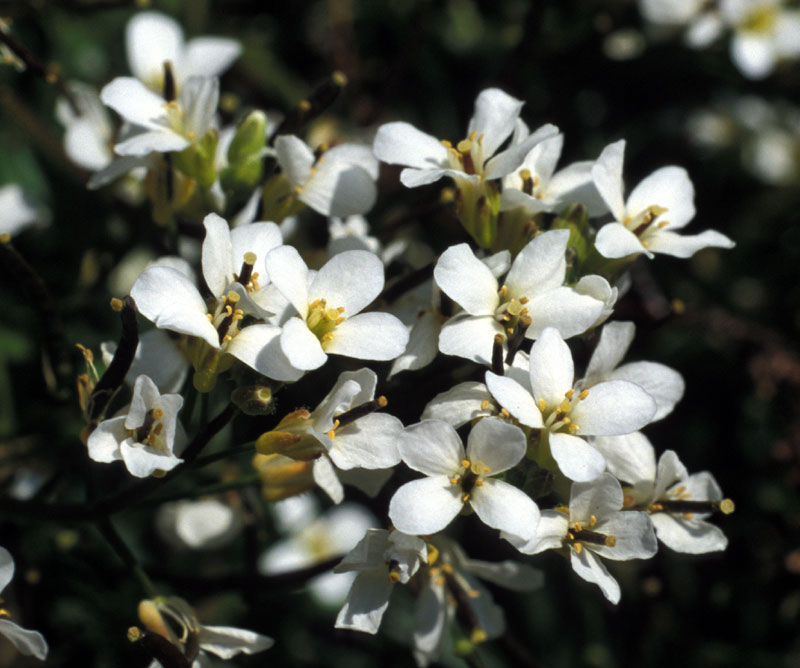 Whitlow grassDraba
A large group of small flowering plants, not true grasses
Draba · Wildflower
Whitlow grassDraba
A large group of small flowering plants, not true grasses
Draba · Wildflower
 Sea kaleCrambe maritima
Salt-loving coastal plant with edible white-flowered shoots
🇬🇧 United Kingdom and 7 more · Wildflower
Sea kaleCrambe maritima
Salt-loving coastal plant with edible white-flowered shoots
🇬🇧 United Kingdom and 7 more · Wildflower