
Basket of gold
Aurinia saxatilis, family Brassicaceae
A low, yellow-flowered perennial for rock gardens and dry slopes
Basket of gold is a small, mound-forming perennial grown for its bright yellow spring flowers. Native to rocky areas in Europe and Asia, it is often used in rock gardens, borders, and containers. Its blooms can also be white, cream, or peach in cultivated varieties.
- Forms low, rounded mounds covered in yellow flowers each spring
- Native to rocky, mountainous areas of Europe and Asia
- Grows well in rock gardens, borders, and containers
- Attracts bees and other pollinators
- Recognized for garden performance and reliability
What does Basket of gold look like?
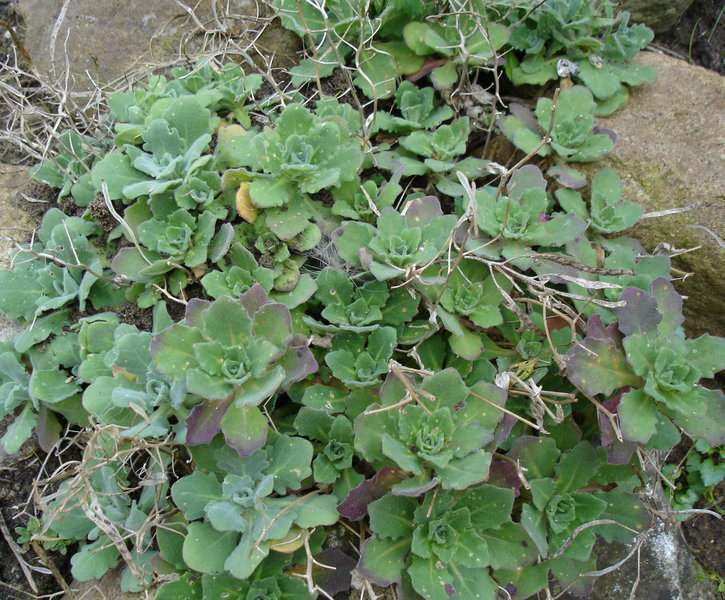
Basket of gold is a compact, evergreen perennial that forms rounded mounds about 10 to 30 cm tall and up to 40 to 50 cm wide. Its leaves are small and stay green year-round. In spring, the plant is covered with clusters of small, four-petalled flowers, most often in clear yellow, but some cultivated forms bloom in white, cream, peach, or gold. The flowers can be so dense that they hide the leaves beneath.
Where does Basket of gold come from?
This plant is native to rocky, mountainous landscapes in Europe and Asia. It was once classified with Alyssum, which is reflected in some of its common names. Its natural preference for well-drained, stony soils made it a popular choice for rock gardens and dry slopes. Over time, gardeners have selected and named several forms for their flower color or leaf markings.
When and how Basket of gold blooms
Basket of gold prefers a sunny spot with soil that drains well, often with added sand, chalk, or grit. It can be grown from seed sown in autumn or from tip cuttings taken in late spring or early summer. Plants are spaced apart to allow room for their rounded shape. Occasional feeding in early spring is optional. To keep the plant neat, gardeners often trim it back after flowering.

How Basket of gold is used
This perennial is mainly grown for its cheerful spring display in gardens, especially in rockeries, along borders, or in containers. The flowers are not usually picked for bouquets, but may be included in small hand-held arrangements. Its ability to attract pollinators has been recognized by horticultural societies.
Kinds of Basket of gold
Several named forms exist, differing in flower color or leaf pattern. Some have paler yellow blooms, others have leaves edged in cream. There are also varieties with golden or tan-tinged flowers. These cultivated types offer gardeners a choice of subtle differences for their gardens.
What Basket of gold means
Basket of gold has received recognition for its performance in gardens, including awards from horticultural groups. It is valued for its reliability, resistance to pests and diseases, and its role in supporting bees and other pollinators. Its bright flowers make it a favorite for spring displays in many temperate gardens.
Questions people ask about Basket of gold
Where does basket of gold come from?
Basket of gold is native to rocky and mountainous regions in Europe and Asia, where it grows wild in well-drained soils.
What does basket of gold look like?
It is a small, evergreen plant that forms rounded mounds. In spring, it is covered with clusters of small, bright yellow flowers, though some varieties bloom in white, cream, peach, or gold.
How is basket of gold used in gardens?
Gardeners use it for spring color in rock gardens, along borders, and in containers. Its flowers attract pollinators, and it is valued for its low maintenance and neat growth.
Are there different types of basket of gold?
Yes, cultivated varieties offer different flower colors, such as pale yellow, cream, or peach, and some have leaves edged in cream.
Does basket of gold have any special meaning or use?
It is mainly valued for its garden beauty and its ability to support pollinators. It has received awards for its performance and reliability in gardens.
Good reading and sources
- Encyclopaedia BritannicaArticle
- Aurinia saxatilisRoyal Horticultural Society, Article
- USDA Plants DatabaseUS Department of Agriculture, Article
- Plants of the World OnlineRoyal Botanic Gardens, Kew, Plant database
- Where it has been recordedGBIF, Plant database
- Sightings and photos by naturalistsiNaturalist, Plant database
- Aurinia saxatilis on WikipediaEncyclopedia
- More photos on Wikimedia CommonsPhotos
- Wikidata recordOpen data
The facts on this page come from the Wikipedia article "Aurinia saxatilis", written by its contributors and used under the CC BY-SA 4.0 licence, and from its Wikidata record (CC0). Phool rewrote the text in its own words, with AI assistance, and compares every page with the article to make sure no passage is copied. It may be reused under the same CC BY-SA 4.0 licence with a link back.
It may contain mistakes. It is not medical or foraging advice: many flowers are poisonous, and traditional uses are reported, not recommended. If something is wrong, tell us. Last refreshed 2026-10-03.
Others in the family Brassicaceae
The whole family RapeseedBrassica napus
A yellow-flowered crop grown for its oil-rich seeds and protein meal
🇨🇳 China and 7 more · Wildflower
RapeseedBrassica napus
A yellow-flowered crop grown for its oil-rich seeds and protein meal
🇨🇳 China and 7 more · Wildflower
 Brown mustardBrassica juncea
A leafy mustard plant grown for greens, seeds, and oil across Asia and beyond
🇨🇳 China and 7 more · Wildflower
Brown mustardBrassica juncea
A leafy mustard plant grown for greens, seeds, and oil across Asia and beyond
🇨🇳 China and 7 more · Wildflower
 Sea kaleCrambe maritima
Salt-loving coastal plant with edible white-flowered shoots
🇬🇧 United Kingdom and 7 more · Wildflower
Sea kaleCrambe maritima
Salt-loving coastal plant with edible white-flowered shoots
🇬🇧 United Kingdom and 7 more · Wildflower
 RockcressArabis
Small white-flowered plants for rocky gardens and wild slopes
Arabis · Wildflower
RockcressArabis
Small white-flowered plants for rocky gardens and wild slopes
Arabis · Wildflower