
Bull banksia
Banksia grandis, family Proteaceae
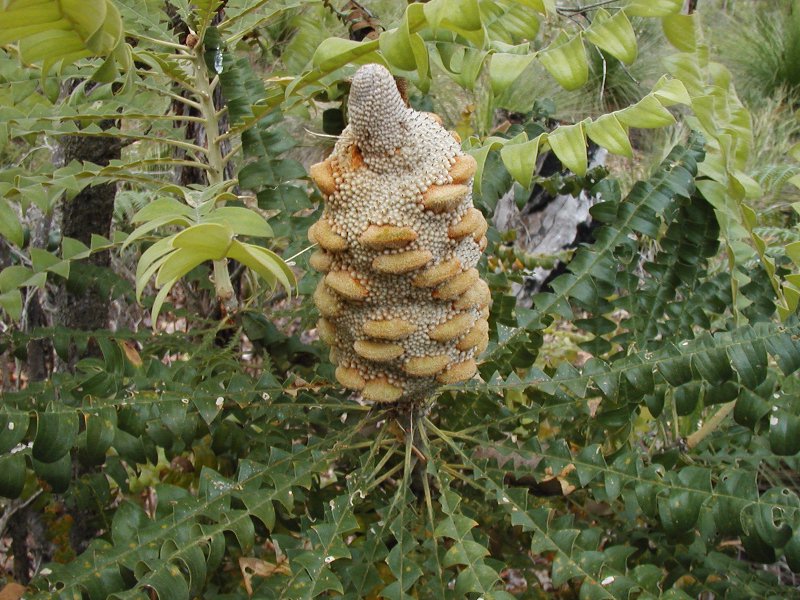
A tall, fire-resistant tree with large lobed leaves and pale yellow flower spikes
Bull banksia is a distinctive tree native to south-western Western Australia. It bears shiny dark green, deeply lobed leaves and tall cones of pale yellow flowers from October to January, and is known to Noongar people for its nectar-rich blooms.
- Flowers from October to January in pale yellow spikes up to 40 cm long
- Leaves have 8–12 triangular lobes on each side and are soft underneath
- Noongar people used its flowers as a source of sweet nectar
- Highly sensitive to dieback and rarely grown in gardens
- Grows as a shrub near granite outcrops or the southern coast
What does Bull banksia look like?
Bull banksia grows as a tree up to 15 metres tall, though it can be a low, spreading shrub near granite outcrops or the southern coast. Its trunk is short and often bent, covered in rough grey bark. The leaves are long, glossy green above and softly hairy below, each split into eight to twelve sharp triangular lobes. Flower spikes are dense, pale yellow, and held upright, with cream styles protruding.
Where does Bull banksia come from?
This species was first described scientifically in 1798 by Carl Ludwig Willdenow. It belongs to the Banksia genus, which was briefly renamed Sirmuellera by Otto Kuntze in 1891 due to a naming conflict, but that change was later rejected. Bull banksia is part of the small Grandes series, which includes only one other close relative, B. solandri.
When and how Bull banksia blooms
It flowers between October and January in its native range. The plant grows slowly and may take over ten years to bloom when grown from seed. It thrives in well-drained sandy soils but is highly vulnerable to dieback and does poorly in humid summer climates. Seeds germinate without pretreatment in three to six weeks.



How Bull banksia is used
Noongar people traditionally called the flowers mangyt, pulgarla or Bool gal la and used them as a source of sweet nectar, either by soaking them in water or sucking directly. In horticulture, it is rarely planted due to its slow growth and sensitivity to disease, though it is valued for its striking form in suitable conditions.
Kinds of Bull banksia
Near the south coast and around granite rocks, bull banksia often grows as a low, wide shrub rather than a tall tree. A specimen raised in Kings Park from south-coast seed kept this spreading shape into adulthood, showing how environment influences its habit.
What Bull banksia means
The tree supports local wildlife, including red wattlebirds that feed on its nectar and black cockatoos that eat its seeds. Though not widely cultivated, it holds ecological importance in jarrah forests and coastal heaths of Western Australia, where it is a familiar part of the landscape.
Where Bull banksia is used and seen

Questions people ask about Bull banksia
Where does bull banksia come from?
It is native to the south-west of Western Australia, growing from Mount Lesueur to Cape Riche and inland to Woodanilling, often in jarrah forest or coastal heath.
What did Indigenous people use bull banksia for?
Noongar peoples soaked or sucked the flowers, called mangyt, pulgarla or Bool gal la, to drink their sweet nectar.
How long does it take to flower from seed?
It grows slowly and typically needs more than ten years to produce its first flowers when grown from seed.
Is bull banksia easy to grow in gardens?
No, it is rarely cultivated because it is very sensitive to dieback and struggles in areas with summer humidity.
What animals feed on bull banksia?
Red wattlebirds drink its nectar, and black cockatoos, including possibly Baudin’s or Carnaby’s, eat its seeds.
Good reading and sources
- IUCN Red List of Threatened SpeciesIUCN Red List, Article
- Plants of the World OnlineRoyal Botanic Gardens, Kew, Plant database
- Where it has been recordedGBIF, Plant database
- Sightings and photos by naturalistsiNaturalist, Plant database
- Banksia grandis on WikipediaEncyclopedia
- More photos on Wikimedia CommonsPhotos
- Wikidata recordOpen data
The facts on this page come from the Wikipedia article "Banksia grandis", written by its contributors and used under the CC BY-SA 4.0 licence, and from its Wikidata record (CC0). Phool rewrote the text in its own words, with AI assistance, and compares every page with the article to make sure no passage is copied. It may be reused under the same CC BY-SA 4.0 licence with a link back.
It may contain mistakes. It is not medical or foraging advice: many flowers are poisonous, and traditional uses are reported, not recommended. If something is wrong, tell us. Last refreshed 2026-10-03.
Others in the family Proteaceae
The whole family Grevillea 'Robyn Gordon'Grevillea ‘Robyn Gordon’
A red-flowered Australian shrub named for a gardener’s daughter
🇦🇺 Australia · Flowering shrub
Grevillea 'Robyn Gordon'Grevillea ‘Robyn Gordon’
A red-flowered Australian shrub named for a gardener’s daughter
🇦🇺 Australia · Flowering shrub
 Protea neriifolia
A South African shrub with cone-shaped flower heads and hairy-tipped bracts
🇿🇦 South Africa and 3 more · Wildflower
Protea neriifolia
A South African shrub with cone-shaped flower heads and hairy-tipped bracts
🇿🇦 South Africa and 3 more · Wildflower
 Silver treeLeucadendron argenteum
A rare South African tree with silky silver leaves and scented pink flowers
🇿🇦 South Africa · Flowering tree
Silver treeLeucadendron argenteum
A rare South African tree with silky silver leaves and scented pink flowers
🇿🇦 South Africa · Flowering tree
 Swamp banksiaBanksia robur
A tough coastal shrub with large serrated leaves and green-gold flower spikes
🇦🇺 Australia · Wildflower
Swamp banksiaBanksia robur
A tough coastal shrub with large serrated leaves and green-gold flower spikes
🇦🇺 Australia · Wildflower
More from Australia
All the flowers of Australia AlmondPrunus amygdalus
A Mediterranean tree grown for its fragrant spring flowers and edible seeds
🇮🇷 Iran and 6 more · Flowering tree
AlmondPrunus amygdalus
A Mediterranean tree grown for its fragrant spring flowers and edible seeds
🇮🇷 Iran and 6 more · Flowering tree
 FennelFoeniculum vulgare
A tall, aromatic herb with feathery leaves and yellow umbels, used for food and spice
🇨🇳 China and 7 more · Herb or useful flower
FennelFoeniculum vulgare
A tall, aromatic herb with feathery leaves and yellow umbels, used for food and spice
🇨🇳 China and 7 more · Herb or useful flower
 RosemarySalvia rosmarinus
A fragrant evergreen shrub with needle-like leaves and purple, blue, or white flowers
🇪🇸 Spain and 5 more · Flowering shrub
RosemarySalvia rosmarinus
A fragrant evergreen shrub with needle-like leaves and purple, blue, or white flowers
🇪🇸 Spain and 5 more · Flowering shrub
 Eucalyptus
The tall, aromatic trees and shrubs known as gum trees or eucalypts
🇦🇺 Australia and 7 more · Flowering tree
Eucalyptus
The tall, aromatic trees and shrubs known as gum trees or eucalypts
🇦🇺 Australia and 7 more · Flowering tree