
Fritillaria persica
A tall bulb plant with deep purple to greenish-brown bell flowers from the Middle East
Fritillaria persica is a perennial bulb plant from the Middle East, grown for its tall stems topped with clusters of narrow, bell-shaped flowers in shades from deep purple to green-brown. It is cultivated in gardens beyond its native area, and a popular garden variety called 'Adiyaman' is especially known for its height and abundant blooms.
- Native to the Middle East, including Iran and Turkey
- Bears up to 30 narrow, bell-shaped flowers per stem
- Flowers range from deep purple to greenish-brown
- The 'Adiyaman' variety is taller and more floriferous
- Naturalized in the Lazio region of Italy
What does Fritillaria persica look like?
Fritillaria persica grows from a bulb and reaches between 30 and 60 centimeters tall. Its upright stems carry clusters of up to 30 flowers, each shaped like a narrow cone or bell. The blossoms can be deep purple, sometimes appearing almost black, or have a greenish-brown tint. The plant stands out in spring gardens for its unusual flower color and tall, sturdy form.
Where does Fritillaria persica come from?
This species comes from the Middle East, where it grows wild in several countries. Its name, 'persica', refers to Persia, now Iran. Over time, gardeners have introduced it to other regions, and it has become established in places like central Italy. It is the only member of its subgenus, Theresia, within the Fritillaria group.
When and how Fritillaria persica blooms
Fritillaria persica grows from bulbs, which are planted in well-drained soil. The plant sends up its leafy stem and flowers in a single season. Gardeners often choose it for borders or mixed beds, and it is valued for its upright growth and unusual flower color. The 'Adiyaman' variety is especially popular for its taller stems and more plentiful blooms.

How Fritillaria persica is used
People mainly grow Fritillaria persica as an ornamental plant in gardens. Its tall stems and dark, bell-shaped flowers make it a striking choice for spring displays. It is not known for use in ceremonies, food, or medicine, but is appreciated for its decorative value.
Kinds of Fritillaria persica
The best-known cultivated form is 'Adiyaman', which is taller and produces more flowers than wild plants. This variety is widely grown in gardens and has received recognition for its performance. There are no other major varieties or subspecies mentioned.
What Fritillaria persica means
Fritillaria persica is grown for its beauty in gardens rather than for symbolic or religious reasons. The 'Adiyaman' cultivar has been awarded for its garden value. Its name reflects its Persian roots, but it does not play a notable role in cultural traditions or emblems.
Questions people ask about Fritillaria persica
Where does Fritillaria persica come from?
It is native to parts of the Middle East, including Iran, Turkey, Iraq, Lebanon, Syria, Cyprus, and Israel.
What does Fritillaria persica look like?
It has tall stems with clusters of up to 30 narrow, bell-shaped flowers that are deep purple or greenish-brown.
How is Fritillaria persica used?
It is mainly grown as an ornamental plant in gardens for its striking flowers and upright growth.
Are there different varieties of Fritillaria persica?
Yes, the 'Adiyaman' cultivar is especially popular for its height and abundant flowers.
Does Fritillaria persica have any cultural or symbolic meaning?
The sources do not mention any special symbolism or cultural use for this plant.
Good reading and sources
- Fritillaria persica 'Adiyaman'Royal Horticultural Society, Article
- Plants of the World OnlineRoyal Botanic Gardens, Kew, Plant database
- Where it has been recordedGBIF, Plant database
- Sightings and photos by naturalistsiNaturalist, Plant database
- Fritillaria persica on WikipediaEncyclopedia
- More photos on Wikimedia CommonsPhotos
- Wikidata recordOpen data
The facts on this page come from the Wikipedia article "Fritillaria persica", written by its contributors and used under the CC BY-SA 4.0 licence, and from its Wikidata record (CC0). Phool rewrote the text in its own words, with AI assistance, and compares every page with the article to make sure no passage is copied. It may be reused under the same CC BY-SA 4.0 licence with a link back.
It may contain mistakes. It is not medical or foraging advice: many flowers are poisonous, and traditional uses are reported, not recommended. If something is wrong, tell us. Last refreshed 2026-10-03.
Others in the family Liliaceae
The whole family LilyLilium
Tall bulb flowers with large, colourful blooms in many gardens and cultures
Lilium · Wildflower
LilyLilium
Tall bulb flowers with large, colourful blooms in many gardens and cultures
Lilium · Wildflower
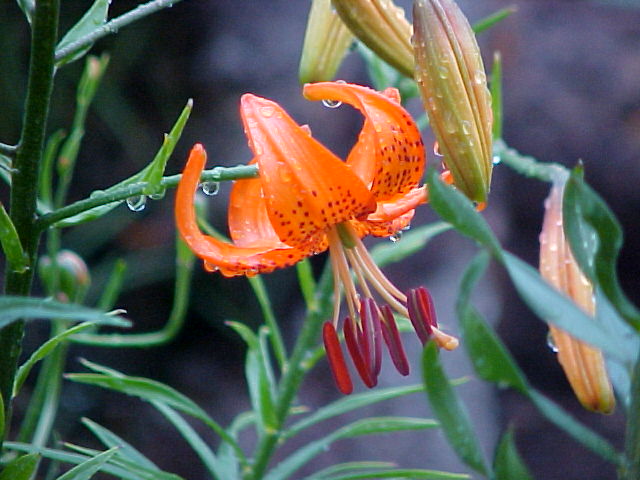 Lilium davidii
A tall Asian lily with edible bulbs and orange recurved flowers
🇨🇳 China and 1 more · Wildflower
Lilium davidii
A tall Asian lily with edible bulbs and orange recurved flowers
🇨🇳 China and 1 more · Wildflower
 Chinese LilyLilium brownii
A wild and cultivated lily from China with edible bulbs
🇨🇳 China and 3 more · Wildflower
Chinese LilyLilium brownii
A wild and cultivated lily from China with edible bulbs
🇨🇳 China and 3 more · Wildflower
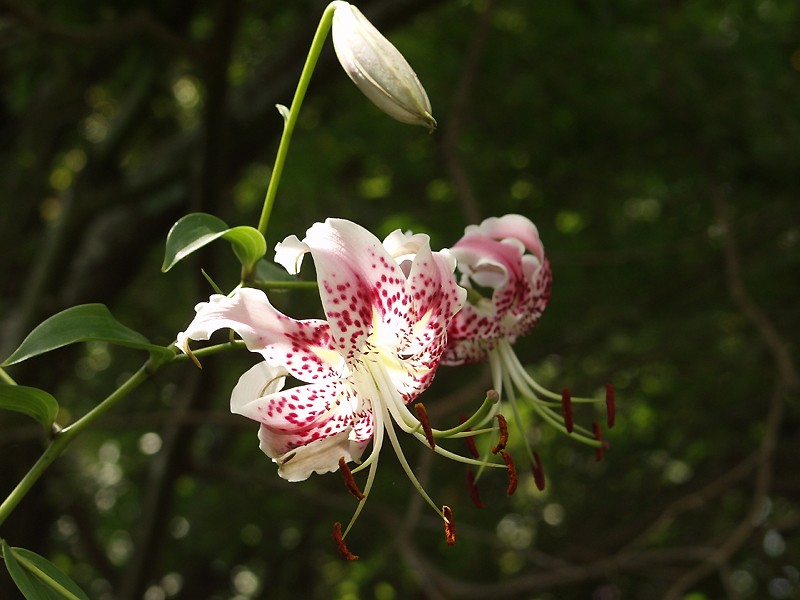 Lilium speciosum
A late-summer lily with fragrant white to pink flowers from East Asia
🇯🇵 Japan and 2 more · Wildflower
Lilium speciosum
A late-summer lily with fragrant white to pink flowers from East Asia
🇯🇵 Japan and 2 more · Wildflower
More from Turkey
All the flowers of Turkey PeachPrunus persica
A flowering fruit tree from China, grown for its pink blossoms and sweet fruit
🇨🇳 China and 7 more · Flowering tree
PeachPrunus persica
A flowering fruit tree from China, grown for its pink blossoms and sweet fruit
🇨🇳 China and 7 more · Flowering tree
 PomegranatePunica granatum
A shrub with bright red flowers and a fruit full of edible seeds
🇮🇷 Iran and 9 more · Flowering shrub
PomegranatePunica granatum
A shrub with bright red flowers and a fruit full of edible seeds
🇮🇷 Iran and 9 more · Flowering shrub
 TulipTulipa
Spring-blooming bulbs with showy, cup-shaped flowers in many colours
🇳🇱 Netherlands and 7 more · Wildflower
TulipTulipa
Spring-blooming bulbs with showy, cup-shaped flowers in many colours
🇳🇱 Netherlands and 7 more · Wildflower
 Sour cherryPrunus cerasus
The small, tart cherry tree grown for its sour red fruit
🇹🇷 Turkey and 7 more · Flowering tree
Sour cherryPrunus cerasus
The small, tart cherry tree grown for its sour red fruit
🇹🇷 Turkey and 7 more · Flowering tree