
Candytuft
Iberis, family Brassicaceae
A group of sun-loving flowers often grown in rock gardens and borders
Candytuft is a group of flowering plants in the Brassicaceae family, known for their use in gardens and borders. These plants, which include annuals and perennials, come from regions around the Mediterranean, parts of Europe, and western Asia. Their clusters of small flowers are valued in landscaping.
- Candytuft includes both annual and perennial species
- The name refers to Candia, an old name for Iraklion, Crete
- Supports the rare Euchloe tagis butterfly
- Used for rock gardens and borders
- Symbolizes indifference in the language of flowers
What does Candytuft look like?
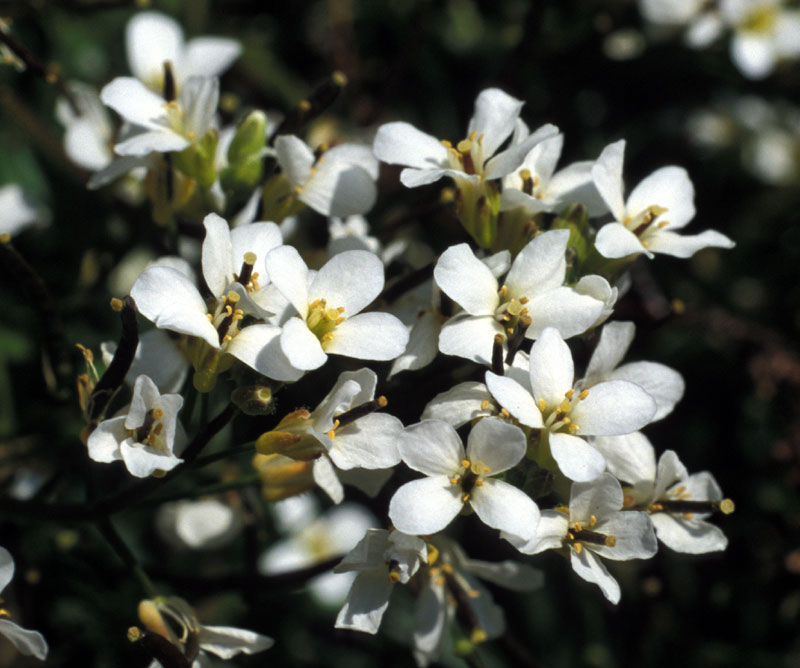
Candytuft plants include both annual and evergreen perennial types, as well as some subshrubs. They typically form low, spreading mounds with clusters of small, four-petaled flowers. These blooms are often used to fill gaps in rock gardens or along borders, creating a neat and colorful display. The foliage is usually narrow and green, complementing the bright flower heads.
Where does Candytuft come from?
The genus Iberis is native to areas around the Mediterranean, including southern Europe and North Africa, as well as parts of western Asia and the Caucasus. The common name 'candytuft' comes from Candia, the old name for Iraklion on Crete, not from the sweet treat. Over time, various species have been cultivated for ornamental use in gardens.
When and how Candytuft blooms
Candytuft thrives in sunny spots with well-drained soil, making it a favorite for rock gardens and sunny borders. Gardeners often plant them in spring or autumn, and they can be grown from seed or young plants. These flowers are chosen for their ability to create low, spreading mats of color in garden designs.
How Candytuft is used
People grow candytuft mainly for its decorative value in gardens, especially in rockeries, bedding schemes, and as edging for paths. Its neat growth and clusters of blooms make it a popular choice for adding structure and brightness to outdoor spaces.
Kinds of Candytuft
There are 32 recognized species within the Iberis genus. Some, like Iberis amara and Iberis umbellata, are noted for their unique chemical compounds, which play roles in plant defense. Gardeners may choose from annual or perennial forms depending on their needs.
What Candytuft means
In the Victorian language of flowers, candytuft stands for indifference. The plants also play a role in supporting certain insects, such as the rare Euchloe tagis butterfly, which relies solely on Iberis species for food.
Questions people ask about Candytuft
Where does candytuft come from?
Candytuft plants originate from the Mediterranean basin, parts of Europe, and western Asia, including southern Europe, North Africa, and the Caucasus.
What does candytuft look like?
Candytuft forms low, spreading mounds with clusters of small, four-petaled flowers and narrow green leaves. It is often used to create colorful borders and rock garden displays.
What is candytuft used for?
Gardeners use candytuft mainly as an ornamental plant for rock gardens, borders, and bedding, thanks to its neat growth and attractive flower clusters.
What does candytuft symbolize?
In the language of flowers, candytuft is associated with the idea of indifference.
Are there different types of candytuft?
Yes, the genus Iberis includes 32 accepted species, with both annual and perennial forms available for gardens.
Good reading and sources
- Encyclopaedia BritannicaArticle
- USDA Plants DatabaseUS Department of Agriculture, Article
- Plants of the World OnlineRoyal Botanic Gardens, Kew, Plant database
- Where it has been recordedGBIF, Plant database
- Sightings and photos by naturalistsiNaturalist, Plant database
The facts on this page come from the Wikipedia article "Iberis", written by its contributors and used under the CC BY-SA 4.0 licence, and from its Wikidata record (CC0). Phool rewrote the text in its own words, with AI assistance, and compares every page with the article to make sure no passage is copied. It may be reused under the same CC BY-SA 4.0 licence with a link back.
It may contain mistakes. It is not medical or foraging advice: many flowers are poisonous, and traditional uses are reported, not recommended. If something is wrong, tell us. Last refreshed 2026-10-03.
Others in the family Brassicaceae
The whole family RapeseedBrassica napus
A yellow-flowered crop grown for its oil-rich seeds and protein meal
🇨🇳 China and 7 more · Wildflower
RapeseedBrassica napus
A yellow-flowered crop grown for its oil-rich seeds and protein meal
🇨🇳 China and 7 more · Wildflower
 Brown mustardBrassica juncea
A leafy mustard plant grown for greens, seeds, and oil across Asia and beyond
🇨🇳 China and 7 more · Wildflower
Brown mustardBrassica juncea
A leafy mustard plant grown for greens, seeds, and oil across Asia and beyond
🇨🇳 China and 7 more · Wildflower
 Whitlow grassDraba
A large group of small flowering plants, not true grasses
Draba · Wildflower
Whitlow grassDraba
A large group of small flowering plants, not true grasses
Draba · Wildflower
 Sea kaleCrambe maritima
Salt-loving coastal plant with edible white-flowered shoots
🇬🇧 United Kingdom and 7 more · Wildflower
Sea kaleCrambe maritima
Salt-loving coastal plant with edible white-flowered shoots
🇬🇧 United Kingdom and 7 more · Wildflower