
Grey tree-pincushion
Leucospermum conocarpodendron, family Proteaceae
In its own language: goudsboom
A tall South African shrub with yellow pincushion-like flower heads
This large evergreen shrub grows up to 6 m tall near Cape Town, South Africa, with a thick corky trunk and stiff branches. It bears globe-shaped yellow flower heads with long, bent styles that resemble pins stuck in a cushion, blooming from August to December.
- Blooms yellow pincushion flower heads from August to December
- Trunk protected by thick corky bark against fynbos fires
- Seeds dispersed and buried by native ants for fire survival
- Two subspecies: one grey-felted, one smooth green-leaved
- 200-year-old seeds successfully germinated in 2006
What does Grey tree-pincushion look like?
The grey tree-pincushion is a large, rounded evergreen shrub that can reach 6 metres in height and width. It has a firm trunk covered in thick, fissured bark and rigid branches growing at right angles. Its leaves are oval to lance-shaped, either grey-felted or smooth green, with three to ten teeth near the tip. The most striking feature is its 7–9 cm wide yellow flower heads, each made of many small flowers with long, stout, bent styles that extend far beyond the petals, creating a pincushion effect.
Where does Grey tree-pincushion come from?
This species is native to the Cape Peninsula and surrounding regions of South Africa. It was first described in 1689 as an African willow based on plants seen on Table Mountain’s lower slopes. Linnaeus gave it a valid binomial name in 1753. Later botanists moved it between genera before settling on Leucospermum. The Dutch name 'kreupelhout' (cripple wood), used before 1680, refers to its twisted branching pattern.
When and how Grey tree-pincushion blooms
It blooms between August and December in South Africa. The plant grows in well-drained soils derived from granite or sandstone, from sea level up to 300 metres. Its thick bark protects the trunk from periodic fynbos fires. After fire, it resprouts from branch tips. Seeds rely on native ants for burial; the ants eat a fatty appendage and leave the hard seed underground, where it survives fire and germinates afterward.


How Grey tree-pincushion is used
It is grown in gardens within its native range for its bold form and bright flower heads. One subspecies is protected in Table Mountain National Park. Though not widely used in ceremonies, its striking appearance makes it a notable part of local landscapes and conservation efforts. Hybridization with garden-planted forms threatens the genetic integrity of the wild grey-leaved subspecies.
Kinds of Grey tree-pincushion
Two subspecies are recognized. Subsp. conocarpodendron has grey, felty leaves and is restricted to parts of the Cape Peninsula. Subsp. viridum has smooth green leaves and a wider distribution from the Cape Peninsula to Hermanus and Stanford. A hybrid zone exists where their ranges meet, showing intermediate leaf hairiness.
What Grey tree-pincushion means
The species is classified as vulnerable due to habitat loss from urban expansion, invasive plants, and altered fire regimes. Alien ants disrupt seed dispersal by eating the elaiosome without burying the seed, leaving it exposed to fire and predators. Remarkably, 200-year-old seeds stored in archives were successfully germinated in 2006 and planted at Kew Gardens.
Questions people ask about Grey tree-pincushion
Where does the grey tree-pincushion come from?
It is native to the Cape Peninsula and nearby coastal areas of South Africa, including Table Mountain and the Cape of Good Hope.
What does the flower look like?
It has round, 7–9 cm wide yellow flower heads with many long, bent yellow styles sticking out like pins from a cushion.
How does it survive wildfires?
Its trunk has thick bark that shields it from fire, and it resprouts from branch tips afterward. Seeds survive underground after being buried by ants.
Why is it called 'pincushion'?
Because the stiff, protruding styles of its flowers resemble pins stuck into a cushion.
Is it endangered?
The grey-leaved subspecies is considered vulnerable due to urban development, invasive species, and hybridization with garden plants.
Good reading and sources
- IUCN Red List of Threatened SpeciesIUCN Red List, Article
- Plants of the World OnlineRoyal Botanic Gardens, Kew, Plant database
- Where it has been recordedGBIF, Plant database
- Sightings and photos by naturalistsiNaturalist, Plant database
- Leucospermum conocarpodendron on WikipediaEncyclopedia
- More photos on Wikimedia CommonsPhotos
- Wikidata recordOpen data
The facts on this page come from the Wikipedia article "Leucospermum conocarpodendron", written by its contributors and used under the CC BY-SA 4.0 licence, and from its Wikidata record (CC0). Phool rewrote the text in its own words, with AI assistance, and compares every page with the article to make sure no passage is copied. It may be reused under the same CC BY-SA 4.0 licence with a link back.
It may contain mistakes. It is not medical or foraging advice: many flowers are poisonous, and traditional uses are reported, not recommended. If something is wrong, tell us. Last refreshed 2026-10-03.
Others in the family Proteaceae
The whole family Bull banksiaBanksia grandis
A tall, fire-resistant tree with large lobed leaves and pale yellow flower spikes
🇦🇺 Australia · Flowering tree
Bull banksiaBanksia grandis
A tall, fire-resistant tree with large lobed leaves and pale yellow flower spikes
🇦🇺 Australia · Flowering tree
 Grevillea 'Robyn Gordon'Grevillea ‘Robyn Gordon’
A red-flowered Australian shrub named for a gardener’s daughter
🇦🇺 Australia · Flowering shrub
Grevillea 'Robyn Gordon'Grevillea ‘Robyn Gordon’
A red-flowered Australian shrub named for a gardener’s daughter
🇦🇺 Australia · Flowering shrub
 Protea neriifolia
A South African shrub with cone-shaped flower heads and hairy-tipped bracts
🇿🇦 South Africa and 3 more · Wildflower
Protea neriifolia
A South African shrub with cone-shaped flower heads and hairy-tipped bracts
🇿🇦 South Africa and 3 more · Wildflower
 Swamp banksiaBanksia robur
A tough coastal shrub with large serrated leaves and green-gold flower spikes
🇦🇺 Australia · Wildflower
Swamp banksiaBanksia robur
A tough coastal shrub with large serrated leaves and green-gold flower spikes
🇦🇺 Australia · Wildflower
More from South Africa
All the flowers of South Africa Eucalyptus
The tall, aromatic trees and shrubs known as gum trees or eucalypts
🇦🇺 Australia and 7 more · Flowering tree
Eucalyptus
The tall, aromatic trees and shrubs known as gum trees or eucalypts
🇦🇺 Australia and 7 more · Flowering tree
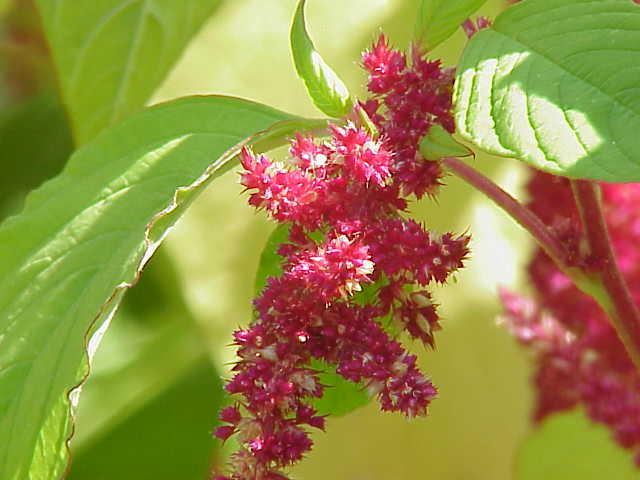 AmaranthAmaranthus
A tall, colourful plant grown for its flowers, leaves and edible seeds
🇲🇽 Mexico and 7 more · Wildflower
AmaranthAmaranthus
A tall, colourful plant grown for its flowers, leaves and edible seeds
🇲🇽 Mexico and 7 more · Wildflower
 Acacia
Shrubs and trees with golden or cream puffball flowers, native mostly to Australia
🇦🇺 Australia and 6 more · Wildflower
Acacia
Shrubs and trees with golden or cream puffball flowers, native mostly to Australia
🇦🇺 Australia and 6 more · Wildflower
 Sensitive PlantMimosa pudica
A touch-sensitive plant whose leaves fold up when disturbed
🇧🇷 Brazil and 8 more · Wildflower
Sensitive PlantMimosa pudica
A touch-sensitive plant whose leaves fold up when disturbed
🇧🇷 Brazil and 8 more · Wildflower