
Moraea
Iris-like flowers from a genus found across Africa and parts of Asia
Moraea is a genus of flowering plants with blooms resembling irises. It grows wild from Africa through the Mediterranean to parts of western Asia, and some species have corms that are edible but often bitter or toxic.
- Named after English botanist Robert More
- Flowers resemble those of irises
- Grows from corms, not true bulbs
- Some species have poisonous underground parts
- Found from Africa to southwestern Asia
What does Moraea look like?
Plants in the Moraea genus produce flowers that look like those of irises. They grow from corms, underground storage organs similar to bulbs, and their blossoms share the distinctive shape and structure typical of the iris family.
Where does Moraea come from?
The genus Moraea was first formally described in 1758. Its name honours Robert More, an English botanist. These plants occur naturally across a broad region stretching from Africa through the Mediterranean into central and southwestern Asia.
When and how Moraea blooms
Moraea species grow from corms and flower above ground. While details of their blooming season vary by species and location, they are adapted to diverse climates within their wide native range.


How Moraea is used
In some places, the corms of certain Moraea species have been eaten. However, they are generally small, often taste unpleasant, and a number of them contain toxins that make them unsafe to consume.
Questions people ask about Moraea
Where does Moraea come from?
It is native to Africa, the Mediterranean region, and central and southwestern Asia.
Are Moraea plants safe to eat?
Some species have corms used as food, but many are bitter or poisonous and should not be eaten.
What do Moraea flowers look like?
They resemble iris flowers, with similar petal shapes and structure, growing from underground corms.
Why is it called Moraea?
The name honours Robert More, an English botanist, as noted when the genus was first described in 1758.
Good reading and sources
- Encyclopaedia BritannicaArticle
- USDA Plants DatabaseUS Department of Agriculture, Article
- Plants of the World OnlineRoyal Botanic Gardens, Kew, Plant database
- Where it has been recordedGBIF, Plant database
- Sightings and photos by naturalistsiNaturalist, Plant database
The facts on this page come from the Wikipedia article "Moraea", written by its contributors and used under the CC BY-SA 4.0 licence, and from its Wikidata record (CC0). Phool rewrote the text in its own words, with AI assistance, and compares every page with the article to make sure no passage is copied. It may be reused under the same CC BY-SA 4.0 licence with a link back.
It may contain mistakes. It is not medical or foraging advice: many flowers are poisonous, and traditional uses are reported, not recommended. If something is wrong, tell us. Last refreshed 2026-10-03.
Others in the family Iridaceae
The whole family Gladiolus
Tall, showy flower spikes grown from corms, known as sword lilies
Gladiolus · Garden flower
Gladiolus
Tall, showy flower spikes grown from corms, known as sword lilies
Gladiolus · Garden flower
 Iris
A large group of perennial flowers with striking, six-lobed blooms
Iris · Wildflower
Iris
A large group of perennial flowers with striking, six-lobed blooms
Iris · Wildflower
 Crocus
Small corm-grown flowers in white, yellow, orange or purple
🇹🇷 Turkey and 7 more · Wildflower
Crocus
Small corm-grown flowers in white, yellow, orange or purple
🇹🇷 Turkey and 7 more · Wildflower
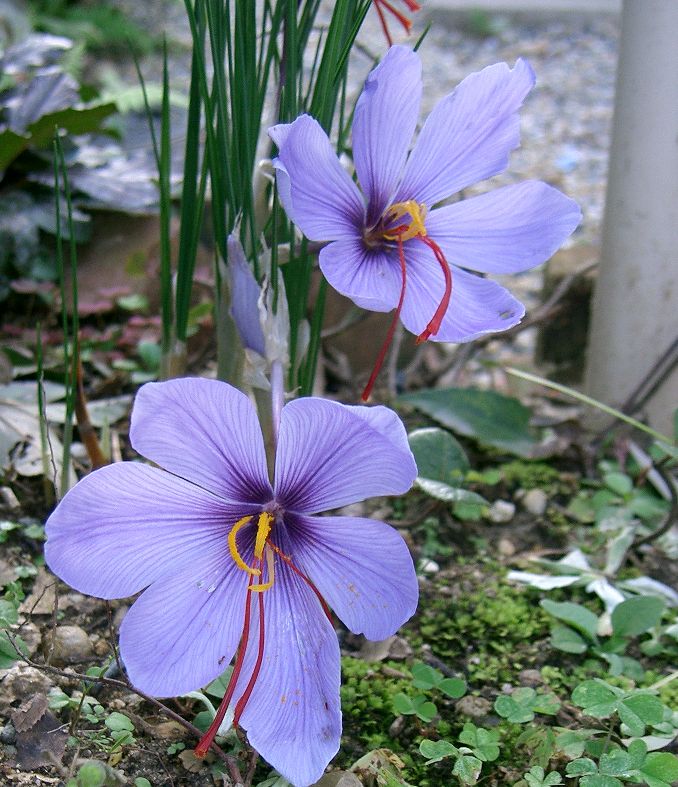 Saffron crocusCrocus sativus
The purple autumn flower whose red stigmas yield the spice saffron
🇨🇳 China and 1 more · Garden flower
Saffron crocusCrocus sativus
The purple autumn flower whose red stigmas yield the spice saffron
🇨🇳 China and 1 more · Garden flower