
Iris
A large group of perennial flowers with striking, six-lobed blooms
Irises are a genus of over 300 perennial plants known for their showy, fan-shaped flowers. Found mainly in temperate regions of the Northern Hemisphere, they grow from either rhizomes or bulbs and display a wide range of colors and forms, making them popular in gardens and floral shows.
- Over 300 accepted species in the genus Iris
- Flowers have six lobes: three 'falls' and three 'standards'
- Grown from rhizomes or bulbs, depending on species
- Popular in gardens and flower shows worldwide
- Named after the Greek word for rainbow
What does Iris look like?
Irises are perennial plants that grow from either creeping rhizomes or bulbs, depending on the species and climate. Their leaves are typically sword-shaped and form dense clumps. The flowers have six lobes: three outer 'falls' that often droop or spread, sometimes with a fuzzy 'beard', and three inner 'standards' that stand upright. Blooms come in a wide range of colors, including purple, blue, yellow, pink, orange, and white. The flowers are symmetrical and often fan-shaped, making them easy to recognize.
Where does Iris come from?
The genus Iris is native to temperate regions across the Northern Hemisphere, from Europe and Asia to North America. Most species are found in dry, semi-desert, or rocky mountainous areas, but some grow in meadows, woodlands, bogs, or riverbanks. The name 'iris' comes from the Greek word for rainbow, reflecting the many colors found in its flowers. Over time, the genus has been divided into several subgenera and sections, with a long history of cultivation and hybridization.
When and how Iris blooms
Irises bloom mainly in spring and summer, with some species flowering as early as February or March in the Northern Hemisphere. They are grown from rhizomes or bulbs, depending on the type. Gardeners plant them in well-drained soil, usually in sunny spots. Bearded irises are often planted as bare root divisions in late summer, while bulbous types are set in autumn. There are thousands of cultivars, each with its own preferred growing conditions.


How Iris is used
Irises are widely grown in home and botanical gardens for their striking flowers. They are popular in floral arrangements and are featured in flower shows and competitions, such as those held in Florence and at the Chelsea Flower Show. Some regions hold large collections or living museums dedicated to irises. The flowers are also given as gifts and serve as emblems in various places.
Kinds of Iris
The genus includes over 300 species and thousands of cultivars. Major groups are bearded irises, beardless irises, and bulbous irises. Bearded irises are especially popular in gardens and come in many sizes and colors. Some well-known species include the German iris, sweet iris, and Hungarian iris. There are also unique forms like the 'blackberry-lily' and 'snake's head iris', now included in the genus.
What Iris means
The iris has long been valued for its beauty and diversity. Its name links to the Greek goddess of the rainbow, symbolizing the variety of colors. Irises are featured in garden societies and competitions, and some regions maintain national or special collections. The genus is also notable in scientific history, as three iris varieties were used in a famous statistical study by Ronald Fisher.
Where Iris is used and seen
 BouquetA creative arrangement of flowers, given or displayed for many occasions
 The Daffodil FestivalPierce County’s spring parade and daffodil celebration since 1934
 Hakone Botanical Garden of WetlandsA garden of wetland and alpine plants in Hakone, Japan
 Parc floral de ParisA botanical garden and flower park in the Bois de Vincennes, Paris
 Parc Floral de la SourceA large public garden in Orléans built around the source of the Loiret river
 KeukenhofA vast Dutch flower garden famous for its spring tulip displays
 KanzashiTraditional Japanese hair ornaments, often crafted as folded silk flowers
 HanafudaJapanese playing cards with flower designs used for traditional games
Traditions that use it
Where to see Iris
 🇮🇳 Srinagar · Apr to OctThe Mughal gardens of SrinagarTerraced seventeenth-century gardens above Dal Lake, with water channels, chinar trees and flower beds.
🇰🇷 Gapyeong · Jan to DecThe Garden of Morning CalmA hillside garden north-east of Seoul designed to show a Korean sense of beauty in plants.
🇮🇳 Srinagar · Apr to OctThe Mughal gardens of SrinagarTerraced seventeenth-century gardens above Dal Lake, with water channels, chinar trees and flower beds.
🇰🇷 Gapyeong · Jan to DecThe Garden of Morning CalmA hillside garden north-east of Seoul designed to show a Korean sense of beauty in plants. 🇬🇧 Cranbrook · Apr to SepThe garden rooms of SissinghurstA Kent garden of hedged rooms made by Vita Sackville-West and Harold Nicolson, known above all for its White Garden.
 🇫🇷 Giverny · Apr to OctMonet's garden and water lily pond at GivernyThe flower garden and lily pond that Claude Monet made in Normandy and painted for the last decades of his life.
 🇫🇷 Paris · May to SepThe rose garden of BagatelleA park in the Bois de Boulogne with about ten thousand rose bushes and a yearly international contest for new roses.
Questions people ask about Iris
Where do irises come from?
Irises are native to temperate regions across the Northern Hemisphere, including Europe, Asia, and North America. They grow in a variety of habitats, from dry rocky areas to meadows and riverbanks.
What do iris flowers look like?
Iris flowers have six lobes: three outer 'falls' that may droop or spread, often with a fuzzy beard, and three inner 'standards' that stand upright. They come in many colors, including purple, blue, yellow, pink, orange, and white.
How are irises used?
Irises are widely grown in gardens and used in floral arrangements. They are also featured in flower shows and competitions, and serve as emblems in some regions. Their striking appearance makes them popular as gifts.
Are there different types of irises?
Yes, the genus includes over 300 species and thousands of cultivars. Major groups include bearded irises, beardless irises, and bulbous irises, each with unique characteristics and growing needs.
What does the iris symbolize?
The name 'iris' comes from the Greek word for rainbow, reflecting the wide range of flower colors. The flower is often associated with beauty and diversity.
Good reading and sources
- Encyclopaedia BritannicaArticle
- Iris 'Alizes' (TB)Royal Horticultural Society, Article
- Plants of the World OnlineRoyal Botanic Gardens, Kew, Plant database
- Where it has been recordedGBIF, Plant database
- Sightings and photos by naturalistsiNaturalist, Plant database
The facts on this page come from the Wikipedia article "Iris (plant)", written by its contributors and used under the CC BY-SA 4.0 licence, and from its Wikidata record (CC0). Phool rewrote the text in its own words, with AI assistance, and compares every page with the article to make sure no passage is copied. It may be reused under the same CC BY-SA 4.0 licence with a link back.
It may contain mistakes. It is not medical or foraging advice: many flowers are poisonous, and traditional uses are reported, not recommended. If something is wrong, tell us. Last refreshed 2026-10-03.
Others in the family Iridaceae
The whole family Gladiolus
Tall, showy flower spikes grown from corms, known as sword lilies
Gladiolus · Garden flower
Gladiolus
Tall, showy flower spikes grown from corms, known as sword lilies
Gladiolus · Garden flower
 Crocus
Small corm-grown flowers in white, yellow, orange or purple
🇹🇷 Turkey and 7 more · Wildflower
Crocus
Small corm-grown flowers in white, yellow, orange or purple
🇹🇷 Turkey and 7 more · Wildflower
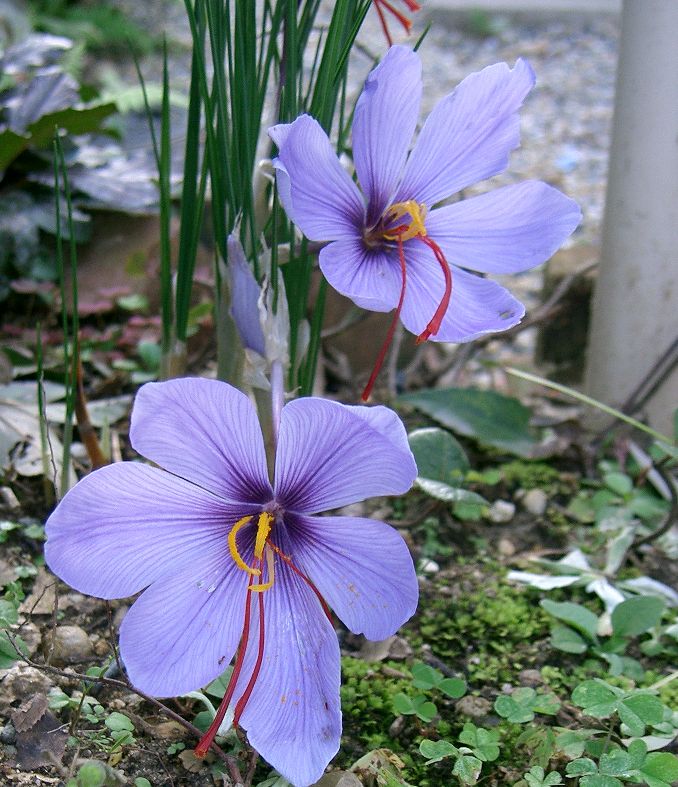 Saffron crocusCrocus sativus
The purple autumn flower whose red stigmas yield the spice saffron
🇨🇳 China and 1 more · Garden flower
Iris damascena
A rare white and purple iris found only on a Syrian mountain
🇸🇾 Syria · Wildflower
Saffron crocusCrocus sativus
The purple autumn flower whose red stigmas yield the spice saffron
🇨🇳 China and 1 more · Garden flower
Iris damascena
A rare white and purple iris found only on a Syrian mountain
🇸🇾 Syria · Wildflower