
Olive
Olea europaea, family Oleaceae
Evergreen tree grown for its fruit and oil across the Mediterranean and beyond
The olive tree is a hardy evergreen from the Mediterranean, valued for its small, oil-rich fruit. Its twisted trunk and grey-green leaves are a common sight in groves from Spain to Greece, where olives are harvested for eating and for pressing into oil, shaping local food and culture.
- Olive trees can live for centuries and are prized for their resilience.
- Spain, Italy, and Greece are the top producers of olives worldwide.
- The fruit is mostly pressed for oil, with the rest cured as table olives.
- Olive branches are a traditional symbol of peace.
- Olives have been grown in the Mediterranean for thousands of years.
What does Olive look like?
Olive trees are medium-sized evergreens, often reaching up to 10 meters tall. Their trunks are usually thick and gnarled, with bark that appears grey and rough. The leaves are narrow, with a silvery-green upper surface and a lighter underside. In spring, small clusters of creamy white to yellowish flowers appear among the leaves. The fruit is a small, oval drupe that matures from green to black or purple, depending on the variety. Wild olives have smaller, thinner-fleshed fruit than cultivated types.
Where does Olive come from?
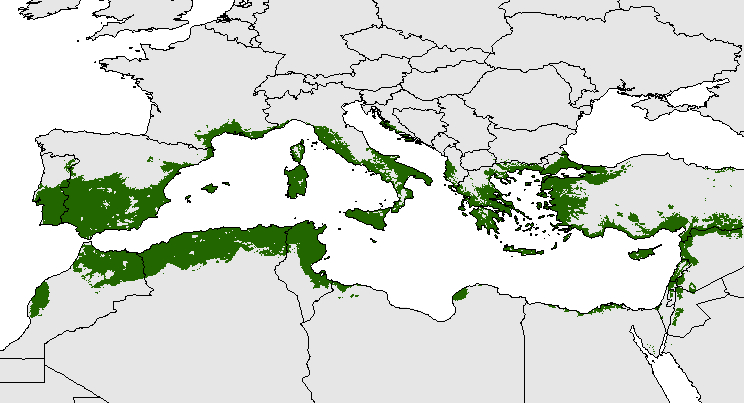
The olive tree has its roots in the Mediterranean, with fossil evidence pointing to its presence there millions of years ago. Early humans used wild olives for food and fuel in North Africa. Cultivation began in the eastern Mediterranean several thousand years ago, and the tree spread westward with trade and migration. Spanish settlers introduced olives to the Americas in the 1700s, and they reached Japan in the early 20th century. Today, olives are grown in many regions with a Mediterranean-like climate.
When and how Olive blooms
Olive trees grow best in sunny, dry places with calcareous or rocky soils. They are usually propagated from cuttings or by grafting, as trees grown from seed or suckers do not yield well. Trees are pruned regularly to keep them productive, and can live for centuries. In autumn, olives are picked by hand or shaken from the branches. Most are pressed for oil, while some are cured and eaten as table olives.


How Olive is used
Olives are a staple in Mediterranean diets, eaten whole or pressed for oil. Olive oil is used in cooking and was once used for lighting lamps. The wood is valued for carving and decorative objects. Olive branches have long been a symbol of peace. The tree itself shapes the landscape and traditions of many Mediterranean countries.
Kinds of Olive
There are hundreds of olive cultivars, each with its own fruit size, shape, and oil quality. Some are grown mainly for oil, others for eating, and some for both. Because many types cannot pollinate themselves, growers often plant two or more varieties together. Breeders have developed hybrids with resistance to pests and diseases.
What Olive means
The olive is deeply woven into the history and identity of the Mediterranean. Its branch stands for peace, and its oil is central to regional cuisines. Ancient trees are revered for their age and resilience. The word for 'oil' in many languages comes from the olive. Olive groves are a defining feature of the landscape in countries like Spain, Italy, and Greece.
Where Olive is used and seen
 Hanbury botanical gardensA historic Mediterranean botanical garden on the Italian Riviera
 Agdal GardensHistoric walled orchards and gardens south of Marrakech's old city
 Menara GardensA historic orchard and water garden west of Marrakesh, Morocco
 Jardin botanique exotique de MentonA Mediterranean garden in Menton with rare and exotic plants from around the world
 WreathA ring-shaped decoration made from flowers, leaves, or other materials
 Olive wreathA crown of wild olive branches given to Olympic victors in ancient Greece
 Gardens of the WorldA 4.5-acre botanical garden with themed gardens in Thousand Oaks, California
 Paradise gardenA walled, symmetrical garden with water channels and fragrant trees
Traditions that use it
Questions people ask about Olive
Where do olive trees originally come from?
Olive trees are native to the Mediterranean Basin, with early cultivation beginning in the eastern Mediterranean thousands of years ago. They have since spread to other regions with similar climates.
What do olives symbolize?
The olive branch has long stood for peace, and the tree itself is a symbol of endurance and prosperity in Mediterranean cultures.
How are olives used?
Most olives are pressed to make oil, which is a key ingredient in Mediterranean cooking. Some are cured and eaten whole, and the wood is used for carving.
What do olive trees look like?
They are evergreen trees with twisted trunks, grey-green leaves, and small white or yellowish flowers. The fruit is a small, oval drupe that ripens from green to black or purple.
Where are olives grown today?
Olives are widely grown in the Mediterranean region, especially in Spain, Italy, Greece, Tunisia, and Morocco, as well as in countries like Japan and Australia.
Good reading and sources
- Encyclopaedia BritannicaArticle
- EU warning as olive tree disease spreads in ItalyBBC, Article
- The island making Japan's best olive oilThe Japan Times, Article
The facts on this page come from the Wikipedia article "Olive", written by its contributors and used under the CC BY-SA 4.0 licence, and from its Wikidata record (CC0). Phool rewrote the text in its own words, with AI assistance, and compares every page with the article to make sure no passage is copied. It may be reused under the same CC BY-SA 4.0 licence with a link back.
It may contain mistakes. It is not medical or foraging advice: many flowers are poisonous, and traditional uses are reported, not recommended. If something is wrong, tell us. Last refreshed 2026-10-03.
Others in the family Oleaceae
The whole family JasmineJasminum
A group of fragrant shrubs and vines with white or yellow star-shaped flowers
🇵🇰 Pakistan and 7 more · Wildflower
JasmineJasminum
A group of fragrant shrubs and vines with white or yellow star-shaped flowers
🇵🇰 Pakistan and 7 more · Wildflower
 LilacSyringa
Fragrant spring-flowering shrubs and small trees grown for their showy clusters
Syringa · Flowering shrub
LilacSyringa
Fragrant spring-flowering shrubs and small trees grown for their showy clusters
Syringa · Flowering shrub
 Common LilacSyringa vulgaris
A spring-flowering shrub with fragrant purple or white blooms
🇷🇸 Serbia and 4 more · Garden flower
Common LilacSyringa vulgaris
A spring-flowering shrub with fragrant purple or white blooms
🇷🇸 Serbia and 4 more · Garden flower
 Star jasmineJasminum multiflorum
A white, scentless jasmine used in Indian weddings and worship
🇮🇳 India and 6 more · Wildflower
Star jasmineJasminum multiflorum
A white, scentless jasmine used in Indian weddings and worship
🇮🇳 India and 6 more · Wildflower
More from Spain
All the flowers of Spain PeachPrunus persica
A flowering fruit tree from China, grown for its pink blossoms and sweet fruit
🇨🇳 China and 7 more · Flowering tree
PeachPrunus persica
A flowering fruit tree from China, grown for its pink blossoms and sweet fruit
🇨🇳 China and 7 more · Flowering tree
 AlmondPrunus amygdalus
A Mediterranean tree grown for its fragrant spring flowers and edible seeds
🇮🇷 Iran and 6 more · Flowering tree
AlmondPrunus amygdalus
A Mediterranean tree grown for its fragrant spring flowers and edible seeds
🇮🇷 Iran and 6 more · Flowering tree
 ApricotPrunus armeniaca
A small fruit tree with early white to pink blossoms and golden-orange fruit
🇨🇳 China and 6 more · Flowering tree
ApricotPrunus armeniaca
A small fruit tree with early white to pink blossoms and golden-orange fruit
🇨🇳 China and 6 more · Flowering tree
 RosemarySalvia rosmarinus
A fragrant evergreen shrub with needle-like leaves and purple, blue, or white flowers
🇪🇸 Spain and 5 more · Flowering shrub
RosemarySalvia rosmarinus
A fragrant evergreen shrub with needle-like leaves and purple, blue, or white flowers
🇪🇸 Spain and 5 more · Flowering shrub