
Maypop
Passiflora incarnata, family Passifloraceae
A hardy North American vine with intricate purple blooms and edible yellow fruit
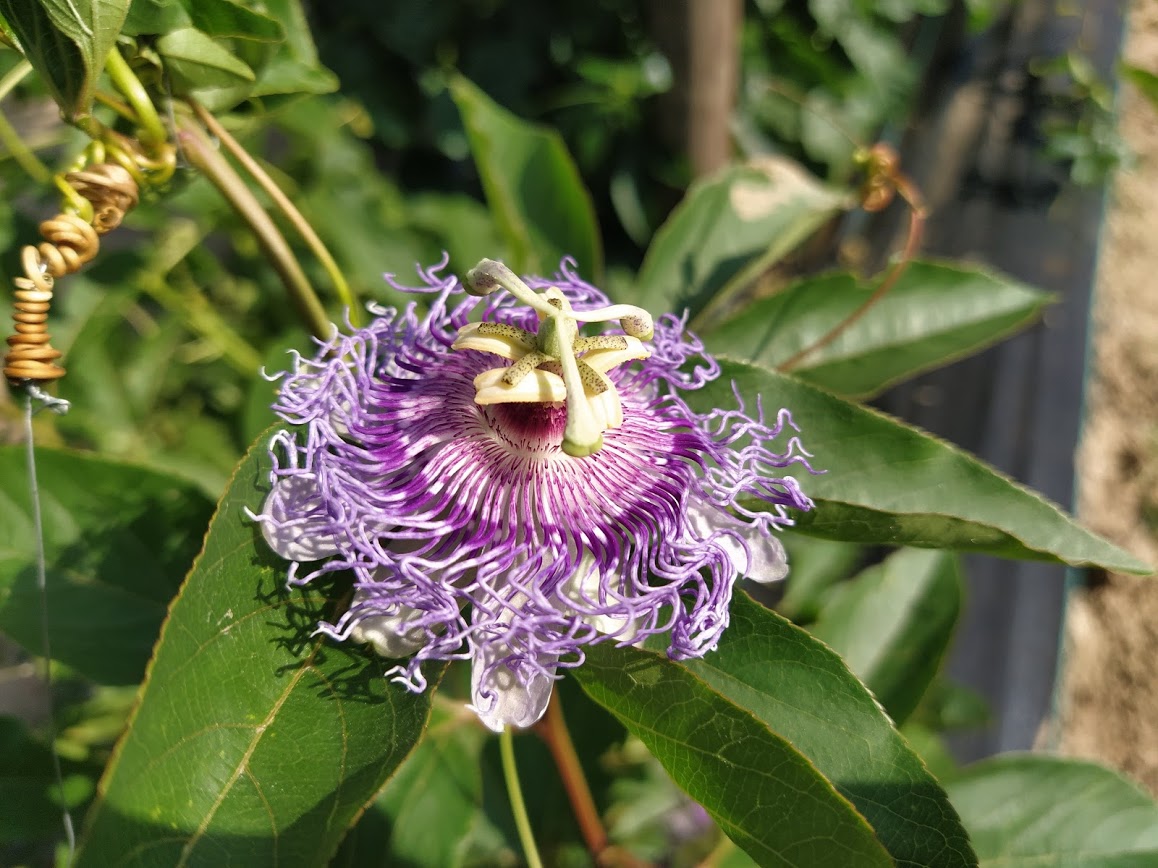
Maypop is a fast-growing perennial vine native to the southeastern United States. It bears large, complex bluish-purple flowers in summer and oval yellowish fruit that pops when stepped on, giving the plant its name.
- Tennessee’s state wildflower, called ocoee by the Cherokee
- Each flower lasts only one day and is self-sterile
- Fruit pops when stepped on, inspiring its common name
- Host plant for Gulf fritillary and other butterflies
- Used historically for food and herbal medicine
What does Maypop look like?
Maypop is a climbing or trailing vine with long stems and many tendrils. Its leaves are three-lobed, sometimes five, with two nectar-secreting glands at the base. The flowers are large, with five bluish-white petals and a striking ring of white and purple filaments between petals and stamens. The fruit is oval, green when young, turning yellow-orange, and makes a popping sound when crushed.
Where does Maypop come from?
This vine grows wild across the southeastern and parts of the central United States, from riverbanks to roadsides, always in full sun. It was long used by the Cherokee people, who called it 'ocoee', a name now given to a Tennessee river and valley. It is the official state wildflower of Tennessee.
When and how Maypop blooms
Maypop blooms in July, with each flower lasting just one day. It needs at least half a day of direct sunlight and thrives in well-drained soil, though it tolerates wet or acidic conditions. It is drought-tolerant and hardy in zones 6–11. Fruit develops over two to three months after flowering, with mature vines yielding 10–20 fruits.



How Maypop is used
The ripe fruit is eaten fresh or used in jams, jellies, and drinks for its mild sweet-tart flavor. Historically, Cherokee people relied on it as food and medicine. Today, its aerial parts appear in European and British pharmacopeias, though the U.S. FDA no longer approves it due to lack of safety evidence.
What Maypop means
Named maypop for the sound its fruit makes when stepped on, or because the plant 'pops' up from dormant roots by May, it supports several butterfly species as a larval host, including the Gulf fritillary. It can spread aggressively and is listed as a weed in some U.S. agricultural guides.
Questions people ask about Maypop
Where does maypop come from?
It is native to the southeastern United States, ranging into the central states like Illinois, Indiana, and Ohio, and grows wild in sunny areas such as roadsides and riverbanks.
What is maypop used for?
Its ripe fruit is eaten fresh or made into jams and drinks. Traditionally, Indigenous peoples used it as food and medicine, and it appears in European herbal pharmacopeias.
Why is it called maypop?
The name comes from the popping sound the green fruit makes when stepped on, or from the way the plant emerges ('pops') from the ground in May after winter dormancy.
Is maypop safe to consume?
The fruit is edible and used as a flavoring. Herbal preparations have a good safety record, but pregnant or breastfeeding women should consult a doctor before using it medicinally.
Does maypop support wildlife?
Yes. It is a larval host for several butterflies, including the Gulf fritillary and variegated fritillary, and its fruit is popular with animals.
Good reading and sources
- Encyclopaedia BritannicaArticle
- USDA Plants DatabaseUS Department of Agriculture, Article
- Plants of the World OnlineRoyal Botanic Gardens, Kew, Plant database
- Where it has been recordedGBIF, Plant database
- Sightings and photos by naturalistsiNaturalist, Plant database
- Passiflora incarnata on WikipediaEncyclopedia
- More photos on Wikimedia CommonsPhotos
- Wikidata recordOpen data
The facts on this page come from the Wikipedia article "Passiflora incarnata", written by its contributors and used under the CC BY-SA 4.0 licence, and from its Wikidata record (CC0). EveryPhool rewrote the text in its own words, with AI assistance, and compares every page with the article to make sure no passage is copied. It may be reused under the same CC BY-SA 4.0 licence with a link back.
It may contain mistakes. It is not medical or foraging advice: many flowers are poisonous, and traditional uses are reported, not recommended. If something is wrong, tell us. Last refreshed 2026-10-04.
Others in the family Passifloraceae
The whole family Passion fruitPassiflora edulis
A tropical vine grown for its sweet-sour, aromatic fruit
🇧🇷 Brazil and 6 more · Climber
Passion fruitPassiflora edulis
A tropical vine grown for its sweet-sour, aromatic fruit
🇧🇷 Brazil and 6 more · Climber
 PassionflowerPassiflora
A vine with intricate flowers and edible fruits, grown worldwide
🇺🇸 United States and 7 more · Wildflower
PassionflowerPassiflora
A vine with intricate flowers and edible fruits, grown worldwide
🇺🇸 United States and 7 more · Wildflower
 Blue passionflowerPassiflora caerulea
A climbing vine with intricate blue-and-white flowers and orange fruit
🇵🇾 Paraguay and 1 more · Climber
Blue passionflowerPassiflora caerulea
A climbing vine with intricate blue-and-white flowers and orange fruit
🇵🇾 Paraguay and 1 more · Climber
 Turnera
A genus of flowering plants from the Americas, once in its own family
Turnera · Wildflower
Turnera
A genus of flowering plants from the Americas, once in its own family
Turnera · Wildflower
More from the United States
All the flowers of the United States RoseRosa
Prickly flowering shrubs grown across the world for fragrant blossoms and rose hips
🇨🇳 China and 7 more · Flowering shrub
RoseRosa
Prickly flowering shrubs grown across the world for fragrant blossoms and rose hips
🇨🇳 China and 7 more · Flowering shrub
 PeachPrunus persica
A flowering fruit tree from China, grown for its pink blossoms and sweet fruit
🇨🇳 China and 7 more · Flowering tree
PeachPrunus persica
A flowering fruit tree from China, grown for its pink blossoms and sweet fruit
🇨🇳 China and 7 more · Flowering tree
 AlmondPrunus amygdalus
A Mediterranean tree grown for its fragrant spring flowers and edible seeds
🇮🇷 Iran and 6 more · Flowering tree
AlmondPrunus amygdalus
A Mediterranean tree grown for its fragrant spring flowers and edible seeds
🇮🇷 Iran and 6 more · Flowering tree
 CactusCactaceae
Succulent plants with spines, native to the Americas
🇲🇽 Mexico and 7 more · Wildflower
CactusCactaceae
Succulent plants with spines, native to the Americas
🇲🇽 Mexico and 7 more · Wildflower