
Protea afra
A variable shrub or small tree with pink to red flower heads from southern Africa
Protea afra is a shrub or small tree native to eastern and southern Africa, found from South Africa to Kenya on rocky slopes and grasslands. Its flower heads are pinkish-red to cream, with leathery leaves and a sweet, slightly sulphurous scent that attracts beetles. The species is highly variable, with several subspecies across its range.
- Native from South Africa to Kenya, on rocky slopes and grasslands
- Flower heads are pinkish-red to cream, 4–8 cm wide
- Bark is dark, fissured, and fire-resistant
- Flowers have a sweet, slightly sulphurous scent
- Appeared on the South African 'tickey' coin until 1961
What does Protea afra look like?
Protea afra grows as an upright shrub or small tree, usually 1 to 4 meters tall, with a main stem up to 40 cm thick. Its crown is uneven and spreading, with dark, fissured bark. The leaves are narrow, leathery or sometimes papery, and range from light to glaucous green. Flower heads are globose to egg-shaped, 4–8 cm wide, appearing singly or in small groups at the ends of twigs. The bracts are arranged in several series, with outer ones silvery and inner ones colored from pale cream to brick red. The flowers emit a sweet, slightly sulphurous scent.
Where does Protea afra come from?
Protea afra is native to eastern and southern Africa, from South Africa northwards to Kenya. It was first described from the eastern regions of South Africa in the 19th century by Ferdinand Krauss. The plant grows wild on rocky ridges, southern slopes, and mountainous grasslands, often forming open stands. It is adapted to a range of soils, from acidic quartzite to alkaline dolomite, and can be found from sea level up to 2,100 meters. The species is highly variable, with several subspecies found in different regions.
When and how Protea afra blooms
Protea afra blooms for a defined 6–8 week period, which may start as early as October in coastal areas and as late as December in higher elevations. The plant is a hardy perennial, tolerating temperatures down to −5°C. Seeds germinate in summer, and young plants grow slowly, reaching 10 cm in the first year. Flowering usually begins from the sixth year, and pruning lower branches encourages more blooms.


How Protea afra is used
The dense, fissured bark of Protea afra is traditionally used for medicinal purposes. The plant has also appeared as a symbol, notably on the reverse of the South African 'tickey' coin for nearly 30 years. Its flowers attract scarab beetles, drawn by their scent. Despite its hardiness, the species has not been widely cultivated in gardens.
Kinds of Protea afra
Protea afra is divided into several subspecies, each adapted to local conditions. Subsp. afra is found from Katberg to Soutpansberg and into Lesotho and Eswatini. Subsp. gazensis grows in the Eastern Highlands of Zimbabwe and Mozambique. Other subspecies include falcata, kilimandscharica, mafingensis, and nyasea, each with slight differences in leaf and flower traits.
What Protea afra means
Protea afra has cultural significance in South Africa, where it was featured on the 'tickey' coin for nearly three decades. The plant's variability and resilience are noted in botanical literature, but it has not become a major horticultural subject. Its fire-resistant bark and adaptation to harsh environments are valued in its native regions.
Questions people ask about Protea afra
Where does Protea afra come from?
Protea afra is native to eastern and southern Africa, ranging from South Africa to Kenya. It grows on rocky ridges, grasslands, and mountainous areas, often at elevations up to 2,100 meters.
What does Protea afra look like?
It is a shrub or small tree, 1–4 meters tall, with leathery green leaves and flower heads that are pinkish-red to cream. The flowers are globose to egg-shaped and have a sweet, slightly sulphurous scent.
When does Protea afra flower?
The plant flowers during a 6–8 week period, starting as early as October in coastal areas and as late as December in higher regions of southern Africa.
How is Protea afra used?
Its bark has traditional medicinal uses, and the species was once featured on the reverse of the South African 'tickey' coin. The flowers attract scarab beetles.
Are there different forms of Protea afra?
Yes, Protea afra is highly variable and has several subspecies, each adapted to specific regions across southern and eastern Africa.
Good reading and sources
- IUCN Red List of Threatened SpeciesIUCN Red List, Article
- Hundreds of racist plant names will change after historic vote by botanistsNature, Article
- Plants of the World OnlineRoyal Botanic Gardens, Kew, Plant database
- Where it has been recordedGBIF, Plant database
- Sightings and photos by naturalistsiNaturalist, Plant database
The facts on this page come from the Wikipedia article "Protea afra", written by its contributors and used under the CC BY-SA 4.0 licence, and from its Wikidata record (CC0). Phool rewrote the text in its own words, with AI assistance, and compares every page with the article to make sure no passage is copied. It may be reused under the same CC BY-SA 4.0 licence with a link back.
It may contain mistakes. It is not medical or foraging advice: many flowers are poisonous, and traditional uses are reported, not recommended. If something is wrong, tell us. Last refreshed 2026-10-03.
Others in the family Proteaceae
The whole family Bull banksiaBanksia grandis
A tall, fire-resistant tree with large lobed leaves and pale yellow flower spikes
🇦🇺 Australia · Flowering tree
Bull banksiaBanksia grandis
A tall, fire-resistant tree with large lobed leaves and pale yellow flower spikes
🇦🇺 Australia · Flowering tree
 Grevillea 'Robyn Gordon'Grevillea ‘Robyn Gordon’
A red-flowered Australian shrub named for a gardener’s daughter
🇦🇺 Australia · Flowering shrub
Grevillea 'Robyn Gordon'Grevillea ‘Robyn Gordon’
A red-flowered Australian shrub named for a gardener’s daughter
🇦🇺 Australia · Flowering shrub
 Protea neriifolia
A South African shrub with cone-shaped flower heads and hairy-tipped bracts
🇿🇦 South Africa and 3 more · Wildflower
Protea neriifolia
A South African shrub with cone-shaped flower heads and hairy-tipped bracts
🇿🇦 South Africa and 3 more · Wildflower
 Swamp banksiaBanksia robur
A tough coastal shrub with large serrated leaves and green-gold flower spikes
🇦🇺 Australia · Wildflower
Swamp banksiaBanksia robur
A tough coastal shrub with large serrated leaves and green-gold flower spikes
🇦🇺 Australia · Wildflower
More from South Africa
All the flowers of South Africa Eucalyptus
The tall, aromatic trees and shrubs known as gum trees or eucalypts
🇦🇺 Australia and 7 more · Flowering tree
Eucalyptus
The tall, aromatic trees and shrubs known as gum trees or eucalypts
🇦🇺 Australia and 7 more · Flowering tree
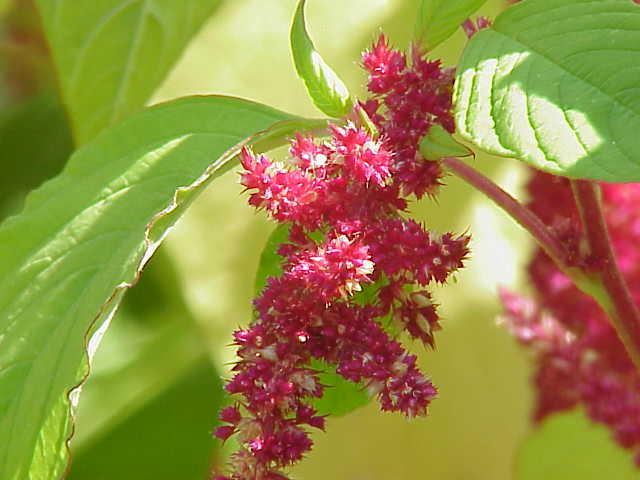 AmaranthAmaranthus
A tall, colourful plant grown for its flowers, leaves and edible seeds
🇲🇽 Mexico and 7 more · Wildflower
AmaranthAmaranthus
A tall, colourful plant grown for its flowers, leaves and edible seeds
🇲🇽 Mexico and 7 more · Wildflower
 Acacia
Shrubs and trees with golden or cream puffball flowers, native mostly to Australia
🇦🇺 Australia and 6 more · Wildflower
Acacia
Shrubs and trees with golden or cream puffball flowers, native mostly to Australia
🇦🇺 Australia and 6 more · Wildflower
 Sensitive PlantMimosa pudica
A touch-sensitive plant whose leaves fold up when disturbed
🇧🇷 Brazil and 8 more · Wildflower
Sensitive PlantMimosa pudica
A touch-sensitive plant whose leaves fold up when disturbed
🇧🇷 Brazil and 8 more · Wildflower