
Blackthorn
Prunus spinosa, family Rosaceae
A spiny shrub with white spring flowers and tart blue-black fruit
Blackthorn is a spiny shrub or small tree from Europe and West Asia, known for its white spring blossoms and blue-black fruit called sloes. Its fruit is used in drinks like sloe gin and preserves, while its tough wood is valued for walking sticks and tool handles.
- Sloes are used to make sloe gin and other fruit liqueurs
- Blackthorn wood is crafted into Irish shillelagh walking sticks
- Flowers bloom before the leaves in early spring
- The fruit is blue-black with a tart, astringent taste
- Native to Europe and West Asia, now found in other regions
What does Blackthorn look like?
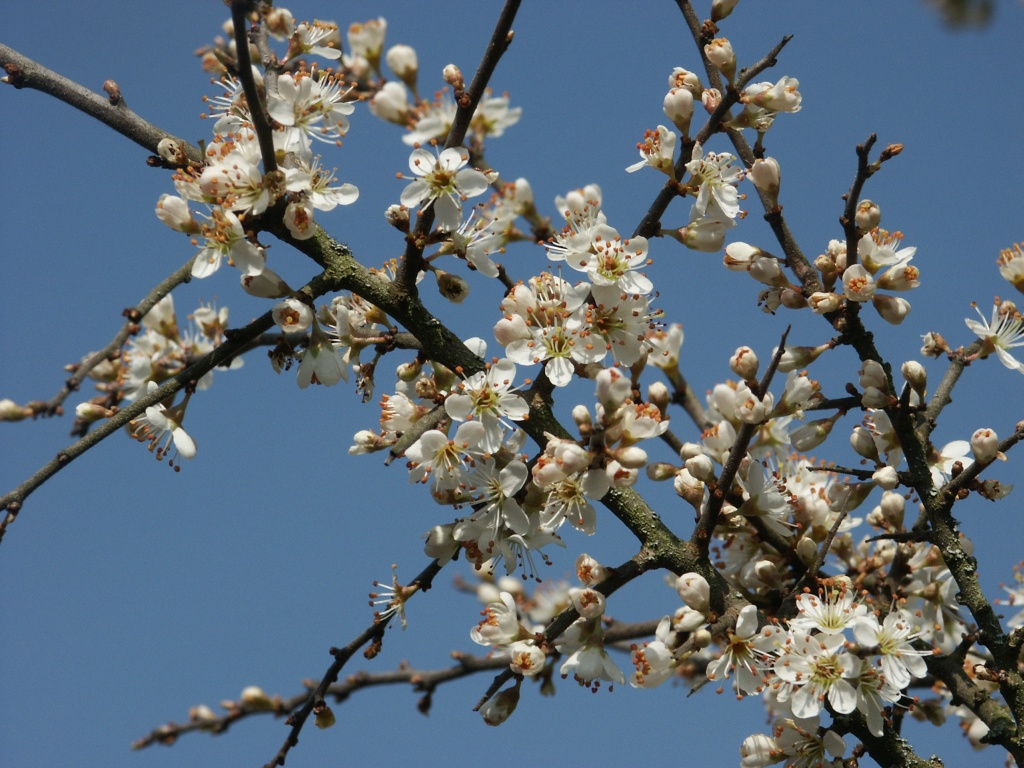
Blackthorn grows as a dense, thorny shrub or sometimes a small tree, reaching up to 5 or 6 metres tall. Its bark is very dark, almost black, and the branches are stiff and tangled with sharp spines. In early spring, before the leaves appear, it produces clusters of small, creamy-white flowers, each with five petals. The leaves are oval and finely toothed. By autumn, the plant bears small, round fruits called sloes, which are blue-black with a waxy coating and contain a single stone inside.
Where does Blackthorn come from?
Blackthorn is native to Europe and West Asia, and also grows in parts of northwest Africa. Over time, it has spread and become established in regions like Tasmania and eastern North America. The name 'spinosa' refers to its thorny shoots, while 'blackthorn' points to its dark bark. The fruit name 'sloe' has roots in old Germanic and Slavic languages, often linked to plums. Archaeological finds show people have eaten sloes since ancient times, including in the Alps over 5,000 years ago.
When and how Blackthorn blooms
Blackthorn flowers appear in early spring, just before the leaves open. The plant thrives in temperate climates and is often found in hedgerows, woodland edges, and scrubby areas. It can be grown from seed or by planting young shrubs. The fruit ripens in late autumn, usually after the first frosts, which soften their skin and make them easier to use for preserves and drinks.


How Blackthorn is used
Sloes are picked in autumn and used to make drinks like sloe gin in Britain and pacharán in Spain. The fruit also goes into jams, chutneys, and pies, and can be preserved in vinegar. Its juice can dye fabric, and the leaves were once mixed with tea. The tough wood is shaped into walking sticks, especially the Irish shillelagh, and tool handles. In Britain and Ireland, blackthorn is also planted as a natural hedge.
Kinds of Blackthorn
Blackthorn is sometimes mistaken for the cherry plum, which flowers earlier and has larger blossoms and different fruit colours. The two can be told apart by flower size, leaf shape, and fruit colour. There are no widely grown named varieties of blackthorn, but local traditions and uses vary across Europe.
What Blackthorn means
In the UK, 'blackthorn winter' describes a cold snap during its spring bloom. The flowering is linked to the Celtic festival of Imbolc in parts of Ireland and Scotland. Sloe fruit has inspired phrases like 'sloe-black eyes' in English literature. The wood is traditional for Irish walking sticks and is carried by officers in some Irish regiments. Sloe juice has also been used to dye cloth and as an ingredient in ink.
Where Blackthorn is used and seen

Questions people ask about Blackthorn
Where does blackthorn come from?
Blackthorn is native to Europe and West Asia, and it has also become established in places like Tasmania and eastern North America.
What are sloes used for?
Sloes, the fruit of blackthorn, are used in drinks such as sloe gin and pacharán, as well as in jams, chutneys, pies, and for dyeing fabric.
What does the blackthorn plant look like?
It is a dense, spiny shrub or small tree with dark bark, white five-petaled flowers in spring, and blue-black fruit in autumn.
How is blackthorn important in culture?
Blackthorn is linked to the Celtic festival of Imbolc, features in English phrases like 'sloe-black eyes,' and its wood is used for traditional Irish walking sticks.
Is blackthorn related to any other plants?
Blackthorn is related to the cherry plum, but they differ in flower size, leaf shape, and fruit colour.
Good reading and sources
- Encyclopaedia BritannicaArticle
- IUCN Red List of Threatened SpeciesIUCN Red List, Article
- USDA Plants DatabaseUS Department of Agriculture, Article
- Prunus spinosaRoyal Horticultural Society, Article
- Plants of the World OnlineRoyal Botanic Gardens, Kew, Plant database
- Where it has been recordedGBIF, Plant database
- Sightings and photos by naturalistsiNaturalist, Plant database
- Prunus spinosa on WikipediaEncyclopedia
- More photos on Wikimedia CommonsPhotos
- Wikidata recordOpen data
The facts on this page come from the Wikipedia article "Prunus spinosa", written by its contributors and used under the CC BY-SA 4.0 licence, and from its Wikidata record (CC0). Phool rewrote the text in its own words, with AI assistance, and compares every page with the article to make sure no passage is copied. It may be reused under the same CC BY-SA 4.0 licence with a link back.
It may contain mistakes. It is not medical or foraging advice: many flowers are poisonous, and traditional uses are reported, not recommended. If something is wrong, tell us. Last refreshed 2026-10-03.
Others in the family Rosaceae
The whole family RoseRosa
Woody perennial plants with showy, often fragrant flowers in many colours
Rosa · Wildflower
RoseRosa
Woody perennial plants with showy, often fragrant flowers in many colours
Rosa · Wildflower
 PeachPrunus persica
A flowering fruit tree from China, grown for its pink blossoms and sweet fruit
🇨🇳 China and 7 more · Flowering tree
PeachPrunus persica
A flowering fruit tree from China, grown for its pink blossoms and sweet fruit
🇨🇳 China and 7 more · Flowering tree
 AlmondPrunus amygdalus
A Mediterranean tree grown for its fragrant spring flowers and edible seeds
🇮🇷 Iran and 6 more · Flowering tree
AlmondPrunus amygdalus
A Mediterranean tree grown for its fragrant spring flowers and edible seeds
🇮🇷 Iran and 6 more · Flowering tree
 ApricotPrunus armeniaca
A small fruit tree with early white to pink blossoms and golden-orange fruit
🇨🇳 China and 6 more · Flowering tree
ApricotPrunus armeniaca
A small fruit tree with early white to pink blossoms and golden-orange fruit
🇨🇳 China and 6 more · Flowering tree
More from the United Kingdom
All the flowers of the United Kingdom Narcissus
Spring-flowering bulbs with trumpet-shaped blooms in white, yellow, and orange
🇬🇧 United Kingdom and 7 more · Wildflower
Narcissus
Spring-flowering bulbs with trumpet-shaped blooms in white, yellow, and orange
🇬🇧 United Kingdom and 7 more · Wildflower
 HawthornCrataegus
A thorny shrub or tree with white or pink spring flowers and small edible fruits
🇮🇪 Ireland and 7 more · Wildflower
HawthornCrataegus
A thorny shrub or tree with white or pink spring flowers and small edible fruits
🇮🇪 Ireland and 7 more · Wildflower
 Common poppyPapaver rhoeas
The vivid red wildflower of fields and remembrance
🇨🇳 China and 7 more · Wildflower
Common poppyPapaver rhoeas
The vivid red wildflower of fields and remembrance
🇨🇳 China and 7 more · Wildflower
 Dog roseRosa canina
A wild climbing rose with pale pink flowers and bright red hips
🇮🇪 Ireland and 7 more · Wildflower
Dog roseRosa canina
A wild climbing rose with pale pink flowers and bright red hips
🇮🇪 Ireland and 7 more · Wildflower