Ramonda nathaliae
In its own language: Наталијина рамонда
A small Balkan flower that can survive drying out and revive with water
Ramonda nathaliae is a compact flowering plant native to rocky places in Serbia, North Macedonia, and Greece. Its lilac-blue blooms appear in late spring, and the plant is known for surviving extreme dryness and reviving when watered. In Serbia, it is a symbol of remembrance and resilience.
- Can survive drying out and revive with water
- Native to rocky areas in Serbia, North Macedonia, and Greece
- Symbol of remembrance in Serbia for World War I
- Awarded for garden merit by a leading horticultural society
What does Ramonda nathaliae look like?
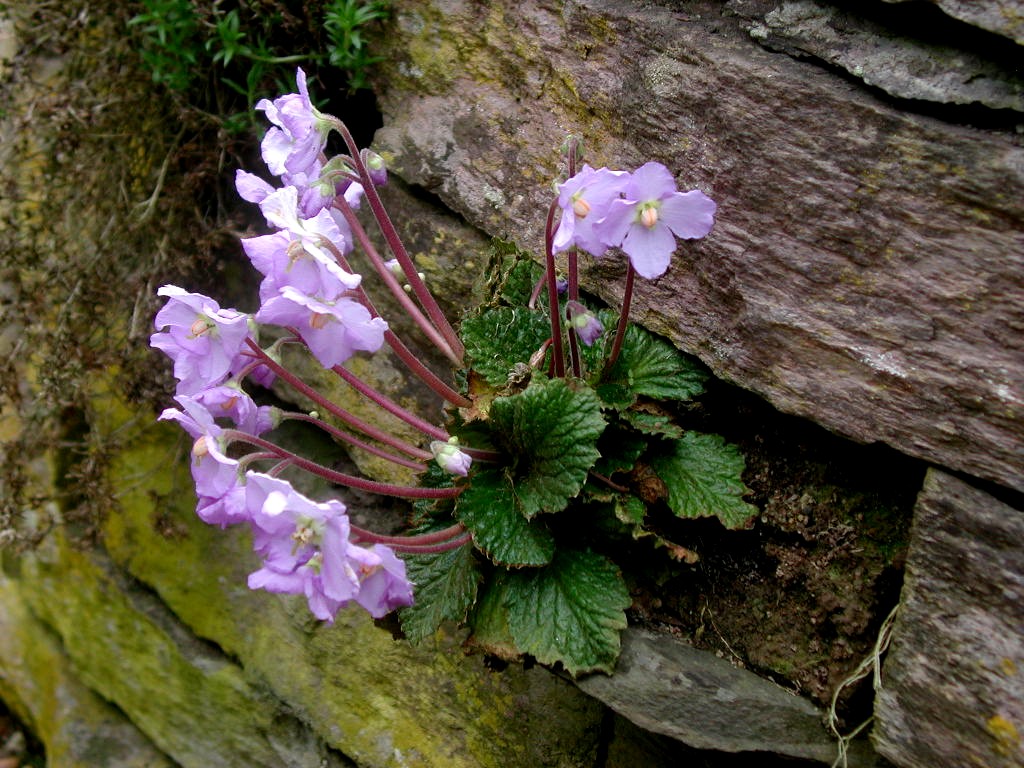
Ramonda nathaliae is a low-growing plant, reaching about 10 cm tall. Its evergreen leaves form a base from which clusters of flat, lilac-blue to purple flowers rise in late spring. The flowers are small and delicate, set against the dark green foliage. This plant is able to survive in rocky crevices and can tolerate cold down to -15°C. Its most unusual trait is its ability to dry out completely and then recover when watered.
Where does Ramonda nathaliae come from?
This species was first found in 1884 near Niš, in what is now Serbia. The botanists Sava Petrović and Josif Pančić named it in honor of Queen Natalie of Serbia. Ramonda nathaliae grows wild in the Balkans, especially in Serbia, North Macedonia, and the Kilkis region of Greece. It is adapted to harsh, rocky habitats and is considered a Balkan endemic plant.
When and how Ramonda nathaliae blooms
Ramonda nathaliae blooms in late spring, producing its flowers after surviving the winter. It grows naturally in crevices and rocky slopes, where it can withstand periods of drought. In gardens, it is valued for its hardiness and is often grown in rock gardens or shaded spots. The plant can be propagated from seed or by dividing established clumps.
How Ramonda nathaliae is used
In Serbia, Ramonda nathaliae is worn as a symbol of remembrance during the week before Armistice Day, honoring those lost in World War I and representing the country's renewal. Artificial versions of the flower are used for this purpose. In horticulture, it is appreciated for its ability to survive dry spells and its attractive spring flowers.
Kinds of Ramonda nathaliae
There are related species in the Ramonda genus, such as Ramonda serbica, which is also found in the Balkans. Ramonda nathaliae itself is recognized for its unique ability to recover from complete dehydration, a trait known as poikilohydry.
What Ramonda nathaliae means
The flower is a national symbol in Serbia, representing endurance and new beginnings, especially connected to World War I. The tradition of wearing the flower for remembrance was established in the 2010s and is now part of Armistice Day commemorations. The plant has also received recognition from horticultural societies for its garden value.
Questions people ask about Ramonda nathaliae
Where does Ramonda nathaliae come from?
Ramonda nathaliae is native to the Balkans, especially Serbia, North Macedonia, and the Kilkis region of Greece. It grows naturally in rocky, mountainous areas.
What does Ramonda nathaliae look like?
This plant is small, about 10 cm tall, with evergreen leaves and clusters of lilac-blue or purple flowers that bloom in late spring.
What is Ramonda nathaliae used for?
In Serbia, it is worn as a symbol of remembrance for World War I, especially around Armistice Day. Gardeners also grow it for its resilience and attractive flowers.
Why is Ramonda nathaliae important in Serbian culture?
The flower stands for resilience and rebirth, reflecting the Serbian experience in World War I. It is a national symbol and part of remembrance traditions.
How does Ramonda nathaliae survive dry conditions?
It can dry out completely and later recover when watered, a rare ability called poikilohydry.
Good reading and sources
- Ramonda nathaliaeRoyal Horticultural Society, Article
- Plants of the World OnlineRoyal Botanic Gardens, Kew, Plant database
- Where it has been recordedGBIF, Plant database
- Sightings and photos by naturalistsiNaturalist, Plant database
- Ramonda nathaliae on WikipediaEncyclopedia
- More photos on Wikimedia CommonsPhotos
- Wikidata recordOpen data
The facts on this page come from the Wikipedia article "Ramonda nathaliae", written by its contributors and used under the CC BY-SA 4.0 licence, and from its Wikidata record (CC0). Phool rewrote the text in its own words, with AI assistance, and compares every page with the article to make sure no passage is copied. It may be reused under the same CC BY-SA 4.0 licence with a link back.
It may contain mistakes. It is not medical or foraging advice: many flowers are poisonous, and traditional uses are reported, not recommended. If something is wrong, tell us. Last refreshed 2026-10-03.
Others in the family Gesneriaceae
The whole family HaberleaHaberlea rhodopensis
A rare Balkan flower that revives after years without water
🇧🇬 Bulgaria and 1 more · Wildflower
HaberleaHaberlea rhodopensis
A rare Balkan flower that revives after years without water
🇧🇬 Bulgaria and 1 more · Wildflower
 African violetSaintpaulia
A small, velvety-leaved house plant with violet, blue or white flowers from East Africa
🇹🇿 Tanzania and 1 more · Wildflower
African violetSaintpaulia
A small, velvety-leaved house plant with violet, blue or white flowers from East Africa
🇹🇿 Tanzania and 1 more · Wildflower
 Cape primroseStreptocarpus
A houseplant with tubular blooms from African mountains and forests
🇿🇦 South Africa and 7 more · Wildflower
Cape primroseStreptocarpus
A houseplant with tubular blooms from African mountains and forests
🇿🇦 South Africa and 7 more · Wildflower
 Brazilian gloxiniaSinningia speciosa
A tuberous houseplant with large, velvety flowers from Brazil
🇧🇷 Brazil and 1 more · Garden flower
Brazilian gloxiniaSinningia speciosa
A tuberous houseplant with large, velvety flowers from Brazil
🇧🇷 Brazil and 1 more · Garden flower
More from Serbia
All the flowers of Serbia HawthornCrataegus
A thorny shrub or tree with white or pink spring flowers and small edible fruits
🇮🇪 Ireland and 7 more · Wildflower
HawthornCrataegus
A thorny shrub or tree with white or pink spring flowers and small edible fruits
🇮🇪 Ireland and 7 more · Wildflower
 Sour cherryPrunus cerasus
The small, tart cherry tree grown for its sour red fruit
🇹🇷 Turkey and 7 more · Flowering tree
Sour cherryPrunus cerasus
The small, tart cherry tree grown for its sour red fruit
🇹🇷 Turkey and 7 more · Flowering tree
 Pedunculate oakQuercus robur
A towering oak tree with stalked acorns, native to Europe and western Asia
🇷🇸 Serbia and 8 more · Flowering tree
Pedunculate oakQuercus robur
A towering oak tree with stalked acorns, native to Europe and western Asia
🇷🇸 Serbia and 8 more · Flowering tree
 PeonyPaeonia
Large spring flowers in pink, red, white, yellow and purple, grown in gardens worldwide
🇨🇳 China and 7 more · Wildflower
PeonyPaeonia
Large spring flowers in pink, red, white, yellow and purple, grown in gardens worldwide
🇨🇳 China and 7 more · Wildflower