
Haberlea
Haberlea rhodopensis, family Gesneriaceae
A rare Balkan flower that revives after years without water
Haberlea rhodopensis is a small evergreen perennial found in rocky, shaded spots in Bulgaria and northern Greece. Its trumpet-shaped flowers, which open in sunlight, range from white to purple. Known for surviving extreme dryness, this plant can revive after years without water and is valued for its resilience and cultural legends.
- Can survive years without water and revive when rehydrated
- Native to the Rhodope Mountains in Bulgaria and northern Greece
- Flowers open in sunlight and close in shade
- Linked to ancient legends about Orpheus
- Awarded for garden merit in horticulture
What does Haberlea look like?
Haberlea rhodopensis forms low rosettes of dark green, slightly curled leaves with serrated edges. The plant has no stem and stays green all year. In spring and summer, it produces trumpet-shaped flowers that can be white, pink, violet, or deep purple. The blooms are sensitive to light, closing in shade and opening quickly in sunlight. It prefers damp, shaded, north-facing rocky areas, often on limestone or volcanic rock, and has a delicate root system.
Where does Haberlea come from?
This plant is native to the Rhodope Mountains and nearby regions in Bulgaria and northern Greece. It is a relic from the Ice Age, having survived in southern European refuges while glaciers spread elsewhere. The species separated from its close relative Ramonda serbica about 25 million years ago. It was first described in 1834 by I. Frivaldszky, who named the genus after his mentor Karl Haberle. Today, it is found in about 20 locations in Bulgaria, mostly at higher elevations.
When and how Haberlea blooms
Haberlea rhodopensis blooms in the warmer months, thriving in cool, moist, shaded spots on rocky slopes. It is usually grown from divisions or dried plants rather than seeds, as seeds are rarely sent between botanical gardens. The plant can survive long periods without water by entering a dormant state, and will revive quickly when moisture returns.


How Haberlea is used
People value this flower for its unique ability to survive desiccation and for its place in local folklore. It has been studied for its potential in medicine, cosmetics, and veterinary uses, thanks to its bioactive compounds. In gardens, it is grown for its resilience and attractive flowers. The plant appears on ancient coins and is linked to legends about Orpheus and the Thracians.
Kinds of Haberlea
Haberlea is a monotypic genus, meaning it contains only this single species, Haberlea rhodopensis. Its closest European relative is Ramonda serbica, which shares similar habitats and survival traits. The flower's color can vary from pale pink to deep purple, and it is sometimes called by different local names in Bulgaria.
What Haberlea means
The Orpheus flower is deeply rooted in Balkan folklore, with legends connecting it to the mythical musician Orpheus and ancient Thracian rituals. Romans associated it with health and longevity, and it has appeared on coins from the time of Emperor Antonius Pius. Today, it is considered a symbol of resilience and is a protected species in its native range.
Questions people ask about Haberlea
Where does Haberlea rhodopensis come from?
This plant is native to the Rhodope Mountains in Bulgaria and a small part of northern Greece, where it grows in shaded, rocky places.
What makes the Orpheus flower special?
It is known for its ability to survive extreme dryness for years and revive quickly when watered, making it one of the so-called resurrection plants.
What does the flower look like?
Haberlea rhodopensis has dark green, rosette-shaped leaves and trumpet-like flowers in shades of white, pink, violet, or purple, which open in sunlight.
How is this plant used?
It is valued in gardens for its hardiness, studied for possible medical and cosmetic uses, and features in local folklore and legends.
What does the Orpheus flower symbolize?
In Balkan culture, it is seen as a symbol of endurance and rebirth, with stories linking it to Orpheus and ancient rituals.
Good reading and sources
- IUCN Red List of Threatened SpeciesIUCN Red List, Article
- Haberlea rhodopensisRoyal Horticultural Society, Article
- Plants of the World OnlineRoyal Botanic Gardens, Kew, Plant database
- Where it has been recordedGBIF, Plant database
- Sightings and photos by naturalistsiNaturalist, Plant database
The facts on this page come from the Wikipedia article "Haberlea", written by its contributors and used under the CC BY-SA 4.0 licence, and from its Wikidata record (CC0). Phool rewrote the text in its own words, with AI assistance, and compares every page with the article to make sure no passage is copied. It may be reused under the same CC BY-SA 4.0 licence with a link back.
It may contain mistakes. It is not medical or foraging advice: many flowers are poisonous, and traditional uses are reported, not recommended. If something is wrong, tell us. Last refreshed 2026-10-03.
Others in the family Gesneriaceae
The whole family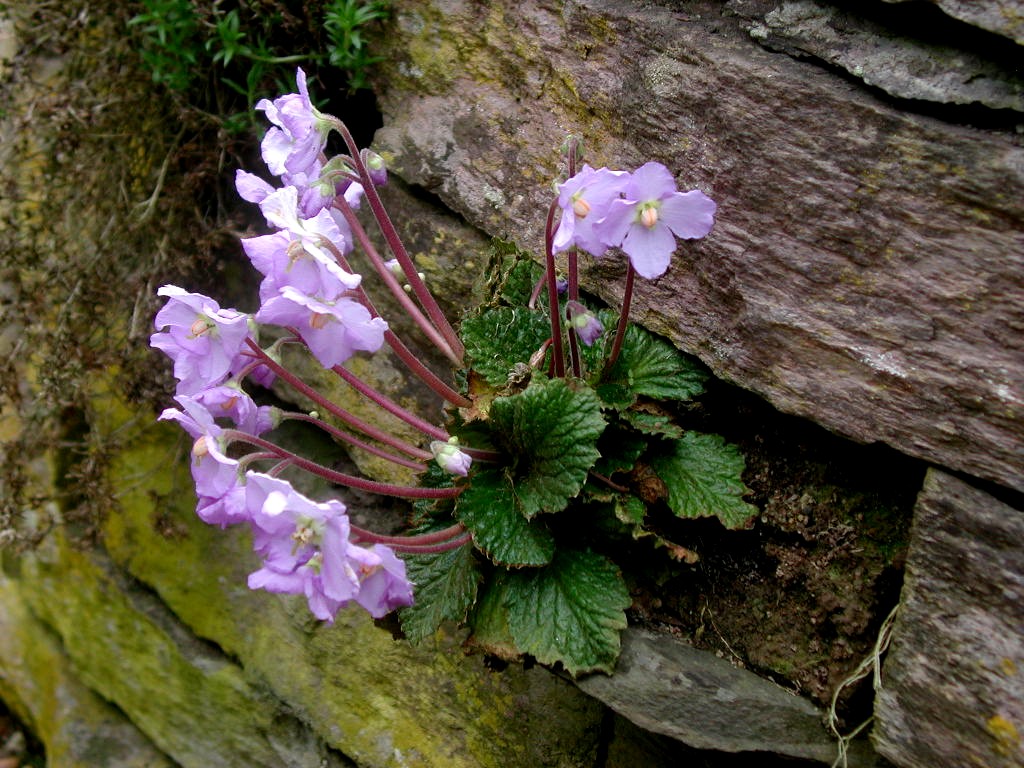 Ramonda nathaliaeНаталијина рамонда
A small Balkan flower that can survive drying out and revive with water
🇷🇸 Serbia and 2 more · Wildflower
Ramonda nathaliaeНаталијина рамонда
A small Balkan flower that can survive drying out and revive with water
🇷🇸 Serbia and 2 more · Wildflower
 African violetSaintpaulia
A small, velvety-leaved house plant with violet, blue or white flowers from East Africa
🇹🇿 Tanzania and 1 more · Wildflower
African violetSaintpaulia
A small, velvety-leaved house plant with violet, blue or white flowers from East Africa
🇹🇿 Tanzania and 1 more · Wildflower
 Cape primroseStreptocarpus
A houseplant with tubular blooms from African mountains and forests
🇿🇦 South Africa and 7 more · Wildflower
Cape primroseStreptocarpus
A houseplant with tubular blooms from African mountains and forests
🇿🇦 South Africa and 7 more · Wildflower
 Brazilian gloxiniaSinningia speciosa
A tuberous houseplant with large, velvety flowers from Brazil
🇧🇷 Brazil and 1 more · Garden flower
Brazilian gloxiniaSinningia speciosa
A tuberous houseplant with large, velvety flowers from Brazil
🇧🇷 Brazil and 1 more · Garden flower
More from Bulgaria
All the flowers of Bulgaria BlackthornPrunus spinosa
A spiny shrub with white spring flowers and tart blue-black fruit
🇬🇧 United Kingdom and 7 more · Wildflower
BlackthornPrunus spinosa
A spiny shrub with white spring flowers and tart blue-black fruit
🇬🇧 United Kingdom and 7 more · Wildflower
 Dog roseRosa canina
A wild climbing rose with pale pink flowers and bright red hips
🇮🇪 Ireland and 7 more · Wildflower
Dog roseRosa canina
A wild climbing rose with pale pink flowers and bright red hips
🇮🇪 Ireland and 7 more · Wildflower
 Horse-chestnutAesculus hippocastanum
A large flowering tree known for its white spring blooms and shiny brown conkers
🇦🇱 Albania and 7 more · Flowering tree
Horse-chestnutAesculus hippocastanum
A large flowering tree known for its white spring blooms and shiny brown conkers
🇦🇱 Albania and 7 more · Flowering tree
 EdelweissLeontopodium nivale
A woolly white star-shaped flower of the European mountains
🇦🇹 Austria and 5 more · Wildflower
EdelweissLeontopodium nivale
A woolly white star-shaped flower of the European mountains
🇦🇹 Austria and 5 more · Wildflower