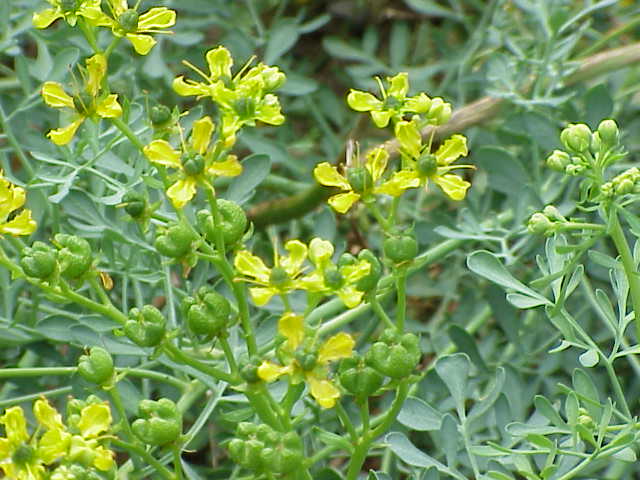
Common rue
Ruta graveolens, family Rutaceae
A strong-scented Mediterranean herb with blue-green leaves and yellow flowers
Common rue is a woody perennial shrub native to the Mediterranean, grown for its blue-green leaves and small yellow flowers. It is used as an ornamental plant, a culinary herb in some regions, and has a long history in folklore, symbolism, and traditional medicine, though it is toxic in large amounts.
- Rue is a symbol of maidenhood in Lithuania and Ukraine.
- Its leaves have a strong, bitter aroma and taste.
- Used in traditional Jewish rituals and as a protective charm.
- Toxic in large amounts; should be used sparingly in food.
- Sprigs of rue flavor grappa in Italy and Istria.
What does Common rue look like?
Common rue is a woody shrub with blue-green, oblong leaves divided into rounded leaflets. The leaves have a strong aroma, especially when bruised. Its small flowers grow in clusters, each with four or five dull yellow petals. After flowering, the plant produces brown seed capsules. Rue is often grown for its unusual foliage and compact form, making it a popular choice for low hedges or ornamental borders.
Where does Common rue come from?
Rue is native to the Mediterranean region, where it has grown wild for centuries. It spread through gardens and kitchens across Europe and beyond, valued for its resilience in hot, dry soils. The plant's name, graveolens, refers to its strong-smelling leaves. Rue has been known since ancient times, mentioned by Roman naturalists and in early cookbooks. It is now grown in many parts of the world, but its cultural roots remain strongest in southern and eastern Europe.
When and how Common rue blooms
Rue is a perennial that thrives in sunny, well-drained spots and tolerates drought. It grows from seed or cuttings and blooms in late spring or summer. The plant is harvested for its leaves, which are used fresh or dried. In some regions, young branches are dipped in batter and fried, or added to spirits for flavor. Rue is also clipped for decorative use in gardens and bouquets.


How Common rue is used
Rue has been used in many ways: as a culinary herb in Mediterranean cooking, to flavor spirits like grappa, and in omelettes or sauces. In Lithuania and Ukraine, it is a symbol in songs and weddings, often worn by brides. Sephardic Jews use it in rituals and as a protective charm, especially during Yom Kippur. Rue is also grown as an insect repellent and for its strong scent in homes. Due to its toxicity, it is used sparingly in food and should be avoided by pregnant women.
Kinds of Common rue
Other species of rue, such as Ruta chalepensis, are used in Ethiopian cuisine. In different regions, rue is prepared in unique ways: in Friuli-Venezia Giulia, young branches are fried, while in Istria, sprigs are added to grappa. The plant appears in heraldry, especially in Saxony, where it is a symbol on coats of arms.
What Common rue means
Rue stands for regret and grace in literature and folklore. In Lithuania, it is a national herb and a symbol of maidenhood, worn by brides. In Ukraine, it features in folk songs about love and loss. Rue is mentioned in the Bible and in Jewish traditions as a protective plant. It appears in Shakespeare's plays as a symbol of sorrow. Its bitter taste and strong scent have made it a plant of legend and ritual across cultures.
Questions people ask about Common rue
Where does common rue come from?
Common rue is native to the Mediterranean region and has been grown in southern and eastern Europe for centuries. It is now found in gardens worldwide, especially in areas with hot, dry summers.
What is common rue used for?
Rue is used as an ornamental plant, a culinary herb, and for its scent. It appears in rituals, folk medicine, and as a protective charm in Jewish and European traditions. In some regions, it flavors spirits or is worn by brides.
Is rue safe to eat?
Rue contains toxic compounds and should only be used in small amounts as a flavoring. Large amounts can cause serious health problems, and it should be avoided by pregnant women and those with liver issues.
What does rue symbolize?
Rue is a symbol of regret, maidenhood, and protection in various cultures. In Lithuania and Ukraine, it represents purity and is worn by brides. In Jewish tradition, it is used to ward off evil and as part of rituals.
What does common rue look and smell like?
Common rue is a woody shrub with blue-green, divided leaves that release a strong, bitter aroma when touched. Its flowers are small and yellow, growing in clusters.
Good reading and sources
- Encyclopaedia BritannicaArticle
- USDA Plants DatabaseUS Department of Agriculture, Article
- Plants of the World OnlineRoyal Botanic Gardens, Kew, Plant database
- Where it has been recordedGBIF, Plant database
- Sightings and photos by naturalistsiNaturalist, Plant database
- Ruta graveolens on WikipediaEncyclopedia
- More photos on Wikimedia CommonsPhotos
- Wikidata recordOpen data
The facts on this page come from the Wikipedia article "Ruta graveolens", written by its contributors and used under the CC BY-SA 4.0 licence, and from its Wikidata record (CC0). Phool rewrote the text in its own words, with AI assistance, and compares every page with the article to make sure no passage is copied. It may be reused under the same CC BY-SA 4.0 licence with a link back.
It may contain mistakes. It is not medical or foraging advice: many flowers are poisonous, and traditional uses are reported, not recommended. If something is wrong, tell us. Last refreshed 2026-10-03.
Others in the family Rutaceae
The whole family Bitter orangeCitrus × aurantium
The citrus tree behind Seville orange marmalade and Neroli oil
🇨🇳 China and 6 more · Flowering tree
Bitter orangeCitrus × aurantium
The citrus tree behind Seville orange marmalade and Neroli oil
🇨🇳 China and 6 more · Flowering tree
 BaelAegle marmelos
A spiny tree with fragrant yellow-green flowers and hard-shelled aromatic fruit
🇮🇳 India and 6 more · Flowering tree
BaelAegle marmelos
A spiny tree with fragrant yellow-green flowers and hard-shelled aromatic fruit
🇮🇳 India and 6 more · Flowering tree
 Orange jasmineMurraya paniculata
A fragrant shrub or small tree with white flowers and orange-red berries
🇨🇳 China and 7 more · Wildflower
Orange jasmineMurraya paniculata
A fragrant shrub or small tree with white flowers and orange-red berries
🇨🇳 China and 7 more · Wildflower
 Boronia
A genus of fragrant shrubs mostly found in Australia’s open forests
🇦🇺 Australia · Wildflower
Boronia
A genus of fragrant shrubs mostly found in Australia’s open forests
🇦🇺 Australia · Wildflower
More from Lithuania
All the flowers of Lithuania Forget-me-notMyosotis
Small blue wildflowers known for remembrance and love
🇳🇿 New Zealand and 7 more · Wildflower
Forget-me-notMyosotis
Small blue wildflowers known for remembrance and love
🇳🇿 New Zealand and 7 more · Wildflower
 Viburnum
Shrubs and small trees with showy flower clusters and colourful berries
🇺🇦 Ukraine and 3 more · Wildflower
Viburnum
Shrubs and small trees with showy flower clusters and colourful berries
🇺🇦 Ukraine and 3 more · Wildflower
 Sea-hollyEryngium maritimum
A spiny, blue-grey perennial of European and Mediterranean coasts
🇮🇪 Ireland and 6 more · Wildflower
Sea-hollyEryngium maritimum
A spiny, blue-grey perennial of European and Mediterranean coasts
🇮🇪 Ireland and 6 more · Wildflower
 Fringed Water-lilyNymphoides peltata
A floating yellow aquatic plant with wavy leaves and fringed flowers
🇨🇳 China and 7 more · Water flower
Fringed Water-lilyNymphoides peltata
A floating yellow aquatic plant with wavy leaves and fringed flowers
🇨🇳 China and 7 more · Water flower