
Tulipa agenensis
A wild red tulip from the eastern Mediterranean and Middle East
Tulipa agenensis is a perennial tulip with deep red flowers and dark central markings, native to parts of the eastern Mediterranean and Middle East. It grows from a bulb and has spread to areas around the central and western Mediterranean, and is sometimes seen in art and old botanical works.
- Native to the eastern Mediterranean and Middle East
- Flowers are deep red with dark and yellow markings
- Named after the French town of Agen
- Appears in 17th-century Dutch and Flemish paintings
What does Tulipa agenensis look like?
Tulipa agenensis produces upright stems with oval, pointed petals that often curl at the tips. Its flowers are a strong red shade, with dark markings and touches of yellow near the center. The plant grows from a bulb and has long, narrow green leaves. It stands out in the wild and in gardens for its vivid color and classic tulip shape.
Where does Tulipa agenensis come from?
This tulip grows naturally in the eastern Mediterranean and Middle East, including places such as Turkey, Iran, Cyprus, and nearby regions. Over time, it has become established in other Mediterranean countries. The name 'agenensis' comes from the French town of Agen, where a group of these tulips was found growing. The species was first described in 1804 by Pierre-Joseph Redouté in his botanical illustrations.
When and how Tulipa agenensis blooms
Tulipa agenensis grows from bulbs, which send up leaves and flowers each year. It prefers climates with cool, wet winters and dry summers, like those found around the Mediterranean. The plant is grown from bulbs, which are planted in the ground and left to develop over the seasons. It is sometimes cultivated in gardens for its striking flowers.


How Tulipa agenensis is used
People value Tulipa agenensis for its beauty in gardens and as a subject in art. It has appeared in paintings from the 17th century, such as works by Jacob de Gheyn II and Osias Beert I, where it is shown alongside other tulips. While not widely used in ceremonies or as a national symbol, it has a place in botanical collections and historical illustrations.
Kinds of Tulipa agenensis
In Italy, Tulipa agenensis was once called the 'Red Tulip of Bologne.' It has also been crossed with other tulip species, such as Tulipa hungarica, to create hybrids featured in historical paintings. Wild colonies have been found in several regions, showing some local variation.
What Tulipa agenensis means
Tulipa agenensis is known from its appearances in early European art, especially Dutch and Flemish still-life paintings. Its discovery in Agen, France, gave it its scientific name. While not a major symbol or emblem, it is recognized by botanists and art historians for its role in both wild flora and cultural history.
Questions people ask about Tulipa agenensis
Where does Tulipa agenensis come from?
Tulipa agenensis is native to the eastern Mediterranean and Middle East, including countries such as Turkey, Iran, Cyprus, Syria, Lebanon, Israel, Palestine, and Jordan. It has also become naturalized in parts of the central and western Mediterranean.
What does Tulipa agenensis look like?
This tulip has upright stems with oval, pointed red petals. The flowers show dark markings and yellow near the center, and the leaves are long and narrow.
How is Tulipa agenensis used?
Tulipa agenensis is grown in gardens for its vivid flowers and has appeared in historical paintings. It is not widely used in ceremonies or as a symbol.
Why is it called Tulipa agenensis?
The species name 'agenensis' refers to the town of Agen in France, where a wild group of these tulips was found.
Has Tulipa agenensis appeared in art?
Yes, it has been painted by artists such as Jacob de Gheyn II and Osias Beert I, often shown with other tulip varieties in still-life works.
Good reading and sources
- Plants of the World OnlineRoyal Botanic Gardens, Kew, Plant database
- Where it has been recordedGBIF, Plant database
- Sightings and photos by naturalistsiNaturalist, Plant database
- Tulipa agenensis on WikipediaEncyclopedia
- More photos on Wikimedia CommonsPhotos
- Wikidata recordOpen data
The facts on this page come from the Wikipedia article "Tulipa agenensis", written by its contributors and used under the CC BY-SA 4.0 licence, and from its Wikidata record (CC0). Phool rewrote the text in its own words, with AI assistance, and compares every page with the article to make sure no passage is copied. It may be reused under the same CC BY-SA 4.0 licence with a link back.
It may contain mistakes. It is not medical or foraging advice: many flowers are poisonous, and traditional uses are reported, not recommended. If something is wrong, tell us. Last refreshed 2026-10-03.
Others in the family Liliaceae
The whole family LilyLilium
Tall bulb flowers with large, colourful blooms in many gardens and cultures
Lilium · Wildflower
LilyLilium
Tall bulb flowers with large, colourful blooms in many gardens and cultures
Lilium · Wildflower
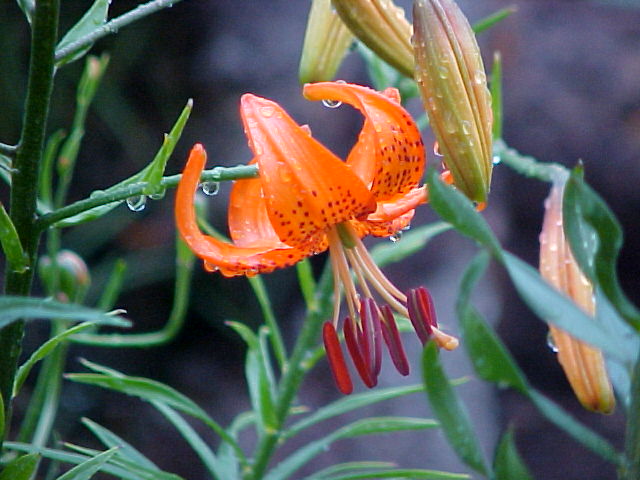 Lilium davidii
A tall Asian lily with edible bulbs and orange recurved flowers
🇨🇳 China and 1 more · Wildflower
Lilium davidii
A tall Asian lily with edible bulbs and orange recurved flowers
🇨🇳 China and 1 more · Wildflower
 Chinese LilyLilium brownii
A wild and cultivated lily from China with edible bulbs
🇨🇳 China and 3 more · Wildflower
Chinese LilyLilium brownii
A wild and cultivated lily from China with edible bulbs
🇨🇳 China and 3 more · Wildflower
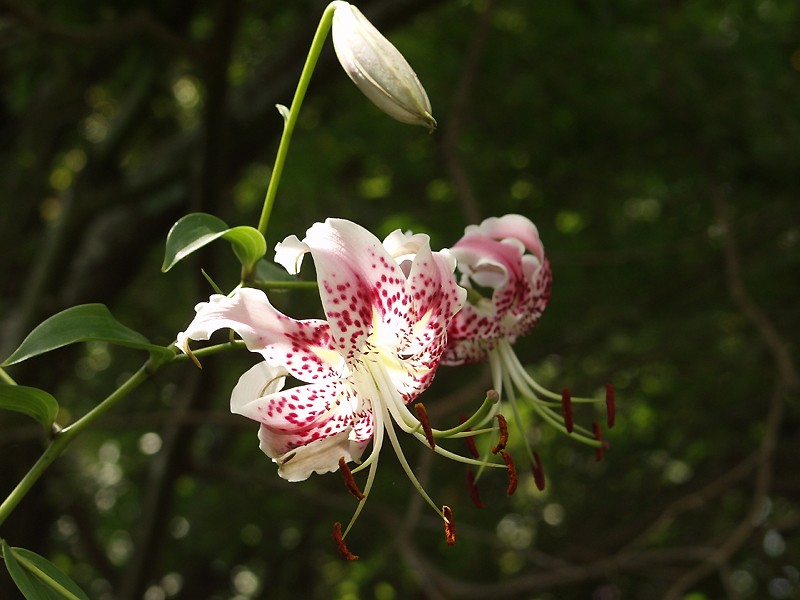 Lilium speciosum
A late-summer lily with fragrant white to pink flowers from East Asia
🇯🇵 Japan and 2 more · Wildflower
Lilium speciosum
A late-summer lily with fragrant white to pink flowers from East Asia
🇯🇵 Japan and 2 more · Wildflower
More from Turkey
All the flowers of Turkey PeachPrunus persica
A flowering fruit tree from China, grown for its pink blossoms and sweet fruit
🇨🇳 China and 7 more · Flowering tree
PeachPrunus persica
A flowering fruit tree from China, grown for its pink blossoms and sweet fruit
🇨🇳 China and 7 more · Flowering tree
 PomegranatePunica granatum
A shrub with bright red flowers and a fruit full of edible seeds
🇮🇷 Iran and 9 more · Flowering shrub
PomegranatePunica granatum
A shrub with bright red flowers and a fruit full of edible seeds
🇮🇷 Iran and 9 more · Flowering shrub
 TulipTulipa
Spring-blooming bulbs with showy, cup-shaped flowers in many colours
🇳🇱 Netherlands and 7 more · Wildflower
TulipTulipa
Spring-blooming bulbs with showy, cup-shaped flowers in many colours
🇳🇱 Netherlands and 7 more · Wildflower
 Sour cherryPrunus cerasus
The small, tart cherry tree grown for its sour red fruit
🇹🇷 Turkey and 7 more · Flowering tree
Sour cherryPrunus cerasus
The small, tart cherry tree grown for its sour red fruit
🇹🇷 Turkey and 7 more · Flowering tree