Arranging and floral design
Ikenobo, the oldest ikebana school
The oldest school of ikebana, based at the Rokkakudo temple in Kyoto and led by one family of priests for centuries.
Presented by ClearTrust Free for gardeners, florists, travellers and the curious.
Ikenobo is the school from which formal ikebana grew. Its home is the Rokkakudo, a six-sided temple in the middle of Kyoto, and its headmasters have also been the temple's head priests. The name means the priest's lodging by the pond. Students around the world still learn its three main styles: rikka, shoka and free style.
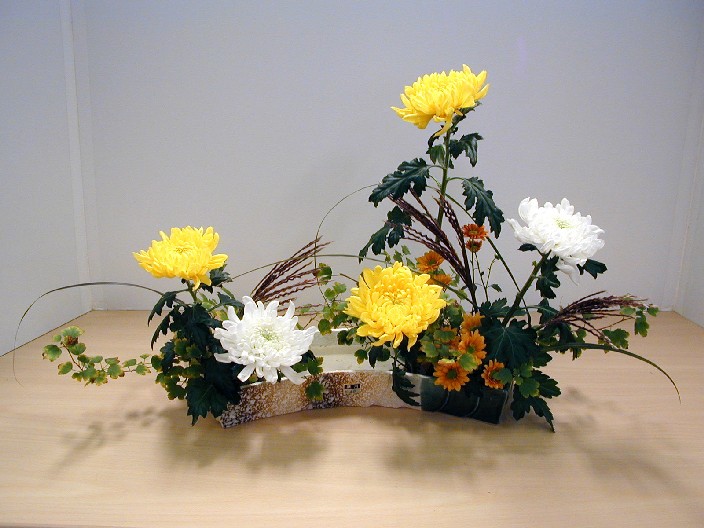
What it is
Ikenobo is both a family and a school. The headmaster, called the iemoto, passes the title down within the Ikenobo family, and teachers are licensed through a long series of grades. The school teaches three kinds of work. Rikka is the grand, upright style, built from many materials to suggest a whole landscape. Shoka is spare, with three main lines rising from a single point as if they were one living plant. Free style, called jiyuka, lets the arranger respond to the material and the room.
Where it comes from
Temple tradition says the Rokkakudo was founded by Prince Shotoku, and that priests living beside its pond offered flowers at the altar morning and evening. A diary entry from 1462 records that a priest named Ikenobo Senkei was invited to arrange flowers and that people in Kyoto crowded to see them. In the following century Ikenobo Senno set down the school's teaching in writing. He argued that an arrangement should show the nature of the plant itself, not just pretty blossoms.
How it works
Lessons begin with shoka, using one to three kinds of material. The three main stems are named shin, soe and tai, and each has a set length and direction. Their bases are bound tightly together so that they leave the water as one line. Students repeat the same forms many times with different plants, since each kind of leaf or branch behaves in its own way. Rikka comes later. It can use seven or nine main parts and is held upright in the vase by a bundle of straw.
How to take part
- Visit the Rokkakudo in central Kyoto, which is open to the public and free to enter.
- Look for the school's large exhibitions in Kyoto, held in spring and autumn.
- Find a licensed Ikenobo teacher or study group near you. They exist in many countries.
Good manners
- The Rokkakudo is a working temple. Keep your voice low and let worshippers pass.
- Do not touch displayed arrangements.
The flowers
IkenobōJapan’s oldest and most influential school of ikebana flower arranging Japanese irisA water-loving Japanese iris with violet-blue blooms and historic garden ties
 ChrysanthemumAutumn-blooming flower with thousands of varieties, cherished in East Asia and beyond
 Prunus mumeThe fragrant plum blossom tree that blooms in winter across East Asia
 PaperwhiteA tall, white-and-yellow narcissus grown for scent and indoor blooms
Also part of it, and being written: Pine, Aspidistra elatior.
Sources and further reading
Original text by the Phool desk, written with AI assistance. Customs vary from place to place. If we have something wrong, tell us.
Photo credits on this page
The small pictures above come from Wikimedia Commons under free licences. Some are cropped to fit.
- Prunus mume: Kakidai, CC BY-SA 3.0, source
- Paperwhite: Zachi Evenor, CC BY 2.0, source
- Chrysanthemum: Muhammad Mahdi Karim, GFDL 1.2, source
- Ikenobō: Unknown author, CC BY-SA 3.0, source
- Japanese iris: Dennis L. Lindwall, CC BY-SA 3.0, source