Markets, growers and the trade
The saffron harvest
Three red threads plucked by hand from an autumn crocus, in Iran, Kashmir, Spain and a handful of other places.
Presented by ClearTrust Free for gardeners, florists, travellers and the curious.
Saffron is the dried stigmas of a small purple crocus that flowers in autumn. Each flower has three threads, and each must be picked by hand, which is why saffron is the most expensive spice in the world by weight. The harvest lasts two or three weeks. In the villages that grow it, every family member takes part.

What it is
The saffron crocus has lilac petals, yellow stamens and three long red stigmas. It is sterile and sets no seed, so it is multiplied by dividing its corms, the bulb-like stems underground. Fields look bare all summer. Flowers appear suddenly in late October and November. Roughly 150,000 flowers or more are needed for a kilogram of dried saffron. The threads give food a golden colour, a bitter-sweet taste and a smell like hay and honey.
Where it is grown
Iran produces the great majority of the world's saffron, mainly in the Khorasan region in the north-east. In India it is grown in Kashmir, on the raised fields around Pampore near Srinagar, and Kashmir saffron has a geographical indication. In Spain the centre is La Mancha, which has a protected designation of origin. Greece grows it around Kozani, Morocco around Taliouine, and Italy near L'Aquila and in Sardinia. Afghanistan has become a notable producer around Herat.
How the harvest works
Flowers are picked at dawn, before they open fully in the sun and wilt. Baskets are carried home, and the family sits round a table pulling the three stigmas from each flower, a job known in Spain as the monda. The threads are dried the same day, traditionally over gentle heat, losing most of their weight. The town of Consuegra in La Mancha holds a saffron festival in late October with a contest for the fastest pluckers.
How to take part
- Visit Pampore in late October or early November, or La Mancha in the last week of October, to see fields in flower.
- Go to the fields at sunrise. By late morning the day's flowers have been picked.
- Buy whole threads, not powder, from a cooperative or a named producer.
- At home, steep a pinch in warm water or milk for twenty minutes before cooking with it.
Good manners
- Do not walk into a saffron field without the farmer's leave. The flowers are the whole year's income.
- Do not confuse it with the autumn-flowering meadow saffron, which looks similar and is poisonous.
The flowers
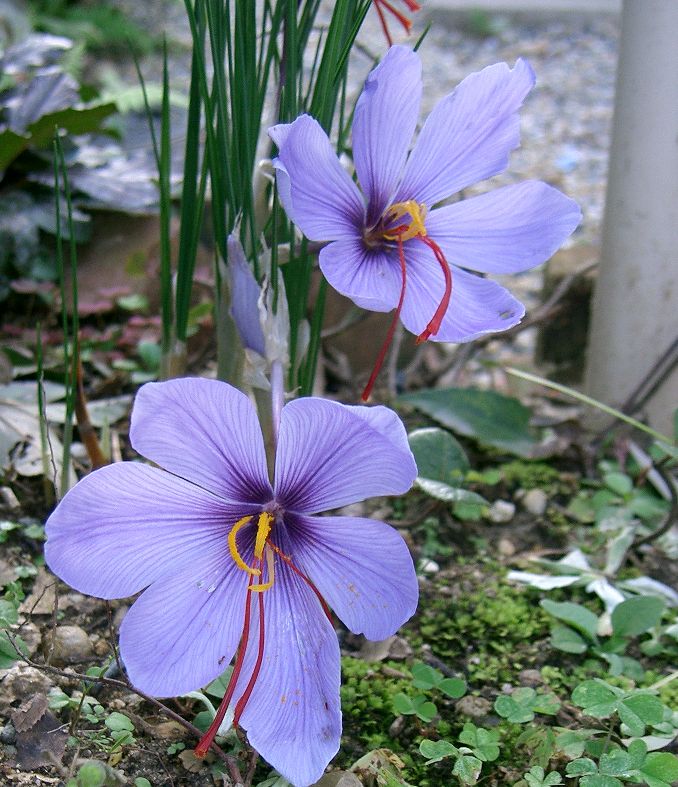 Saffron crocusThe purple autumn flower whose red stigmas yield the spice saffron
 CrocusSmall corm-grown flowers in white, yellow, orange or purple
 Autumn crocusA lilac autumn flower that blooms before its leaves appear
 Crocus cartwrightianusA small autumn-blooming crocus from Greece with vivid red stigmas
Sources and further reading
Original text by the Phool desk, written with AI assistance. Customs vary from place to place. If we have something wrong, tell us.
Photo credits on this page
The small pictures above come from Wikimedia Commons under free licences. Some are cropped to fit.
- Saffron crocus: KENPEI, CC BY-SA 3.0, source
- Autumn crocus: Stemonitis, Public domain, source
- Crocus: Meneerke bloem, CC BY-SA 3.0, source
- Crocus cartwrightianus: Meneerke bloem, CC BY-SA 4.0, source