
Crocus cartwrightianus
A small autumn-blooming crocus from Greece with vivid red stigmas
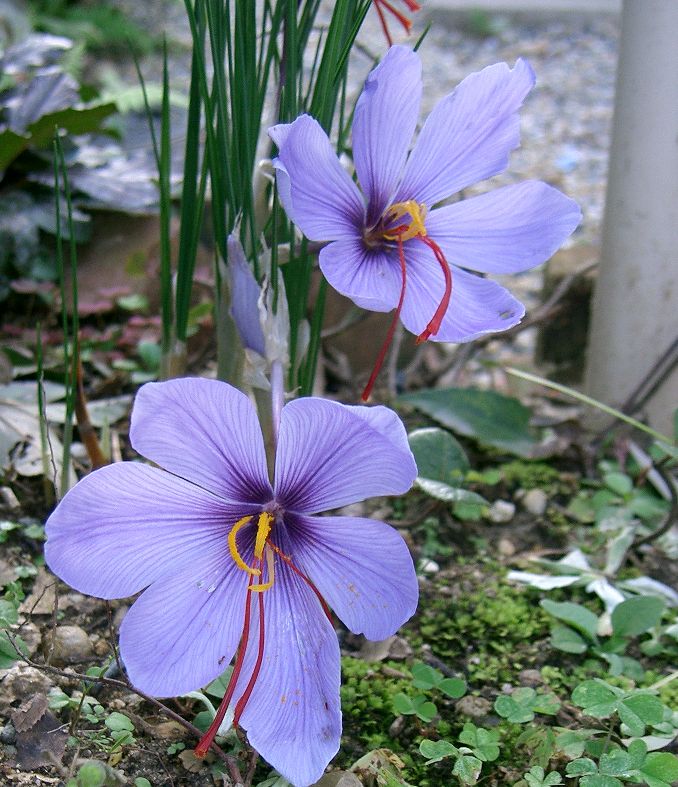
Crocus cartwrightianus is a perennial plant from Greece and nearby islands that flowers in autumn and winter. Its blooms are lilac or white with purple lines and striking red stigmas, and it is thought to be a wild ancestor of the saffron crocus.
- Native to Greece and several Aegean islands
- Blooms in autumn and winter with lilac or white flowers
- Red stigmas are longer than the anthers
- Ancestor of the cultivated saffron crocus
- Featured in ancient Minoan art from Crete
What does Crocus cartwrightianus look like?
Crocus cartwrightianus is a low-growing plant, reaching about 5 cm tall. Its flowers appear in autumn or winter, showing shades of lilac or white with purple veins. The most noticeable feature is the long, bright red stigmas that rise above the yellow anthers and are about as long as the petals. The flower throat is hairy, and the leaves grow alongside the flowers.
Where does Crocus cartwrightianus come from?
This crocus species grows wild in mainland Greece and several Aegean islands, including Crete, Euboea, Skyros, and the Cyclades. It prefers limestone soils, especially in the Attica region. The plant is named after John Cartwright, a British consul in the 1800s. Crocus cartwrightianus is believed to be the wild ancestor of the cultivated saffron crocus, Crocus sativus, with populations in Attica closely related to those used for saffron.
When and how Crocus cartwrightianus blooms
Crocus cartwrightianus grows from a corm, a swollen underground stem. It sends up its leaves and flowers at the same time in the cooler months of autumn and winter. The plant does best in well-drained, rocky or limestone soils. It can be grown in gardens as an ornamental bulb, planted in the ground or in pots.

How Crocus cartwrightianus is used
In ancient Crete, this crocus was gathered for its stigmas, which were used to make a pigment called Zafran. Wild plants were also collected for medicinal purposes on the island of Andros in the Cyclades. Today, it is grown as a garden flower for its attractive blooms.
Kinds of Crocus cartwrightianus
There are no widely recognized varieties, but Crocus cartwrightianus is important because it is closely related to Crocus sativus, the source of saffron. Some populations in Attica are thought to be especially close to the original saffron crocus.
What Crocus cartwrightianus means
A mural from the Middle Minoan period on Crete, known as the 'Saffron Gatherer', shows people collecting crocuses, likely this species. The plant is linked to the early history of saffron use in the region. Its connection to ancient art and the origins of saffron makes it culturally significant in Greece.
Where Crocus cartwrightianus is used and seen


Traditions that use it
Questions people ask about Crocus cartwrightianus
Where does Crocus cartwrightianus come from?
It is native to mainland Greece and several nearby islands, including Crete, Euboea, Skyros, and the Cyclades, often found in limestone-rich areas.
What does Crocus cartwrightianus look like?
It is a small plant, about 5 cm tall, with lilac or white flowers marked with purple veins and long, bright red stigmas that stand out above the yellow anthers.
How is Crocus cartwrightianus connected to saffron?
This species is considered the wild ancestor of Crocus sativus, the plant from which saffron is harvested. Populations in Attica are especially close to the original saffron crocus.
How has Crocus cartwrightianus been used traditionally?
In the past, its stigmas were collected to make a pigment called Zafran, and wild plants were used for medicinal purposes, especially on the island of Andros.
When does Crocus cartwrightianus flower?
It blooms in the autumn and winter months, sending up flowers and leaves at the same time.
Good reading and sources
- Crocus cartwrightianusRoyal Horticultural Society, Article
- IUCN Red List of Threatened SpeciesIUCN Red List, Article
- Plants of the World OnlineRoyal Botanic Gardens, Kew, Plant database
- Where it has been recordedGBIF, Plant database
- Sightings and photos by naturalistsiNaturalist, Plant database
- Crocus cartwrightianus on WikipediaEncyclopedia
- More photos on Wikimedia CommonsPhotos
- Wikidata recordOpen data
The facts on this page come from the Wikipedia article "Crocus cartwrightianus", written by its contributors and used under the CC BY-SA 4.0 licence, and from its Wikidata record (CC0). Phool rewrote the text in its own words, with AI assistance, and compares every page with the article to make sure no passage is copied. It may be reused under the same CC BY-SA 4.0 licence with a link back.
It may contain mistakes. It is not medical or foraging advice: many flowers are poisonous, and traditional uses are reported, not recommended. If something is wrong, tell us. Last refreshed 2026-10-03.
Others in the family Iridaceae
The whole family Gladiolus
Tall, showy flower spikes grown from corms, known as sword lilies
Gladiolus · Garden flower
Gladiolus
Tall, showy flower spikes grown from corms, known as sword lilies
Gladiolus · Garden flower
 Iris
A large group of perennial flowers with striking, six-lobed blooms
Iris · Wildflower
Iris
A large group of perennial flowers with striking, six-lobed blooms
Iris · Wildflower
 Crocus
Small corm-grown flowers in white, yellow, orange or purple
🇹🇷 Turkey and 7 more · Wildflower
Crocus
Small corm-grown flowers in white, yellow, orange or purple
🇹🇷 Turkey and 7 more · Wildflower
 Saffron crocusCrocus sativus
The purple autumn flower whose red stigmas yield the spice saffron
🇨🇳 China and 1 more · Garden flower
Saffron crocusCrocus sativus
The purple autumn flower whose red stigmas yield the spice saffron
🇨🇳 China and 1 more · Garden flower
More from Greece
All the flowers of Greece TulipTulipa
Spring-blooming bulbs with showy, cup-shaped flowers in many colours
🇳🇱 Netherlands and 7 more · Wildflower
TulipTulipa
Spring-blooming bulbs with showy, cup-shaped flowers in many colours
🇳🇱 Netherlands and 7 more · Wildflower
 Eucalyptus
The tall, aromatic trees and shrubs known as gum trees or eucalypts
🇦🇺 Australia and 7 more · Flowering tree
Eucalyptus
The tall, aromatic trees and shrubs known as gum trees or eucalypts
🇦🇺 Australia and 7 more · Flowering tree
 Narcissus
Spring-flowering bulbs with trumpet-shaped blooms in white, yellow, and orange
🇬🇧 United Kingdom and 7 more · Wildflower
Narcissus
Spring-flowering bulbs with trumpet-shaped blooms in white, yellow, and orange
🇬🇧 United Kingdom and 7 more · Wildflower
 Bitter orangeCitrus × aurantium
The citrus tree behind Seville orange marmalade and Neroli oil
🇨🇳 China and 6 more · Flowering tree
Bitter orangeCitrus × aurantium
The citrus tree behind Seville orange marmalade and Neroli oil
🇨🇳 China and 6 more · Flowering tree