
Flower Carpet of Brussels
In its own language: Tapis de Fleurs
A giant floral tapestry on Brussels’ Grand-Place every two years
Every two years, volunteers in Brussels create a vast floral carpet on the city’s Grand-Place, using hundreds of thousands of begonias and sometimes dahlias. Each edition features a new theme, drawing visitors from Belgium and abroad to view the colourful display for several days in August.
- Held every two years on Brussels’ Grand-Place since 1971
- Up to 750,000 begonias or dahlias used in each carpet
- Each edition features a new artistic theme
- Recognised as intangible cultural heritage in Brussels
- Created by about 120 volunteers in a single day
What is Flower Carpet of Brussels?
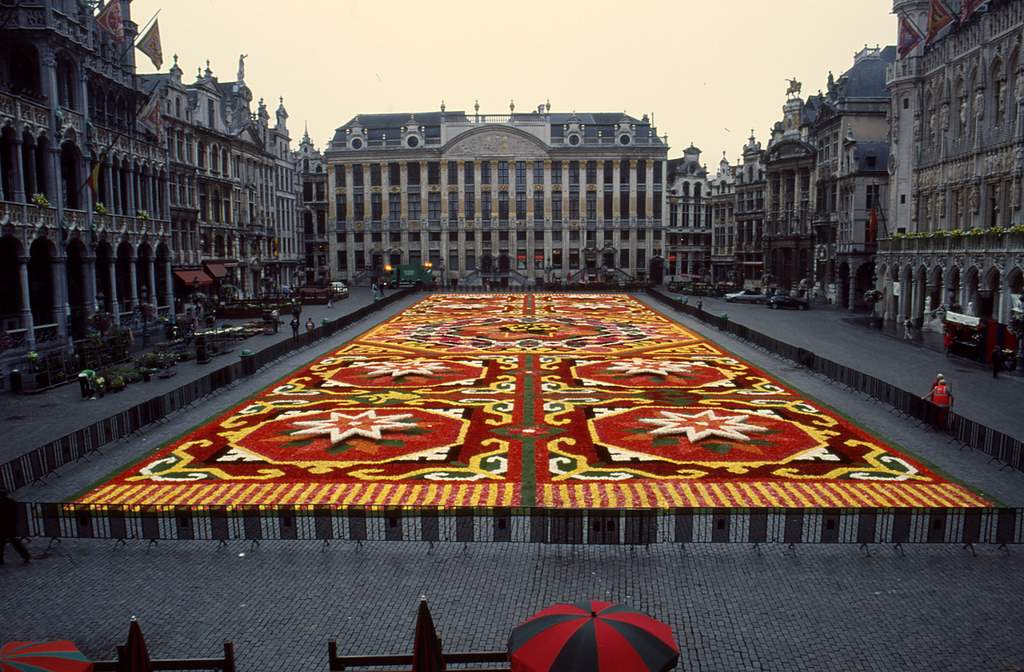
The Flower Carpet of Brussels is a temporary, large-scale floral display laid out on the cobblestones of the Grand-Place. Measuring about 24 by 77 metres, the carpet is made up of hundreds of thousands of tightly packed begonia or dahlia flowers, arranged to form intricate patterns and images based on a chosen theme. The result is a vivid, multi-coloured tapestry that can be viewed up close or admired from above, especially from the Town Hall balcony.
Where does Flower Carpet of Brussels come from?
The tradition began in 1971, started by landscape architect Etienne Stautemans from Ghent, who wanted to showcase his skills. Its popularity led to the founding of a non-profit group to organise the event regularly. Since 1986, the carpet has been created every two years, with each edition reflecting a different theme. The event is now recognised as part of the intangible cultural heritage of the Brussels-Capital Region, and there is an ongoing effort to have it listed by UNESCO.
How Flower Carpet of Brussels is made
Planning for each Flower Carpet starts two years in advance, with organisers selecting a theme and designing the layout. Horticulturists from the Ghent area grow the required flowers, mainly begonias and sometimes dahlias. On the day of assembly, around 120 volunteers work together to place up to 750,000 flowers onto a prepared mat, following a life-sized drawing. The entire process takes between four and eight hours, resulting in a carpet that covers 1,800 square metres.



When and where Flower Carpet of Brussels is used
The carpet is displayed for several days in August, timed with the holiday of Assumption. Visitors can walk around the Grand-Place to see the carpet up close, and for a fee, view it from the Town Hall balcony. The event often includes music, light shows, and other cultural activities, attracting large crowds from Belgium and around the world.
Forms of Flower Carpet of Brussels
Each edition of the Flower Carpet has a unique theme, ranging from Belgian history and local symbols to international cultures like Japan, Mexico, and Turkey. Some years, the design has featured national emblems, famous artworks, or patterns inspired by different countries. While begonias are the main flower, dahlias have been used for certain themes, such as in 2018 and 2024.
What Flower Carpet of Brussels means
The Flower Carpet is a major cultural event in Brussels, drawing up to 200,000 visitors. Its themes often celebrate Belgian heritage or international friendship, and it has included tributes to historical events, art styles, and communities. The event is officially recognised as part of Brussels’ intangible heritage and is seeking UNESCO status.
The flowers of Flower Carpet of Brussels
 DahliaA bushy perennial with tuberous roots and bright, star-shaped blooms
 BegoniaA vast group of colourful, shade-loving flowering plants from warm climates
 Red dahliaA Mexican dahlia with red, orange or yellow blooms
 Tree dahliaA towering dahlia with lavender-pink flowers from the mountains of Central America
 Begonia × tuberhybridaHybrid begonias grown for their large, colourful flowers from tubers
 Garden dahliaA showy perennial with pink to deep purple blooms, grown in gardens worldwide
Where to see Flower Carpet of Brussels

Questions people ask about Flower Carpet of Brussels
Where does the Flower Carpet of Brussels take place?
The Flower Carpet is set up in the Grand-Place, the historic central square of Brussels, Belgium.
What flowers are used to make the carpet?
Most carpets are made with tuberous begonias, a major Belgian export, though dahlias are sometimes used for special themes.
When can visitors see the Flower Carpet?
The event takes place every two years in August, for several days around the middle of the month.
How is the theme for the carpet chosen?
A new theme is selected for each edition, often reflecting Belgian history, international relations, or cultural events.
Is the Flower Carpet recognised as a heritage event?
Yes, it is listed as intangible cultural heritage in the Brussels-Capital Region and is being considered for UNESCO recognition.
Good reading and sources
- Flower Carpet (Brussels) on WikipediaEncyclopedia
- More photos on Wikimedia CommonsPhotos
- Wikidata recordOpen data
The facts on this page come from the Wikipedia article "Flower Carpet (Brussels)", written by its contributors and used under the CC BY-SA 4.0 licence, and from its Wikidata record (CC0). Phool rewrote the text in its own words, with AI assistance, and compares every page with the article to make sure no passage is copied. It may be reused under the same CC BY-SA 4.0 licence with a link back.
It may contain mistakes. If something is wrong, tell us. Last refreshed 2026-10-03.
More of the same kind
 Decoration
Onam
Kerala’s ten-day harvest festival with flower carpets, feasts and boat races
🇮🇳 India and 1 more · Custom, Aug to Sep
Decoration
Onam
Kerala’s ten-day harvest festival with flower carpets, feasts and boat races
🇮🇳 India and 1 more · Custom, Aug to Sep
 Decoration
Well dressing
Decorating wells with flower petal pictures in rural England
🇬🇧 United Kingdom · Carpet or floor pattern
Decoration
Well dressing
Decorating wells with flower petal pictures in rural England
🇬🇧 United Kingdom · Carpet or floor pattern
 Decoration
carpet bedding
Giant plant sculptures made from thousands of bedding plants on steel frames
🇨🇦 Canada · Carpet or floor pattern
Decoration
carpet bedding
Giant plant sculptures made from thousands of bedding plants on steel frames
🇨🇦 Canada · Carpet or floor pattern
 Decoration
Rangoliरंगोली
Indian floor art made with coloured powders, rice, or petals for festivals and daily welcome
🇮🇳 India and 1 more · Carpet or floor pattern
Decoration
Rangoliरंगोली
Indian floor art made with coloured powders, rice, or petals for festivals and daily welcome
🇮🇳 India and 1 more · Carpet or floor pattern
More from Belgium
All the flowers of Belgium Decoration
Flower carpet
Patterns made on the ground from fresh flowers or petals
🇧🇪 Belgium and 3 more · Carpet or floor pattern, Aug to Dec
Decoration
Flower carpet
Patterns made on the ground from fresh flowers or petals
🇧🇪 Belgium and 3 more · Carpet or floor pattern, Aug to Dec
 Decoration
Maypole
A tall decorated pole at the heart of spring and summer festivals in Europe
🇩🇪 Germany and 6 more · Custom
Decoration
Maypole
A tall decorated pole at the heart of spring and summer festivals in Europe
🇩🇪 Germany and 6 more · Custom
 Decoration
May devotions to the Blessed Virgin Mary
Month-long Catholic customs honouring Mary with flowers, altars, and processions
🇮🇹 Italy and 7 more · Custom, May
Decoration
May devotions to the Blessed Virgin Mary
Month-long Catholic customs honouring Mary with flowers, altars, and processions
🇮🇹 Italy and 7 more · Custom, May
 Decoration
Bloemencorso
Annual flower parades with decorated floats in the Netherlands and Belgium
🇳🇱 Netherlands and 1 more · Parade or display
Decoration
Bloemencorso
Annual flower parades with decorated floats in the Netherlands and Belgium
🇳🇱 Netherlands and 1 more · Parade or display