
Tanabata
In its own language: たなばた / 七夕
Japan’s festival of wishes, bamboo, and colorful paper decorations
Tanabata is a Japanese festival held in July or August, celebrating the meeting of two star-crossed lovers from legend. People write wishes on strips of paper and hang them on bamboo, with streets decorated in bright streamers and ornaments. The largest festivals are in Sendai, Hiratsuka, and Tokyo.
- People hang wishes on bamboo branches using colorful paper strips called tanzaku.
- The Sendai Tanabata Festival is Japan’s largest, held from 6 to 8 August.
- Decorations include streamers, paper balls, and ornaments in five colors.
- The festival celebrates the meeting of two star lovers, Orihime and Hikoboshi.
What is Tanabata?
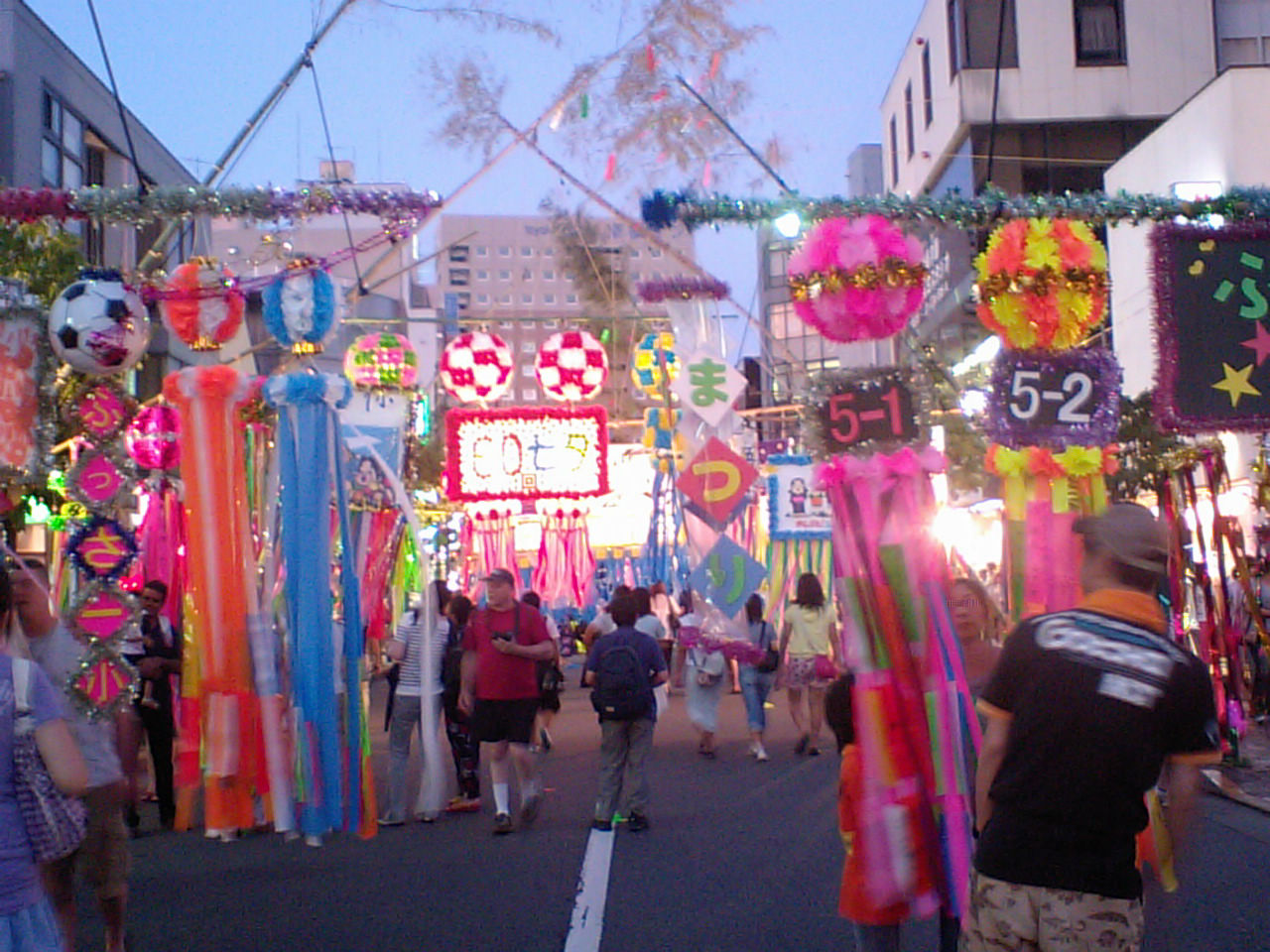
Tanabata is a festival where streets and shopping arcades are decorated with large, colorful streamers, paper ornaments, and bamboo branches. People write their wishes on small strips of paper called tanzaku and hang them on bamboo. The decorations often include balls modeled after flowers, box-shaped ornaments, and other symbolic items. During the festival, visitors see parades, food stalls, and lively crowds in yukata (summer kimono).
Where does Tanabata come from?
Tanabata comes from the Chinese Qixi Festival and was introduced to Japan in the 8th century. Over time, it merged with local traditions, including a Shinto ceremony where special cloth was woven and offered to the gods for a good harvest. The festival’s name and customs developed as it spread, especially during the Edo period, when writing wishes became popular. The story of Orihime and Hikoboshi, separated by the Milky Way and allowed to meet only once a year, is central to the festival.
How Tanabata is made
To prepare for Tanabata, people cut bamboo branches and decorate them with tanzaku (wish papers) and other paper ornaments in bright colors. In Sendai, seven types of decorations are used, each with a meaning. Community groups, shops, and families create elaborate displays, often competing in decoration contests. The decorations are usually taken down at the end of the festival and sometimes floated on rivers or burned.

![Tanabata Festival in Edo (Japanese: 大江戸市中七夕祭, Ōedo shichū tanabata matsuri ). No. 11 [1] (or No. 3 [2] ) in the series Thirty-six Views of Mount Fuji (first version).](https://upload.wikimedia.org/wikipedia/commons/f/f3/Tanabata_Festival_in_Edo_%28Hiroshige%2C_1852%29.jpg)

When and where Tanabata is used
Tanabata is celebrated in July or August, depending on the region. Major festivals feature parades, music, and food stalls, with the largest in Sendai, Hiratsuka, and Tokyo. People of all ages take part by writing wishes and enjoying the festive atmosphere. The festival is also marked by fireworks and special events, and some places hold Miss Tanabata contests or themed parades.
Forms of Tanabata
While the main custom is writing wishes on tanzaku and hanging them on bamboo, each region has its own style of decorations and timing. The Sendai festival is famous for its large streamers and use of seven symbolic ornaments. In other cities, the festival may coincide with local Obon traditions or feature unique parades and events.
What Tanabata means
Tanabata is a symbol of hope and longing, inspired by the legend of two lovers separated by the Milky Way. It is one of Japan’s major summer festivals and is closely tied to Shinto beliefs and local traditions. The festival’s decorations and customs express wishes for skill, good fortune, and happiness. It is also a time for community celebration and artistic display.
Questions people ask about Tanabata
What is Tanabata?
Tanabata is a Japanese festival that celebrates the meeting of two legendary star lovers. People write wishes on paper strips and hang them on bamboo, with streets decorated in colorful ornaments.
Where does Tanabata come from?
Tanabata originated from the Chinese Qixi Festival and was introduced to Japan in the 8th century. It later merged with local Shinto and seasonal customs.
When is Tanabata celebrated?
The festival is held on the 7th day of the 7th month, which is usually in July or August, depending on the region and calendar used.
What do people do during Tanabata?
People write wishes on small pieces of paper called tanzaku and hang them on bamboo. Cities hold festivals with parades, food stalls, and elaborate decorations.
What does Tanabata symbolize?
Tanabata symbolizes hope, longing, and the wish for dreams to come true, inspired by the story of two lovers separated by the Milky Way who can meet only once a year.
Good reading and sources
The facts on this page come from the Wikipedia article "Tanabata", written by its contributors and used under the CC BY-SA 4.0 licence, and from its Wikidata record (CC0). Phool rewrote the text in its own words, with AI assistance, and compares every page with the article to make sure no passage is copied. It may be reused under the same CC BY-SA 4.0 licence with a link back.
It may contain mistakes. If something is wrong, tell us. Last refreshed 2026-10-03.
More of the same kind
 Decoration
Floriculture
The science and business of growing flowers and ornamental plants
Arrangement
Decoration
Floriculture
The science and business of growing flowers and ornamental plants
Arrangement
 Decoration
Corn dolly
Straw figures shaped for harvest customs across Europe
🇮🇪 Ireland and 3 more · Flower craft
Decoration
Corn dolly
Straw figures shaped for harvest customs across Europe
🇮🇪 Ireland and 3 more · Flower craft
 Decoration
Varamalaवरमाला
A flower garland exchanged by bride and groom in Hindu weddings
🇮🇳 India · Garland or wreath
Decoration
Varamalaवरमाला
A flower garland exchanged by bride and groom in Hindu weddings
🇮🇳 India · Garland or wreath
 Decoration
Bouquet
A creative arrangement of flowers, given or displayed for many occasions
🇨🇳 China and 1 more · Arrangement
Decoration
Bouquet
A creative arrangement of flowers, given or displayed for many occasions
🇨🇳 China and 1 more · Arrangement
More from Japan
All the flowers of Japan Decoration
Bonsai盆栽
The Japanese art of shaping miniature trees in shallow pots
🇯🇵 Japan and 7 more · Art or design
Decoration
Bonsai盆栽
The Japanese art of shaping miniature trees in shallow pots
🇯🇵 Japan and 7 more · Art or design
 Decoration
Tokonoma床の間
A Japanese alcove for displaying scrolls and flower arrangements
🇯🇵 Japan · Arrangement
Decoration
Tokonoma床の間
A Japanese alcove for displaying scrolls and flower arrangements
🇯🇵 Japan · Arrangement
 Decoration
Hanami花見
The Japanese tradition of gathering to enjoy cherry blossoms in spring
🇯🇵 Japan and 7 more · Custom, Jan to May
Decoration
Hanami花見
The Japanese tradition of gathering to enjoy cherry blossoms in spring
🇯🇵 Japan and 7 more · Custom, Jan to May
 Decoration
Sōgetsu草月流
A modern school of Japanese ikebana open to all materials and styles
🇯🇵 Japan · Arrangement
Decoration
Sōgetsu草月流
A modern school of Japanese ikebana open to all materials and styles
🇯🇵 Japan · Arrangement