
Poppy anemone
Anemone coronaria, family Ranunculaceae
Red, white, or blue Mediterranean flower with a dark crown centre
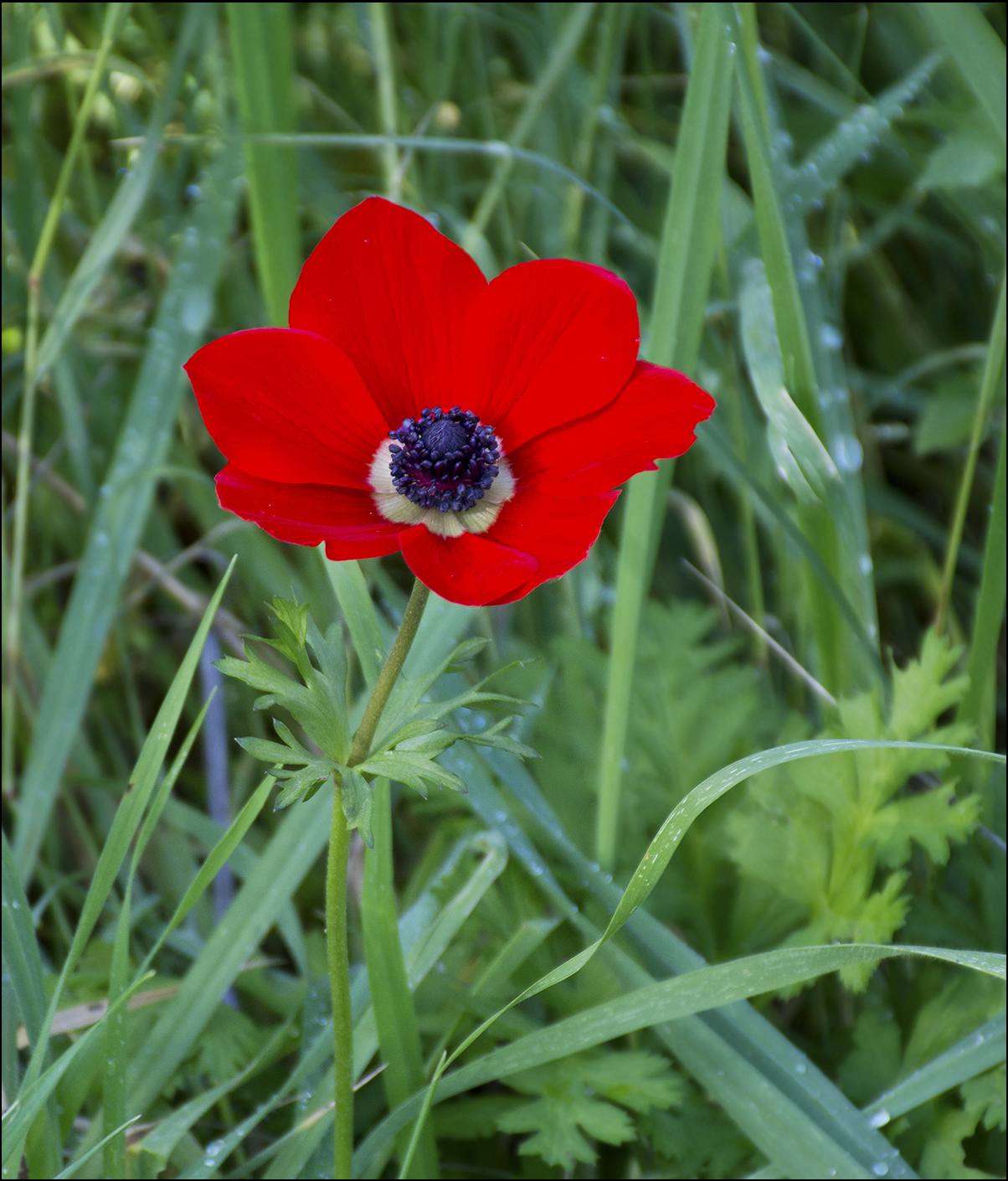
Poppy anemone (Anemone coronaria) is a tuberous perennial from the Mediterranean, known for its showy red, white, or blue flowers with a dark centre. It grows wild from Greece to Israel and is widely grown in gardens for its bright spring blooms. In Israel, it is celebrated as the national flower.
- National flower of Israel, celebrated at the Darom Adom festival
- Native to the Mediterranean, from Greece to Iran
- Flowers come in red, white, blue, purple, and pink
- Linked to the Adonis myth and Christian symbolism
- Popular garden and cut flower since the Renaissance
What does Poppy anemone look like?
Poppy anemone is a low-growing perennial, reaching 20–40 cm tall, with a few deeply lobed leaves forming a basal rosette. Each plant produces single, showy flowers 3–8 cm across, usually with 5–8 petal-like tepals in red, white, blue, purple, or pink, and a dark, crown-like centre. The flowers stand on tall stems above the leaves, and the plant grows from hard, black tubers.
Where does Poppy anemone come from?
Native to the Mediterranean coast from Greece and Albania through Turkey, Syria, Israel, and into North Africa and Iran, Anemone coronaria grows wild in fields and open areas. It was cultivated as early as ancient Rome, mentioned by Pliny the Elder. The plant was introduced to England before 1596 and became popular in European gardens, with breeders in France and Italy developing new colours by the 18th century.
When and how Poppy anemone blooms
In its native range, poppy anemone blooms from winter to early spring. It is usually grown from tubers, planted in autumn in mild climates or in spring after frost in cooler areas. The plant prefers full sun to part shade and is often grown as an annual outside its native zone. Flowers are cross-pollinated by bees, flies, and beetles, with each colour attracting different pollinators.


How Poppy anemone is used
People grow poppy anemone for its bright, decorative flowers in gardens and as cut flowers. In Israel, it is the focus of the Darom Adom festival, where people gather to see the red blooms in the Negev. The flower is also linked to weddings and is a symbol in art and folklore. In Christianity, it is associated with the 'lilies of the field' in the Beatitudes.
Kinds of Poppy anemone
There are many cultivars, including the single-flowered De Caen group and the semi-double or double St Brigid group. De Caen types come in red, blue, pink, and white, while St Brigid cultivars originated in Ireland. Other groups like Rissoana and Grassensis offer early blooming or large double flowers. Wild forms are usually red, but garden varieties show a wide range of colours.
What Poppy anemone means
The red poppy anemone is the national flower of Israel, celebrated each year at the Darom Adom festival. In Greek myth, it is linked to Adonis, whose blood was said to create the flower. In Christian tradition, it is called 'lily of the field' and symbolizes beauty and renewal. In Israeli art, it represents both hope and remembrance, especially after times of conflict.
Where Poppy anemone is used and seen


Where to see Poppy anemone
Questions people ask about Poppy anemone
Where does the poppy anemone come from?
Poppy anemone is native to the Mediterranean region, growing wild from Greece and Albania through Turkey, Syria, Israel, and into North Africa and Iran.
What does the poppy anemone look like?
It is a low perennial with deeply lobed leaves and single flowers 3–8 cm wide, usually red, white, blue, purple, or pink with a dark centre, blooming on tall stems.
What is the poppy anemone used for?
It is grown for its decorative flowers in gardens and as a cut flower, and is celebrated in festivals, especially in Israel, where it is the national flower.
What does the poppy anemone symbolize?
In Greek myth, it is linked to the story of Adonis and symbolizes love and loss. In Israel, it stands for renewal and hope, while in Christianity it is associated with beauty and the 'lilies of the field.'
Are there different types of poppy anemone?
Yes, there are many cultivated varieties, including single, semi-double, and double forms in a wide range of colours, such as the De Caen and St Brigid groups.
Good reading and sources
- Encyclopaedia BritannicaArticle
- USDA Plants DatabaseUS Department of Agriculture, Article
- Plants of the World OnlineRoyal Botanic Gardens, Kew, Plant database
- Where it has been recordedGBIF, Plant database
- Sightings and photos by naturalistsiNaturalist, Plant database
- Anemone coronaria on WikipediaEncyclopedia
- More photos on Wikimedia CommonsPhotos
- Wikidata recordOpen data
The facts on this page come from the Wikipedia article "Anemone coronaria", written by its contributors and used under the CC BY-SA 4.0 licence, and from its Wikidata record (CC0). Phool rewrote the text in its own words, with AI assistance, and compares every page with the article to make sure no passage is copied. It may be reused under the same CC BY-SA 4.0 licence with a link back.
It may contain mistakes. It is not medical or foraging advice: many flowers are poisonous, and traditional uses are reported, not recommended. If something is wrong, tell us. Last refreshed 2026-10-03.
Others in the family Ranunculaceae
The whole family ButtercupRanunculus
A widespread group of bright, often shiny-petalled wild and garden flowers
Ranunculus · Wildflower
ButtercupRanunculus
A widespread group of bright, often shiny-petalled wild and garden flowers
Ranunculus · Wildflower
 Anemone
Perennial wildflowers with colorful, petal-like sepals known as windflowers
Anemone · Wildflower
Anemone
Perennial wildflowers with colorful, petal-like sepals known as windflowers
Anemone · Wildflower
 MonkshoodAconitum
Tall, hooded wildflowers of mountain meadows, known for beauty and deadly poison
Aconitum · Wildflower
MonkshoodAconitum
Tall, hooded wildflowers of mountain meadows, known for beauty and deadly poison
Aconitum · Wildflower
 Clematis
A climbing vine with showy flowers, prized in gardens worldwide
Clematis · Wildflower
Clematis
A climbing vine with showy flowers, prized in gardens worldwide
Clematis · Wildflower
More from Israel
All the flowers of Israel PomegranatePunica granatum
A shrub with bright red flowers and a fruit full of edible seeds
🇮🇷 Iran and 9 more · Flowering shrub
PomegranatePunica granatum
A shrub with bright red flowers and a fruit full of edible seeds
🇮🇷 Iran and 9 more · Flowering shrub
 Bay laurelLaurus nobilis
Evergreen tree with aromatic leaves used as bay leaf in cooking
🇬🇷 Greece and 9 more · Flowering tree
Bay laurelLaurus nobilis
Evergreen tree with aromatic leaves used as bay leaf in cooking
🇬🇷 Greece and 9 more · Flowering tree
 Indian fig opuntiaOpuntia ficus-indica
A large, spiny cactus grown for its sweet fruit and edible pads
🇲🇽 Mexico and 7 more · Wildflower
Indian fig opuntiaOpuntia ficus-indica
A large, spiny cactus grown for its sweet fruit and edible pads
🇲🇽 Mexico and 7 more · Wildflower
 Orchis
A group of wild orchids with tuberous roots from Europe, North Africa and Asia
🇹🇷 Turkey and 7 more · Wildflower
Orchis
A group of wild orchids with tuberous roots from Europe, North Africa and Asia
🇹🇷 Turkey and 7 more · Wildflower