
Freshwater mangrove
Barringtonia acutangula, family Lecythidaceae
A riverside tree with long drooping white flower clusters
Freshwater mangrove is a tree found along rivers and wetlands from Afghanistan to northern Australia. It grows up to 15 meters tall and produces long, hanging clusters of large white flowers. Young leaves are eaten in some Asian cuisines, and parts of the plant are used in traditional medicine.
- Grows up to 15 meters tall with drooping white flower clusters
- Young leaves are eaten fresh in Vietnamese cuisine
- Used in traditional medicine for skin and digestive issues
- Native to riverbanks from Afghanistan to northern Australia
- Conservation status is least concern
What does Freshwater mangrove look like?
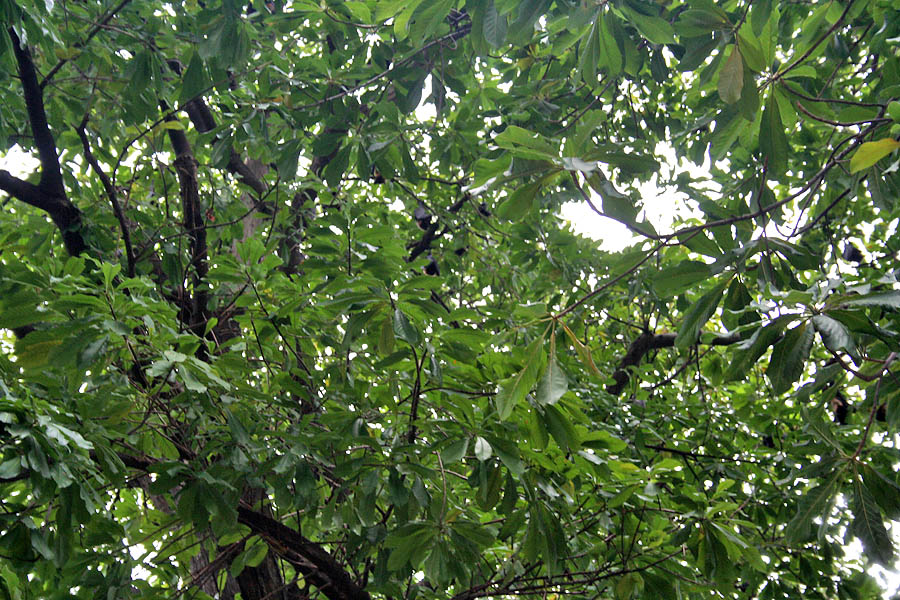
Freshwater mangrove is a medium-sized tree, reaching 8 to 15 meters in height. Its leaves are thick, smooth, and oval, with reddish stalks. The tree is known for its long, drooping flower clusters, which can be up to half a meter long and bear many large, white blossoms. The fruit is oval and about 3 centimeters long, containing a single seed.
Where does Freshwater mangrove come from?
This tree grows wild along rivers, lakes, and wetlands from Afghanistan and the Indian subcontinent through Southeast Asia to northern Australia. It is adapted to moist, often flooded areas. Its spread covers a wide region, including parts of Western Asia, the Indian subcontinent, Indo-China, Malesia, New Guinea, and northern Australia. The species is not considered threatened.
When and how Freshwater mangrove blooms
Freshwater mangrove blooms on long, hanging racemes that carry many white flowers. It thrives in wet, tropical or subtropical climates, often along riverbanks or in swampy ground. The tree grows from seed and is found in both wild and cultivated settings in its native range.


How Freshwater mangrove is used
Young leaves are eaten fresh in Vietnam, often with vegetables, meat, or shrimp. Traditional medicine in India and other regions uses extracts from the leaves, seeds, and roots for various purposes, including skin eruptions and digestive issues. The bark contains compounds with pain-relieving properties, and other parts have been studied for antibiotic and antifungal effects.
Kinds of Freshwater mangrove
There are no widely recognized cultivated varieties or subspecies noted in the sources. The tree is known by several common names in different regions, such as itchytree and mango-pine.
What Freshwater mangrove means
Freshwater mangrove is valued in traditional medicine and as a food plant in parts of Asia. It is not reported as a national or state emblem. Its conservation status is listed as least concern, meaning it is not currently at risk in the wild.
Questions people ask about Freshwater mangrove
Where does the freshwater mangrove come from?
It is native to riverbanks and wetlands from Afghanistan and the Indian subcontinent through Southeast Asia to northern Australia.
What does the freshwater mangrove look like?
It is a tree 8–15 meters tall with thick, oval leaves and long, drooping clusters of large white flowers. Its fruit is oval and contains a single seed.
How is the freshwater mangrove used?
Young leaves are eaten fresh in Vietnam, and various parts are used in traditional medicine for skin eruptions, digestive issues, and as a pain reliever.
Is the freshwater mangrove threatened in the wild?
No, its conservation status is listed as least concern, meaning it is not currently at risk.
Does the freshwater mangrove have any other names?
Yes, it is also known as itchytree and mango-pine in some regions.
Good reading and sources
- IUCN Red List of Threatened SpeciesIUCN Red List, Article
- Plants of the World OnlineRoyal Botanic Gardens, Kew, Plant database
- Where it has been recordedGBIF, Plant database
- Sightings and photos by naturalistsiNaturalist, Plant database
- Barringtonia acutangula on WikipediaEncyclopedia
- More photos on Wikimedia CommonsPhotos
- Wikidata recordOpen data
The facts on this page come from the Wikipedia article "Barringtonia acutangula", written by its contributors and used under the CC BY-SA 4.0 licence, and from its Wikidata record (CC0). Phool rewrote the text in its own words, with AI assistance, and compares every page with the article to make sure no passage is copied. It may be reused under the same CC BY-SA 4.0 licence with a link back.
It may contain mistakes. It is not medical or foraging advice: many flowers are poisonous, and traditional uses are reported, not recommended. If something is wrong, tell us. Last refreshed 2026-10-03.
More from Afghanistan
All the flowers of Afghanistan FennelFoeniculum vulgare
A tall, aromatic herb with feathery leaves and yellow umbels, used for food and spice
🇨🇳 China and 7 more · Herb or useful flower
FennelFoeniculum vulgare
A tall, aromatic herb with feathery leaves and yellow umbels, used for food and spice
🇨🇳 China and 7 more · Herb or useful flower
 Crocus
Small corm-grown flowers in white, yellow, orange or purple
🇹🇷 Turkey and 7 more · Wildflower
Crocus
Small corm-grown flowers in white, yellow, orange or purple
🇹🇷 Turkey and 7 more · Wildflower
 Datura
A group of trumpet-shaped, highly toxic flowering plants in the nightshade family
🇲🇽 Mexico and 7 more · Wildflower
Datura
A group of trumpet-shaped, highly toxic flowering plants in the nightshade family
🇲🇽 Mexico and 7 more · Wildflower
 Marsh-marigoldCaltha palustris
A bright yellow wildflower of marshes and wet woodlands in cool climates
🇨🇳 China and 7 more · Wildflower
Marsh-marigoldCaltha palustris
A bright yellow wildflower of marshes and wet woodlands in cool climates
🇨🇳 China and 7 more · Wildflower