
Dendrobium
A vast genus of orchids found from the Himalayas to Australia and the Pacific
Dendrobium is a large group of mostly epiphytic orchids with over 1,800 species, native to diverse habitats across south, east, and southeast Asia, Australia, and the Pacific. These orchids grow on trees or rocks and are known for their varied flower shapes and colours, with some species valued as emblems, in traditional medicine, and as ornamental plants.
- Dendrobium includes over 1,800 orchid species.
- Found from the Himalayas to Australia and the Pacific islands.
- Some species are used in traditional Chinese medicine.
- Dendrobium orchids are regional emblems in Asia and Australia.
- Certain flowers can last up to nine months.
What does Dendrobium look like?
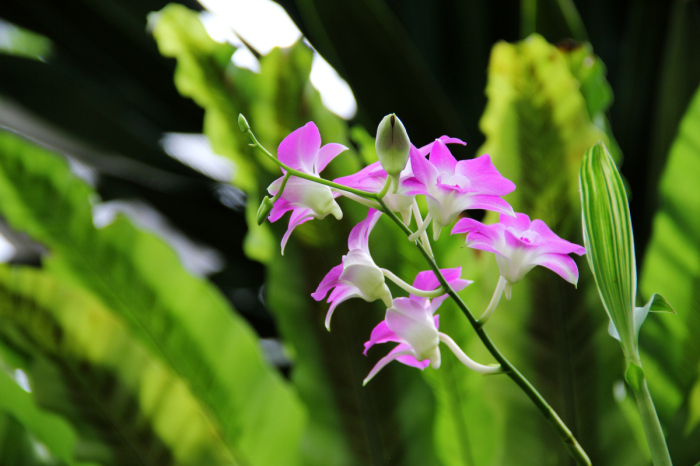
Dendrobium orchids are mostly epiphytes, growing on trees or rocks, with creeping roots and hard, sometimes cane-like pseudobulbs. Their leaves are arranged in two rows and can be linear, oblong, or cylindrical, usually lasting only one season. The flowers, which may be few or many on a stem, come in shades of white, green, yellow, pink, or purple, often with a contrasting lip. The petals and sepals are similar, but the lip is distinct, usually egg-shaped and sometimes ridged.
Where does Dendrobium come from?
The genus Dendrobium was first described in 1799 by Olof Swartz, with its name coming from Greek words meaning 'tree life', reflecting its habit of growing on trees. It includes over 1,800 species found across a wide area from the Himalayas to the Pacific islands, adapting to environments from mountain forests to dry Australian deserts. Several attempts to split the genus into smaller groups have been made, but most are not widely accepted.
When and how Dendrobium blooms
Dendrobium orchids flower from unbranched stems, with blooms that can last from a short time to several months, depending on the species. They are grown from pseudobulbs or cuttings, often attached to bark or rock rather than planted in soil. Many hybrids and cultivars have been developed for gardens and collections, with some species and hybrids in high demand among orchid enthusiasts.


How Dendrobium is used
Dendrobium orchids are popular in horticulture for their decorative flowers and are collected by enthusiasts worldwide. Some species, like D. nobile, are used in traditional Chinese medicine. In Australia, the stems of certain species have been eaten after removing old leaves. Many Dendrobium orchids serve as floral emblems for regions and appear in art and on currency.
Kinds of Dendrobium
The genus includes notable species such as D. nobile (noble dendrobium), D. bigibbum (Cooktown orchid), D. formosum, and D. chrysotoxum (golden-bow dendrobium). Hybrids and cultivars have been named after public figures and institutions. Some, like D. stratiotes, are known for their exceptionally long-lasting flowers.
What Dendrobium means
Dendrobium orchids hold symbolic value as emblems for regions like Sikkim, Queensland, and Maluku. D. nobile is one of the 50 fundamental herbs in traditional Chinese medicine. The Cooktown orchid has featured on Australian stamps, and Dendrobium hybrids have appeared on Singaporean currency. The genus is also present in literature and popular culture.
Traditions that use it
Where to see Dendrobium
 🇹🇭 Bangkok · All yearPak Khlong Talat by nightBangkok's round-the-clock flower market near the river, at its fullest after dark.
 🇸🇬 Singapore · All yearSingapore Botanic Gardens and the National Orchid GardenA tropical garden and UNESCO World Heritage Site, with one of the great orchid collections.
 🇺🇸 Honolulu · All yearMake a lei in HonoluluLearn to string a Hawaiian flower lei, and see the lei stands of Chinatown.
Questions people ask about Dendrobium
Where do Dendrobium orchids come from?
Dendrobium orchids are native to a wide area covering south, east, and southeast Asia, Australia, and many Pacific islands. They grow in habitats ranging from mountain forests to tropical lowlands and even dry regions.
What do Dendrobium orchids look like?
Dendrobium orchids have hard, sometimes cane-like stems, with leaves arranged in two rows. Their flowers vary in number and can be white, green, yellow, pink, or purple, often with a contrasting lip.
How are Dendrobium orchids used?
They are grown as ornamental plants, used as regional emblems, and some species are important in traditional Chinese medicine. In some places, parts of the plant have been eaten or used for air purification.
Are there famous types of Dendrobium?
Yes, notable types include D. nobile, D. bigibbum (Cooktown orchid), and D. formosum. Many hybrids have been named after public figures and have received horticultural awards.
What do Dendrobium orchids symbolise?
They serve as floral emblems for several regions, such as Sikkim in India and Queensland in Australia, and appear in art, stamps, and currency. Some species are also valued in traditional medicine.
Good reading and sources
- Encyclopaedia BritannicaArticle
- Dendrobium Berry gxRoyal Horticultural Society, Article
- DendrobiumAustralian National Botanic Gardens, Article
- USDA Plants DatabaseUS Department of Agriculture, Article
- Plants of the World OnlineRoyal Botanic Gardens, Kew, Plant database
- Where it has been recordedGBIF, Plant database
- Sightings and photos by naturalistsiNaturalist, Plant database
The facts on this page come from the Wikipedia article "Dendrobium", written by its contributors and used under the CC BY-SA 4.0 licence, and from its Wikidata record (CC0). Phool rewrote the text in its own words, with AI assistance, and compares every page with the article to make sure no passage is copied. It may be reused under the same CC BY-SA 4.0 licence with a link back.
It may contain mistakes. It is not medical or foraging advice: many flowers are poisonous, and traditional uses are reported, not recommended. If something is wrong, tell us. Last refreshed 2026-10-03.
Others in the family Orchidaceae
The whole family OrchidOrchidaceae
A vast family of colourful, often fragrant flowers found almost everywhere on earth
Orchidaceae · Wildflower
OrchidOrchidaceae
A vast family of colourful, often fragrant flowers found almost everywhere on earth
Orchidaceae · Wildflower
 Vanilla
Climbing orchids with pods used for the world’s most popular flavor
🇲🇽 Mexico and 7 more · Wildflower
Vanilla
Climbing orchids with pods used for the world’s most popular flavor
🇲🇽 Mexico and 7 more · Wildflower
 Orchis
A group of wild orchids with tuberous roots from Europe, North Africa and Asia
🇹🇷 Turkey and 7 more · Wildflower
Orchis
A group of wild orchids with tuberous roots from Europe, North Africa and Asia
🇹🇷 Turkey and 7 more · Wildflower
 Fire star orchidEpidendrum radicans
A bright orange orchid that roots along its whole stem
🇲🇽 Mexico and 7 more · Orchid
Fire star orchidEpidendrum radicans
A bright orange orchid that roots along its whole stem
🇲🇽 Mexico and 7 more · Orchid
More from Australia
All the flowers of Australia AlmondPrunus amygdalus
A Mediterranean tree grown for its fragrant spring flowers and edible seeds
🇮🇷 Iran and 6 more · Flowering tree
AlmondPrunus amygdalus
A Mediterranean tree grown for its fragrant spring flowers and edible seeds
🇮🇷 Iran and 6 more · Flowering tree
 FennelFoeniculum vulgare
A tall, aromatic herb with feathery leaves and yellow umbels, used for food and spice
🇨🇳 China and 7 more · Herb or useful flower
FennelFoeniculum vulgare
A tall, aromatic herb with feathery leaves and yellow umbels, used for food and spice
🇨🇳 China and 7 more · Herb or useful flower
 RosemarySalvia rosmarinus
A fragrant evergreen shrub with needle-like leaves and purple, blue, or white flowers
🇪🇸 Spain and 5 more · Flowering shrub
RosemarySalvia rosmarinus
A fragrant evergreen shrub with needle-like leaves and purple, blue, or white flowers
🇪🇸 Spain and 5 more · Flowering shrub
 Eucalyptus
The tall, aromatic trees and shrubs known as gum trees or eucalypts
🇦🇺 Australia and 7 more · Flowering tree
Eucalyptus
The tall, aromatic trees and shrubs known as gum trees or eucalypts
🇦🇺 Australia and 7 more · Flowering tree