
Meadowsweet
Filipendula ulmaria, family Rosaceae
A tall, sweet-scented wildflower of damp meadows in Europe and western Asia
Meadowsweet is a perennial herb with creamy-white, fragrant flowers clustered on tall, reddish stems. Native to Europe and western Asia, it grows in wet meadows and woods, and is used for its scent, as a flavouring, and in traditional remedies. Its flowers and leaves have a sweet, almond-like aroma.
- Meadowsweet has a strong, sweet, almond-like scent.
- It was used to flavour mead and other drinks.
- Elizabeth I preferred it as a strewing herb for her chambers.
- The plant helped inspire the name 'aspirin'.
- It is found in Bronze Age burial sites in Britain.
What does Meadowsweet look like?
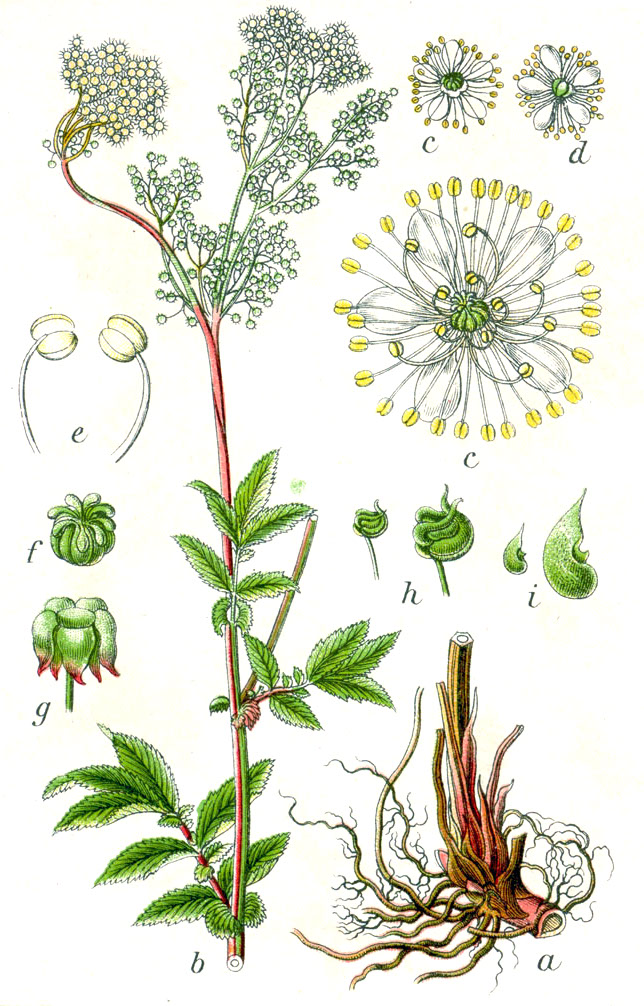
Meadowsweet is a tall perennial herb, reaching up to two metres. Its stems are upright, reddish or purple, and furrowed. The leaves are dark green above, pale and downy below, and deeply divided with large, lobed end leaflets. The plant produces dense clusters of small, creamy-white flowers with a strong, sweet, antiseptic-like scent. Each flower has five petals and many stamens, giving the clusters a fluffy look.
Where does Meadowsweet come from?
Meadowsweet is native to most of Europe and western Asia, thriving in damp meadows, fens, and wet woods. It is common in the British Isles and has spread to other regions, including North America, where it has naturalised. The name 'meadowsweet' comes from its use in flavouring mead, not from its habitat. Its scientific name refers to the elm-like shape of its leaves and the thread-like roots of its genus.
When and how Meadowsweet blooms
Meadowsweet blooms from early summer to early autumn. It prefers wet soils and is often found in low-lying meadows and along streams. The plant grows from seed or division, forming clumps in moist ground. Its flowers attract many insects, especially flies. The whole plant, including flowers and leaves, is harvested for its scent, flavour, or traditional uses.



How Meadowsweet is used
People have long used meadowsweet for its sweet aroma, spreading it on floors during festivals and weddings or making garlands. The flowers flavour mead, vinegar, wine, and desserts, and are added to jams and stewed fruit for an almond note. Dried flowers are used in potpourri. In Austria and elsewhere, teas and remedies are made from the plant. Its roots yield a black dye.
Kinds of Meadowsweet
Meadowsweet is sometimes called by other names, such as queen of the meadow or bridewort, reflecting its place in local traditions. It is dominant in certain wetland habitats in western Europe. There are no widely grown cultivars, but it is closely related to other Filipendula species.
What Meadowsweet means
Meadowsweet has been found in Bronze Age burial sites in Britain, possibly as a grave offering or flavouring for drinks. In Welsh mythology, it was one of the flowers used to create the figure Blodeuwedd. In the 16th century, it was a favourite strewing herb of Elizabeth I. The plant played a role in the development of aspirin, as its old name 'Spiraea' gave rise to the drug's name.
Where Meadowsweet is used and seen

Questions people ask about Meadowsweet
Where does meadowsweet come from?
Meadowsweet is native to most of Europe and western Asia, growing wild in damp meadows, fens, and wet woods. It is common in the British Isles and has also naturalised in North America.
What does meadowsweet look and smell like?
It is a tall plant with reddish, upright stems and deeply divided leaves. The creamy-white flowers are clustered in fluffy heads and have a strong, sweet, antiseptic-like scent, often compared to almonds.
How has meadowsweet been used by people?
Meadowsweet has been used to scent rooms, flavour mead, wine, and desserts, and as a traditional remedy. It was also used in wedding garlands and to make a natural black dye from its roots.
What does meadowsweet symbolise or mean in culture?
Meadowsweet is linked to weddings and festivals in Europe, and appears in Welsh mythology. It was found in ancient British graves and was a favourite of Elizabeth I for its scent.
Is meadowsweet important in science or medicine?
Yes, the plant contains salicin, and its old botanical name 'Spiraea' inspired the name 'aspirin' after scientists used its compounds to develop the drug.
Good reading and sources
- USDA Plants DatabaseUS Department of Agriculture, Article
- IUCN Red List of Threatened SpeciesIUCN Red List, Article
- Plants of the World OnlineRoyal Botanic Gardens, Kew, Plant database
- Where it has been recordedGBIF, Plant database
- Sightings and photos by naturalistsiNaturalist, Plant database
- Filipendula ulmaria on WikipediaEncyclopedia
- More photos on Wikimedia CommonsPhotos
- Wikidata recordOpen data
The facts on this page come from the Wikipedia article "Filipendula ulmaria", written by its contributors and used under the CC BY-SA 4.0 licence, and from its Wikidata record (CC0). Phool rewrote the text in its own words, with AI assistance, and compares every page with the article to make sure no passage is copied. It may be reused under the same CC BY-SA 4.0 licence with a link back.
It may contain mistakes. It is not medical or foraging advice: many flowers are poisonous, and traditional uses are reported, not recommended. If something is wrong, tell us. Last refreshed 2026-10-03.
Others in the family Rosaceae
The whole family RoseRosa
Woody perennial plants with showy, often fragrant flowers in many colours
Rosa · Wildflower
RoseRosa
Woody perennial plants with showy, often fragrant flowers in many colours
Rosa · Wildflower
 PeachPrunus persica
A flowering fruit tree from China, grown for its pink blossoms and sweet fruit
🇨🇳 China and 7 more · Flowering tree
PeachPrunus persica
A flowering fruit tree from China, grown for its pink blossoms and sweet fruit
🇨🇳 China and 7 more · Flowering tree
 AlmondPrunus amygdalus
A Mediterranean tree grown for its fragrant spring flowers and edible seeds
🇮🇷 Iran and 6 more · Flowering tree
AlmondPrunus amygdalus
A Mediterranean tree grown for its fragrant spring flowers and edible seeds
🇮🇷 Iran and 6 more · Flowering tree
 ApricotPrunus armeniaca
A small fruit tree with early white to pink blossoms and golden-orange fruit
🇨🇳 China and 6 more · Flowering tree
ApricotPrunus armeniaca
A small fruit tree with early white to pink blossoms and golden-orange fruit
🇨🇳 China and 6 more · Flowering tree
More from Austria
All the flowers of Austria RapeseedBrassica napus
A yellow-flowered crop grown for its oil-rich seeds and protein meal
🇨🇳 China and 7 more · Wildflower
RapeseedBrassica napus
A yellow-flowered crop grown for its oil-rich seeds and protein meal
🇨🇳 China and 7 more · Wildflower
 BlackthornPrunus spinosa
A spiny shrub with white spring flowers and tart blue-black fruit
🇬🇧 United Kingdom and 7 more · Wildflower
BlackthornPrunus spinosa
A spiny shrub with white spring flowers and tart blue-black fruit
🇬🇧 United Kingdom and 7 more · Wildflower
 ColtsfootTussilago farfara
A yellow spring-flowering herb once used in traditional remedies
🇨🇳 China and 4 more · Wildflower
ColtsfootTussilago farfara
A yellow spring-flowering herb once used in traditional remedies
🇨🇳 China and 4 more · Wildflower
 CornflowerCentaurea cyanus
A bright blue wildflower once common in European grain fields
🇩🇪 Germany and 7 more · Wildflower
CornflowerCentaurea cyanus
A bright blue wildflower once common in European grain fields
🇩🇪 Germany and 7 more · Wildflower