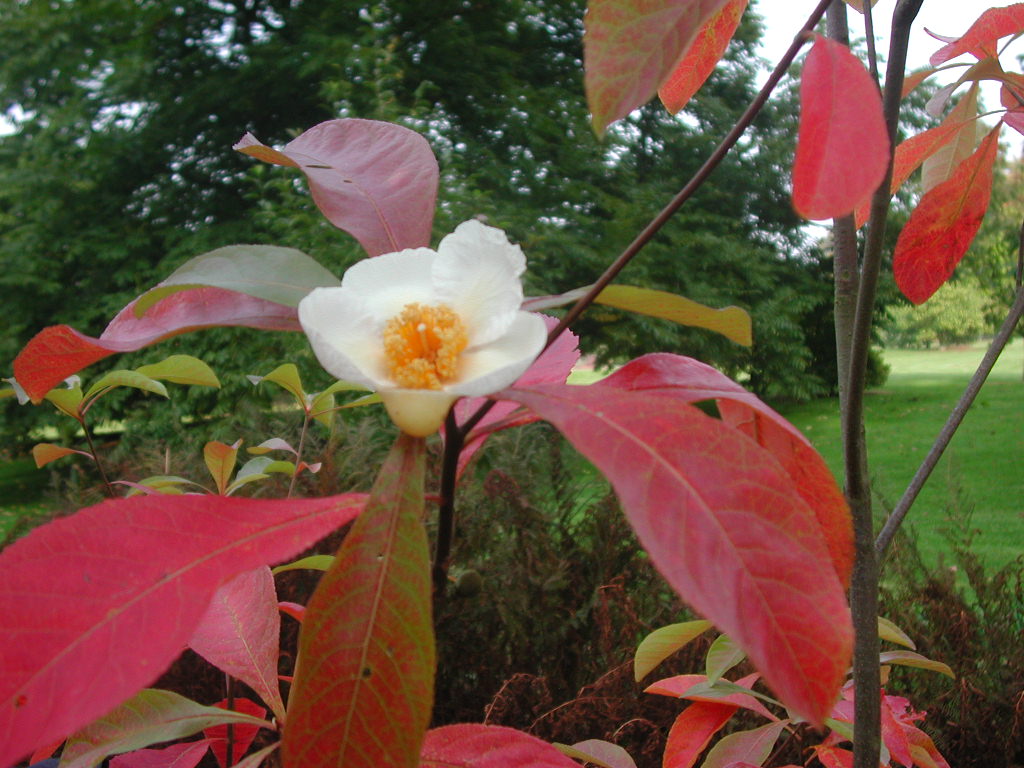
Franklin tree
Franklinia alatamaha, family Theaceae
A rare flowering tree once native to Georgia, now extinct in the wild
The Franklin tree is a small deciduous tree with large white flowers and bright autumn leaves, once found only along Georgia’s Altamaha River. Extinct in the wild since the early 1800s, it survives today in gardens from seed collected in the 18th century.
- Extinct in the wild since the early 1800s
- Large white flowers bloom in late summer and autumn
- All living trees descend from seeds collected in Georgia in the 1770s
- Leaves turn orange or red in fall
- Named to honor Benjamin Franklin
What does Franklin tree look like?
The Franklin tree grows as a small tree or large shrub, usually 5 to 7 meters tall, with a rounded shape and often several trunks. Its bark is gray with white streaks and a ridged feel. The leaves are bright green in summer, turning orange or red in fall, and are shaped like reversed teardrops. In late summer and autumn, it produces solitary, cup-shaped flowers about 7–10 cm across, with five creamy-white petals and golden-yellow stamens.
Where does Franklin tree come from?
The Franklin tree was native only to a small area along the Altamaha River in Georgia, USA. It was first recorded by John and William Bartram in the 1760s and 1770s, who collected seeds and brought them to Philadelphia. The tree disappeared from the wild by the early 1800s, likely due to a mix of natural and human causes. All living Franklin trees descend from the Bartrams’ original seed collection. Fossil evidence suggests its ancestors once had a much wider range.
When and how Franklin tree blooms
Franklinia blooms in late summer or early autumn. Its seeds take over a year to mature, with a rare dormancy period through winter before fruit sets the next summer. The tree prefers sandy, acidic soil and full sun for best flowering and autumn color. It is grown from seed or nursery stock, but can be difficult to establish due to sensitive roots and intolerance of poor drainage or drought.


How Franklin tree is used
Today, the Franklin tree is grown as an ornamental in gardens, valued for its large flowers and colorful fall leaves. It is not found in the wild, but can be seen in places like Bartram’s Garden in Philadelphia. There have been attempts to reintroduce it to its native Georgia habitat, but these have not succeeded.
Kinds of Franklin tree
Franklinia is a monotypic genus, meaning it contains only one species, Franklinia alatamaha. It has sometimes been grouped with related genera like Gordonia and Schima, and hybrids have been made with these relatives. The tree’s appearance and flowering are fairly consistent, though fall leaf color can vary.
What Franklin tree means
The Franklin tree is named for Benjamin Franklin, a friend of the Bartrams. It is known for its unique story of discovery, extinction in the wild, and survival only in cultivation. The tree is sometimes seen as a symbol of rarity and conservation. Its history is closely tied to early American botany and the Bartram family’s work.
Questions people ask about Franklin tree
Where did the Franklin tree originally grow?
The Franklin tree was native only to the Altamaha River valley in Georgia, United States. It was never found growing wild anywhere else.
Why is the Franklin tree extinct in the wild?
The exact cause is unknown, but factors may include fire, flooding, disease, and overcollection. The last confirmed wild tree was seen in the early 1800s.
What does the Franklin tree look like?
It is a small tree with bright green leaves that turn orange or red in autumn. Its flowers are large, cup-shaped, and white with yellow centers, appearing in late summer and autumn.
How is the Franklin tree used today?
It is grown as an ornamental tree in gardens for its striking flowers and colorful fall foliage. All cultivated trees come from seeds collected in the 18th century.
What does the Franklin tree symbolize?
The Franklin tree is often seen as a symbol of rarity and conservation, and its story is closely linked to early American botanical history.
Good reading and sources
- Encyclopaedia BritannicaArticle
- IUCN Red List of Threatened SpeciesIUCN Red List, Article
- USDA Plants DatabaseUS Department of Agriculture, Article
- Plants of the World OnlineRoyal Botanic Gardens, Kew, Plant database
- Where it has been recordedGBIF, Plant database
- Sightings and photos by naturalistsiNaturalist, Plant database
The facts on this page come from the Wikipedia article "Franklinia", written by its contributors and used under the CC BY-SA 4.0 licence, and from its Wikidata record (CC0). Phool rewrote the text in its own words, with AI assistance, and compares every page with the article to make sure no passage is copied. It may be reused under the same CC BY-SA 4.0 licence with a link back.
It may contain mistakes. It is not medical or foraging advice: many flowers are poisonous, and traditional uses are reported, not recommended. If something is wrong, tell us. Last refreshed 2026-10-03.
Others in the family Theaceae
The whole family Camellia
Evergreen shrubs and trees with showy blooms, best known for tea and garden flowers
🇨🇳 China and 6 more · Garden flower
Camellia
Evergreen shrubs and trees with showy blooms, best known for tea and garden flowers
🇨🇳 China and 6 more · Garden flower
 Camellia reticulata
Tall pink-flowered camellia from Yunnan, grown for gardens and tea oil
🇨🇳 China · Flowering tree
Camellia reticulata
Tall pink-flowered camellia from Yunnan, grown for gardens and tea oil
🇨🇳 China · Flowering tree
 Camellia amplexicaulisHải đường
A pink-flowered camellia tree once found in Vietnam’s forests
🇻🇳 Vietnam · Flowering tree
Camellia amplexicaulisHải đường
A pink-flowered camellia tree once found in Vietnam’s forests
🇻🇳 Vietnam · Flowering tree
 Hong Kong CamelliaCamellia hongkongensis
A rare camellia tree from Hong Kong with red flowers
🇭🇰 Hong Kong and 1 more · Flowering tree
Hong Kong CamelliaCamellia hongkongensis
A rare camellia tree from Hong Kong with red flowers
🇭🇰 Hong Kong and 1 more · Flowering tree
More from the United States
All the flowers of the United States RoseRosa
Prickly flowering shrubs grown across the world for fragrant blossoms and rose hips
🇨🇳 China and 7 more · Flowering shrub
RoseRosa
Prickly flowering shrubs grown across the world for fragrant blossoms and rose hips
🇨🇳 China and 7 more · Flowering shrub
 PeachPrunus persica
A flowering fruit tree from China, grown for its pink blossoms and sweet fruit
🇨🇳 China and 7 more · Flowering tree
PeachPrunus persica
A flowering fruit tree from China, grown for its pink blossoms and sweet fruit
🇨🇳 China and 7 more · Flowering tree
 AlmondPrunus amygdalus
A Mediterranean tree grown for its fragrant spring flowers and edible seeds
🇮🇷 Iran and 6 more · Flowering tree
AlmondPrunus amygdalus
A Mediterranean tree grown for its fragrant spring flowers and edible seeds
🇮🇷 Iran and 6 more · Flowering tree
 CactusCactaceae
Succulent plants with spines, native to the Americas
🇲🇽 Mexico and 7 more · Wildflower
CactusCactaceae
Succulent plants with spines, native to the Americas
🇲🇽 Mexico and 7 more · Wildflower