
Yellow Himalayan fritillary
Fritillaria cirrhosa, family Liliaceae
A rare Himalayan lily with bell-shaped, checkered flowers and prized medicinal bulbs
Yellow Himalayan fritillary is a perennial plant native to the high slopes and shrublands of the Himalayas and parts of China and Myanmar. It has nodding, bell-shaped flowers in yellow-green to brownish-purple, and is mainly harvested for its bulbs, which are used in traditional Chinese medicine.
- Native to high-altitude slopes of the Himalayas and southwestern China
- Bell-shaped flowers with yellow-green to brownish-purple checkered tepals
- Bulbs are prized in traditional Chinese medicine for coughs and asthma
- Now endangered due to overharvesting and habitat loss
- Protected as a medicinal plant in China
What does Yellow Himalayan fritillary look like?
Fritillaria cirrhosa is a perennial herb with slender, upright stems reaching up to 60 cm tall. Its leaves are long, narrow, and usually grow in pairs or whorls. The plant produces one to three nodding, bell-shaped flowers at the top of the stem. The flowers have six tepals that range from yellowish-green to brownish-purple, often marked with a dull purple checkered pattern. The bulbs are small, up to 20 mm across. The fruit is a capsule with narrow wings.
Where does Yellow Himalayan fritillary come from?
This plant is native to the alpine slopes, shrublands, and moist meadows of the Himalayas and southwestern China, growing at elevations between 2,700 and 4,000 meters. It is found in regions such as Gansu, Qinghai, Sichuan, Tibet, Yunnan, Nepal, Bhutan, India, Pakistan, and Myanmar. Fritillaria cirrhosa was first described by David Don in 1825. The genus name refers to the checkered pattern of the flowers, while the species name hints at the plant's curly or tendril-like features.
When and how Yellow Himalayan fritillary blooms
Fritillaria cirrhosa flowers from May to July. It thrives in cool, moist, high-altitude habitats and is adapted to alpine slopes, shrublands, and forest edges. The plant reproduces both by seed, dispersed by wind or water, and asexually, though its breeding is not well documented. Cultivation is challenging due to its specific habitat needs, so most bulbs are still collected from the wild.


How Yellow Himalayan fritillary is used
The bulbs of Fritillaria cirrhosa are highly valued in traditional Chinese medicine and are used to treat coughs, asthma, and other respiratory issues. They are an ingredient in herbal syrups and powders, and are also used in food and ritual offerings in the Nepal Himalaya. In Tibet and Ladakh, the plant is used as a snake bite antidote. Overharvesting for these uses has put the species at risk.
Kinds of Yellow Himalayan fritillary
Some plants once considered varieties or forms of Fritillaria cirrhosa are now recognized as separate species, such as Fritillaria yuzhongensis, Fritillaria sichuanica, and Fritillaria taipaiensis. No infraspecific varieties are currently recognized for Fritillaria cirrhosa itself.
What Yellow Himalayan fritillary means
Fritillaria cirrhosa is a Class III protected species in China due to its declining wild populations. Its bulbs are an important part of Chinese herbal medicine, and the plant is also used in ritual offerings in the Himalayas. Conservation efforts are underway in regions like Sichuan and Yunnan to protect its genetic diversity and reduce wild harvesting.
Questions people ask about Yellow Himalayan fritillary
Where does Fritillaria cirrhosa come from?
It grows wild on alpine slopes and shrublands in the Himalayas and southwestern China, including regions like Sichuan, Yunnan, Tibet, Nepal, Bhutan, India, Pakistan, and Myanmar.
What does the yellow Himalayan fritillary look like?
It is a slender herb with narrow leaves and nodding, bell-shaped flowers. The flowers are yellowish-green to brownish-purple, often with a checkered pattern, and usually appear singly at the top of the stem.
How is Fritillaria cirrhosa used?
Its bulbs are used in traditional Chinese medicine, especially for treating coughs and asthma. They are also used in food, ritual offerings in the Himalayas, and as a snake bite antidote in Tibet and Ladakh.
Why is Fritillaria cirrhosa endangered?
The species is threatened by overharvesting for its medicinal bulbs and by habitat loss. Most bulbs are still collected from the wild, making conservation a concern.
Does Fritillaria cirrhosa have any symbolic or cultural meaning?
Its main cultural role is as a valued medicinal plant in Chinese and Himalayan traditions, and it is used in ritual offerings in the Nepal Himalaya.
Good reading and sources
- IUCN Red List of Threatened SpeciesIUCN Red List, Article
- Plants of the World OnlineRoyal Botanic Gardens, Kew, Plant database
- Where it has been recordedGBIF, Plant database
- Sightings and photos by naturalistsiNaturalist, Plant database
- Fritillaria cirrhosa on WikipediaEncyclopedia
- More photos on Wikimedia CommonsPhotos
- Wikidata recordOpen data
The facts on this page come from the Wikipedia article "Fritillaria cirrhosa", written by its contributors and used under the CC BY-SA 4.0 licence, and from its Wikidata record (CC0). Phool rewrote the text in its own words, with AI assistance, and compares every page with the article to make sure no passage is copied. It may be reused under the same CC BY-SA 4.0 licence with a link back.
It may contain mistakes. It is not medical or foraging advice: many flowers are poisonous, and traditional uses are reported, not recommended. If something is wrong, tell us. Last refreshed 2026-10-03.
Others in the family Liliaceae
The whole family TulipTulipa
Spring-blooming bulbs with showy, cup-shaped flowers in many colours
🇳🇱 Netherlands and 7 more · Wildflower
TulipTulipa
Spring-blooming bulbs with showy, cup-shaped flowers in many colours
🇳🇱 Netherlands and 7 more · Wildflower
 LilyLilium
Tall bulb flowers with large, colourful blooms in many gardens and cultures
Lilium · Wildflower
LilyLilium
Tall bulb flowers with large, colourful blooms in many gardens and cultures
Lilium · Wildflower
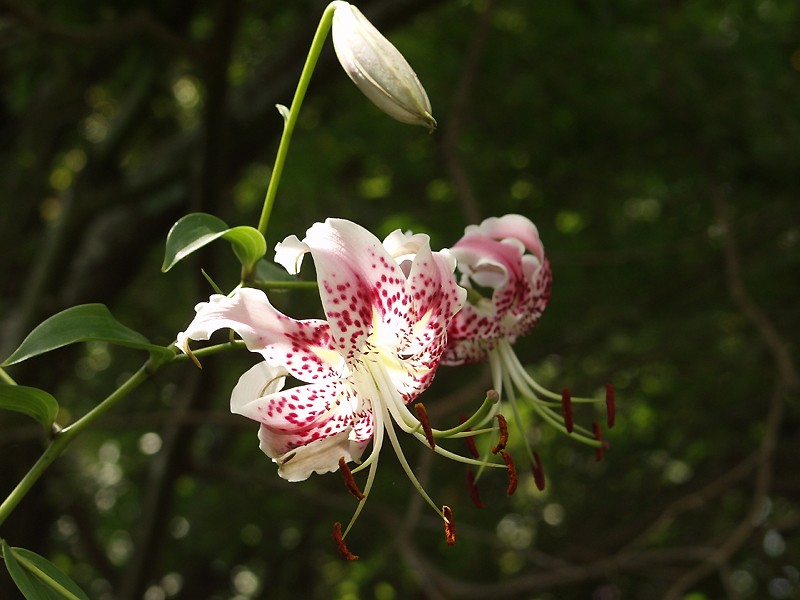 Lilium speciosum
A late-summer lily with fragrant white to pink flowers from East Asia
🇯🇵 Japan and 2 more · Wildflower
Lilium speciosum
A late-summer lily with fragrant white to pink flowers from East Asia
🇯🇵 Japan and 2 more · Wildflower
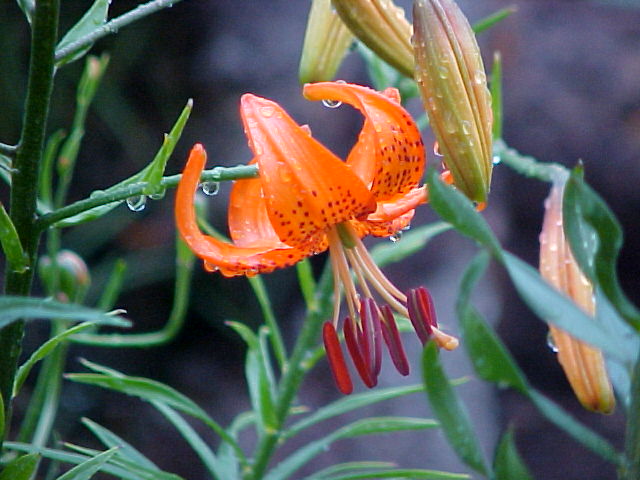 Lilium davidii
A tall Asian lily with edible bulbs and orange recurved flowers
🇨🇳 China and 1 more · Wildflower
Lilium davidii
A tall Asian lily with edible bulbs and orange recurved flowers
🇨🇳 China and 1 more · Wildflower
More from China
All the flowers of China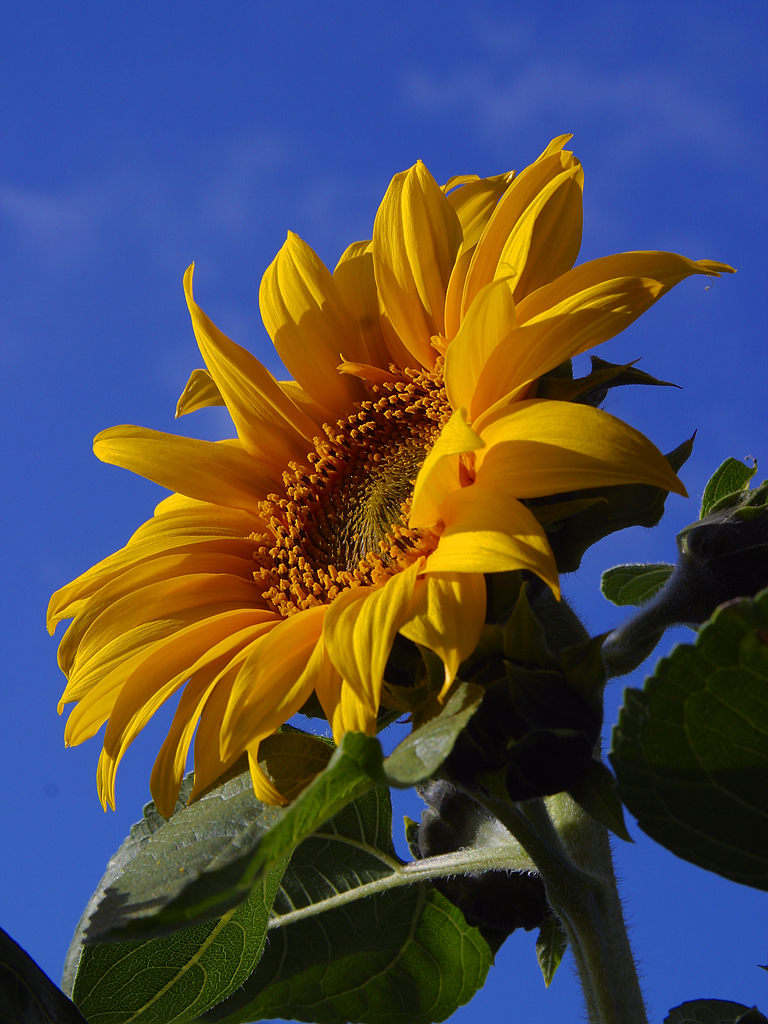 Common sunflowerHelianthus annuus
A tall annual plant grown for its large yellow flower heads and edible seeds
🇨🇦 Canada and 4 more · Wildflower
Common sunflowerHelianthus annuus
A tall annual plant grown for its large yellow flower heads and edible seeds
🇨🇦 Canada and 4 more · Wildflower
 BirchBetula
Slender trees with papery bark found across the northern world
🇨🇳 China and 7 more · Wildflower
BirchBetula
Slender trees with papery bark found across the northern world
🇨🇳 China and 7 more · Wildflower
 FennelFoeniculum vulgare
A tall, aromatic herb with feathery leaves and yellow umbels, used for food and spice
🇨🇳 China and 7 more · Herb or useful flower
FennelFoeniculum vulgare
A tall, aromatic herb with feathery leaves and yellow umbels, used for food and spice
🇨🇳 China and 7 more · Herb or useful flower
 RosemarySalvia rosmarinus
A fragrant evergreen shrub with needle-like leaves and purple, blue, or white flowers
🇪🇸 Spain and 5 more · Flowering shrub
RosemarySalvia rosmarinus
A fragrant evergreen shrub with needle-like leaves and purple, blue, or white flowers
🇪🇸 Spain and 5 more · Flowering shrub