
Giant snowdrop
Galanthus elwesii, family Amaryllidaceae
A tall, early-blooming snowdrop from the Balkans and Asia Minor
Giant snowdrop is a perennial bulb plant with nodding white flowers and blue-green leaves, native to the Balkans and parts of Asia Minor. It grows in gardens for its early spring blooms and is valued for its robust size compared to other snowdrops.
- Native to the Balkans and Asia Minor
- Flowers in early spring from autumn-planted bulbs
- Named after botanist Henry John Elwes
- More robust than the common snowdrop
- Blue-green leaves and white, green-marked flowers
What does Giant snowdrop look like?
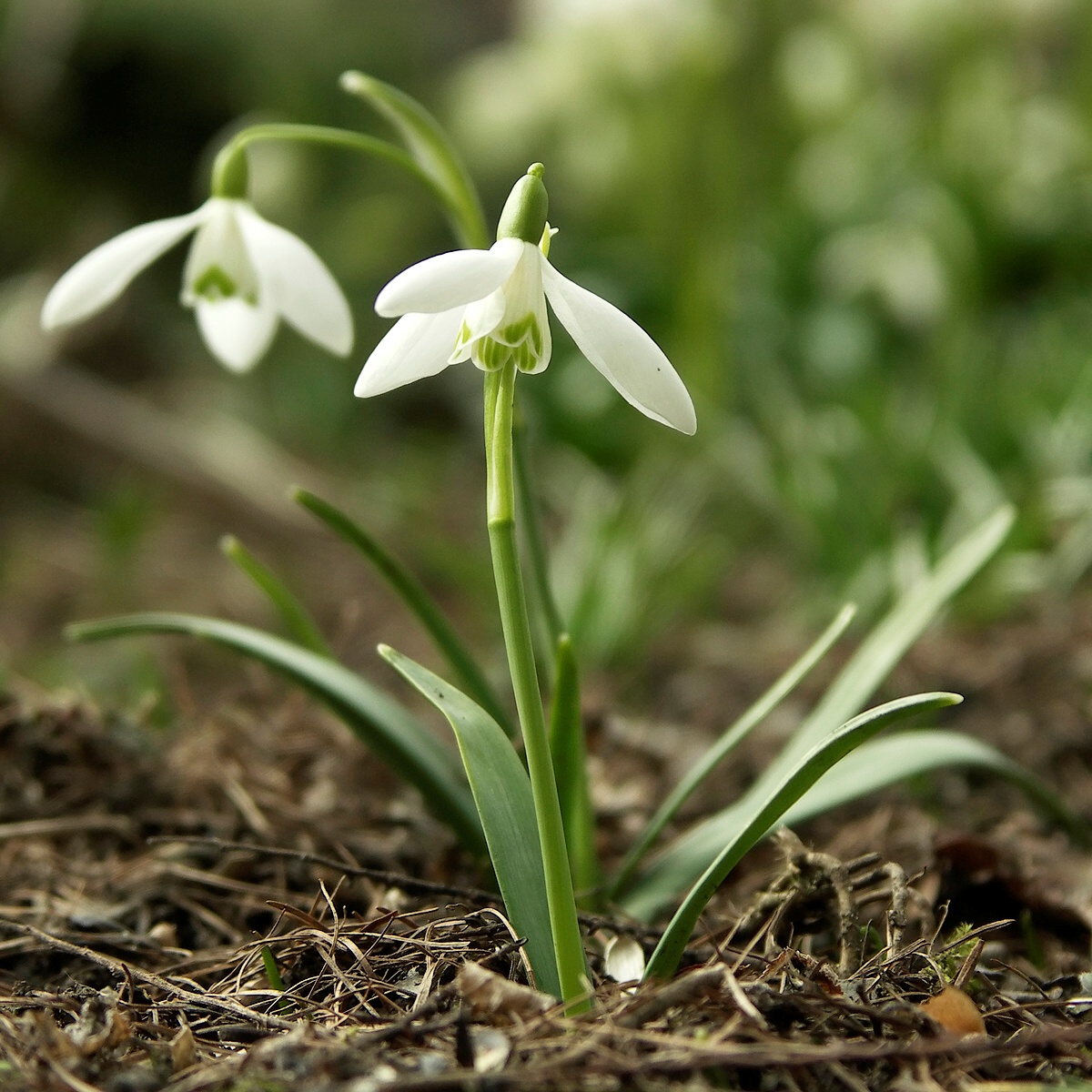
Giant snowdrop grows from a rounded bulb and reaches up to 25 cm tall. It has two blue-green, linear leaves and produces a single, drooping white flower at the tip of a sturdy stem. The outer petals are longer and shaped like narrow spoons, while the inner petals are shorter, notched at the tip, and marked with green patches. The plant is more robust than the common snowdrop.
Where does Giant snowdrop come from?
This snowdrop is native to the Balkans and Asia Minor, including areas now in Turkey, Bulgaria, Greece, Serbia, Moldova, and Ukraine. It was first collected by Henry John Elwes in Turkey in 1874 and named after him by Joseph Dalton Hooker the following year. The name stuck even after it was found that Elwes’s original specimen was a different species.
When and how Giant snowdrop blooms
Giant snowdrop bulbs are planted in autumn and bloom in early spring. The plant prefers to grow in gardens where it can naturalise, spreading gradually over time. After flowering, new bulbs can be separated from the main clump to encourage further growth. It thrives in climates similar to its native range.

How Giant snowdrop is used
Gardeners grow giant snowdrop for its early white flowers, which appear at the end of winter or start of spring. It is often planted in borders, under trees, or in lawns where it can form natural-looking drifts. Its ability to naturalise makes it a favourite for creating early spring displays.
Kinds of Giant snowdrop
Several forms of Galanthus elwesii are grown in gardens. Notable ones include the main species, the 'Comet' cultivar, and the variety monostictus. These forms differ in flower markings and shape, offering gardeners a choice of subtle variations.
What Giant snowdrop means
Giant snowdrop is appreciated for its early flowering and resilience. It is grown widely outside its native region as an ornamental bulb. Its introduction to gardens began in the late 19th century, and it remains a sign of the changing seasons for many gardeners.
Questions people ask about Giant snowdrop
Where does the giant snowdrop come from?
It is native to the Balkans and Asia Minor, including countries such as Turkey, Bulgaria, Greece, Serbia, Moldova, and Ukraine.
What does the giant snowdrop look like?
It grows up to 25 cm tall, with two blue-green leaves and a single white, nodding flower marked with green patches on the inner petals.
How is the giant snowdrop used?
It is grown in gardens for its early spring flowers and is valued for its ability to naturalise and form drifts.
When does the giant snowdrop bloom?
It blooms in early spring, shortly after the winter ends, from bulbs planted in autumn.
Why is it called Elwes's snowdrop?
It is named after Henry John Elwes, a British botanist who collected it in Turkey in 1874.
Good reading and sources
- Encyclopaedia BritannicaArticle
- Galanthus elwesiiRoyal Horticultural Society, Article
- IUCN Red List of Threatened SpeciesIUCN Red List, Article
- Plants of the World OnlineRoyal Botanic Gardens, Kew, Plant database
- Where it has been recordedGBIF, Plant database
- Sightings and photos by naturalistsiNaturalist, Plant database
- Galanthus elwesii on WikipediaEncyclopedia
- More photos on Wikimedia CommonsPhotos
- Wikidata recordOpen data
The facts on this page come from the Wikipedia article "Galanthus elwesii", written by its contributors and used under the CC BY-SA 4.0 licence, and from its Wikidata record (CC0). Phool rewrote the text in its own words, with AI assistance, and compares every page with the article to make sure no passage is copied. It may be reused under the same CC BY-SA 4.0 licence with a link back.
It may contain mistakes. It is not medical or foraging advice: many flowers are poisonous, and traditional uses are reported, not recommended. If something is wrong, tell us. Last refreshed 2026-10-03.
Others in the family Amaryllidaceae
The whole family Narcissus
Spring-flowering bulbs with trumpet-shaped blooms in white, yellow, and orange
🇬🇧 United Kingdom and 7 more · Wildflower
Narcissus
Spring-flowering bulbs with trumpet-shaped blooms in white, yellow, and orange
🇬🇧 United Kingdom and 7 more · Wildflower
 Wild GarlicAllium ursinum
A wild woodland plant with star-shaped white flowers and edible leaves
🇮🇪 Ireland · Wildflower
Wild GarlicAllium ursinum
A wild woodland plant with star-shaped white flowers and edible leaves
🇮🇪 Ireland · Wildflower
 Allium
The genus of onions, garlic, leeks, chives and their wild relatives
Allium · Wildflower
Allium
The genus of onions, garlic, leeks, chives and their wild relatives
Allium · Wildflower
 SnowdropGalanthus
White bell-shaped flowers that bloom at the end of winter
🇹🇷 Turkey and 7 more · Wildflower
SnowdropGalanthus
White bell-shaped flowers that bloom at the end of winter
🇹🇷 Turkey and 7 more · Wildflower
More from Turkey
All the flowers of Turkey PeachPrunus persica
A flowering fruit tree from China, grown for its pink blossoms and sweet fruit
🇨🇳 China and 7 more · Flowering tree
PeachPrunus persica
A flowering fruit tree from China, grown for its pink blossoms and sweet fruit
🇨🇳 China and 7 more · Flowering tree
 PomegranatePunica granatum
A shrub with bright red flowers and a fruit full of edible seeds
🇮🇷 Iran and 9 more · Flowering shrub
PomegranatePunica granatum
A shrub with bright red flowers and a fruit full of edible seeds
🇮🇷 Iran and 9 more · Flowering shrub
 TulipTulipa
Spring-blooming bulbs with showy, cup-shaped flowers in many colours
🇳🇱 Netherlands and 7 more · Wildflower
TulipTulipa
Spring-blooming bulbs with showy, cup-shaped flowers in many colours
🇳🇱 Netherlands and 7 more · Wildflower
 Sour cherryPrunus cerasus
The small, tart cherry tree grown for its sour red fruit
🇹🇷 Turkey and 7 more · Flowering tree
Sour cherryPrunus cerasus
The small, tart cherry tree grown for its sour red fruit
🇹🇷 Turkey and 7 more · Flowering tree