
Gesneriad
Gesneriaceae, family Gesneriaceae
A diverse family of showy tropical herbs, houseplants, and forest bloomers
Gesneriaceae is a widespread family of flowering perennials and small shrubs native mainly to tropical and subtropical forests worldwide. Celebrated for their showy tubular blossoms, these plants include popular houseplants like African violets alongside wild species adapted to hummingbird pollination.
- Contains over 3,500 species across roughly 152 genera, mainly in tropical and subtropical zones.
- Named in honour of the Swiss naturalist Conrad Gessner.
- Includes popular ornamental houseplants such as African violets and Cape primroses.
- Many American species produce tubular red blooms adapted for hummingbird pollination.
What does Gesneriad look like?
Gesneriads are mostly perennial herbs and small woody subshrubs, though a few grow into small trees or larger shrubs. Their blossoms feature fused petals that form an elongated tube, often with two distinct lips. Leaves generally grow in balanced opposite pairs along the stems, though some varieties display spiral or alternating leaf patterns. A hallmark of many species is an unusual flower cluster structure where blossoms emerge in paired cymes. Their seed capsules can be dry or fleshy berries, each packed with hundreds of minute seeds.
Where does Gesneriad come from?
The family honours Conrad Gessner, a sixteenth-century Swiss humanist and naturalist. French botanists Louis Claude Richard and Antoine Laurent de Jussieu established the official family name in 1816. Gesneriaceae includes approximately 3,540 species spread across 152 genera. Wild populations thrive primarily in tropical and subtropical regions across the Americas, Africa, and Asia, with minor extensions into temperate climates. Numerous historic taxonomists, including Robert Brown and George Bentham, helped map out relationships within the family.
When and how Gesneriad blooms
Growers categorize these plants into three distinct types depending on their stem structures. Tuberous varieties develop thick underground lumps, rhizomatous kinds spread through scaly underground stems, and fibrous-rooted types grow standard roots without storage organs. Many species from the Americas produce tubular red blooms adapted for feeding hummingbirds. In cultivation, these forest plants often perform best in sheltered, humid indoor conditions with filtered light.


How Gesneriad is used
People around the world grow gesneriads as indoor houseplants and ornamental garden flowers. The best-known garden and windowsill varieties are African violets and Cape primroses, both classified under the genus Streptocarpus. Enthusiasts also cultivate trailing plants from genera such as Aeschynanthus, Nematanthus, and Columnea. The international Gesneriad Society supports amateur growers and botanists who cultivate, breed, and document these plants.
Kinds of Gesneriad
Taxonomists split the family into two primary branches. Didymocarpoideae encompasses nearly all Old World varieties, which usually feature two pollen-bearing stamens and seedlings where one seed leaf outgrows the other. In contrast, Gesnerioideae contains American and Pacific species, typically possessing four fertile stamens. A third, isolated subfamily contains only the woody genus Sanango from South America.
Where Gesneriad is used and seen


Questions people ask about Gesneriad
Where do gesneriads come from?
They grow wild primarily across tropical and subtropical regions of the Americas, Africa, Asia, Australia, and Pacific islands, with a small number reaching into temperate areas.
What are the most familiar gesneriads grown in homes?
African violets and Cape primroses, both part of the genus Streptocarpus, are the most widely grown houseplants in the family, alongside species of Columnea and Aeschynanthus.
How do wild gesneriads get pollinated?
Around half of the New World species rely on birds such as hummingbirds for pollination, developing distinctive red, two-lipped tubular flowers. Similar bird-pollinated floral shapes also appear in some Old World genera.
Good reading and sources
- Encyclopaedia BritannicaArticle
- Plants of the World OnlineRoyal Botanic Gardens, Kew, Plant database
- Where it has been recordedGBIF, Plant database
- Sightings and photos by naturalistsiNaturalist, Plant database
The facts on this page come from the Wikipedia article "Gesneriaceae", written by its contributors and used under the CC BY-SA 4.0 licence, and from its Wikidata record (CC0). EveryPhool rewrote the text in its own words, with AI assistance, and compares every page with the article to make sure no passage is copied. It may be reused under the same CC BY-SA 4.0 licence with a link back.
It may contain mistakes. It is not medical or foraging advice: many flowers are poisonous, and traditional uses are reported, not recommended. If something is wrong, tell us. Last refreshed 2026-10-04.
Others in the family Gesneriaceae
The whole family HaberleaHaberlea rhodopensis
A rare Balkan flower that revives after years without water
🇧🇬 Bulgaria and 1 more · Wildflower
HaberleaHaberlea rhodopensis
A rare Balkan flower that revives after years without water
🇧🇬 Bulgaria and 1 more · Wildflower
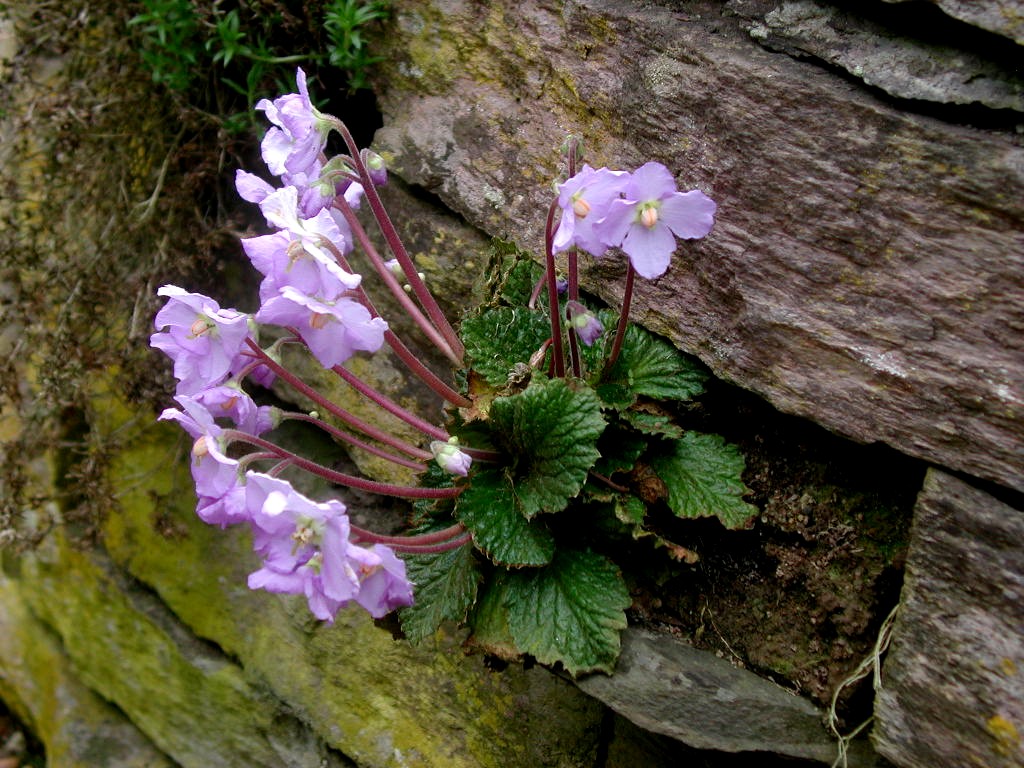 Ramonda nathaliaeНаталијина рамонда
A small Balkan flower that can survive drying out and revive with water
🇷🇸 Serbia and 2 more · Wildflower
Ramonda nathaliaeНаталијина рамонда
A small Balkan flower that can survive drying out and revive with water
🇷🇸 Serbia and 2 more · Wildflower
 African violetSaintpaulia
A small, velvety-leaved house plant with violet, blue or white flowers from East Africa
🇹🇿 Tanzania and 1 more · Wildflower
African violetSaintpaulia
A small, velvety-leaved house plant with violet, blue or white flowers from East Africa
🇹🇿 Tanzania and 1 more · Wildflower
 Brazilian gloxiniaSinningia speciosa
A tuberous houseplant with large, velvety flowers from Brazil
🇧🇷 Brazil and 1 more · Garden flower
Brazilian gloxiniaSinningia speciosa
A tuberous houseplant with large, velvety flowers from Brazil
🇧🇷 Brazil and 1 more · Garden flower
More from Australia
All the flowers of Australia AlmondPrunus amygdalus
A Mediterranean tree grown for its fragrant spring flowers and edible seeds
🇮🇷 Iran and 6 more · Flowering tree
AlmondPrunus amygdalus
A Mediterranean tree grown for its fragrant spring flowers and edible seeds
🇮🇷 Iran and 6 more · Flowering tree
 FennelFoeniculum vulgare
A tall, aromatic herb with feathery leaves and yellow umbels, used for food and spice
🇨🇳 China and 7 more · Herb or useful flower
FennelFoeniculum vulgare
A tall, aromatic herb with feathery leaves and yellow umbels, used for food and spice
🇨🇳 China and 7 more · Herb or useful flower
 RosemarySalvia rosmarinus
A fragrant evergreen shrub with needle-like leaves and purple, blue, or white flowers
🇪🇸 Spain and 5 more · Flowering shrub
RosemarySalvia rosmarinus
A fragrant evergreen shrub with needle-like leaves and purple, blue, or white flowers
🇪🇸 Spain and 5 more · Flowering shrub
 Eucalyptus
The tall, aromatic trees and shrubs known as gum trees or eucalypts
🇦🇺 Australia and 7 more · Flowering tree
Eucalyptus
The tall, aromatic trees and shrubs known as gum trees or eucalypts
🇦🇺 Australia and 7 more · Flowering tree