
Leucojum
White-flowered bulbs of damp meadows and shady gardens
Leucojum is a small group of bulb plants in the amaryllis family, found wild from Europe to Iran and widely grown elsewhere. Its two species, known as snowflakes, have white flowers with green or yellow tips and prefer moist, shady spots. Gardeners value them for their hardiness and early blooms.
- Leucojum includes only two species: L. aestivum and L. vernum
- Both species have white, bell-shaped flowers with green or yellow tips
- Native from Europe to Iran, now naturalized in Japan, Australia, and the Americas
- Prefers damp meadows, ditches, and shady woodlands
- Cultivars like 'Gravetye Giant' are popular in gardens
What does Leucojum look like?
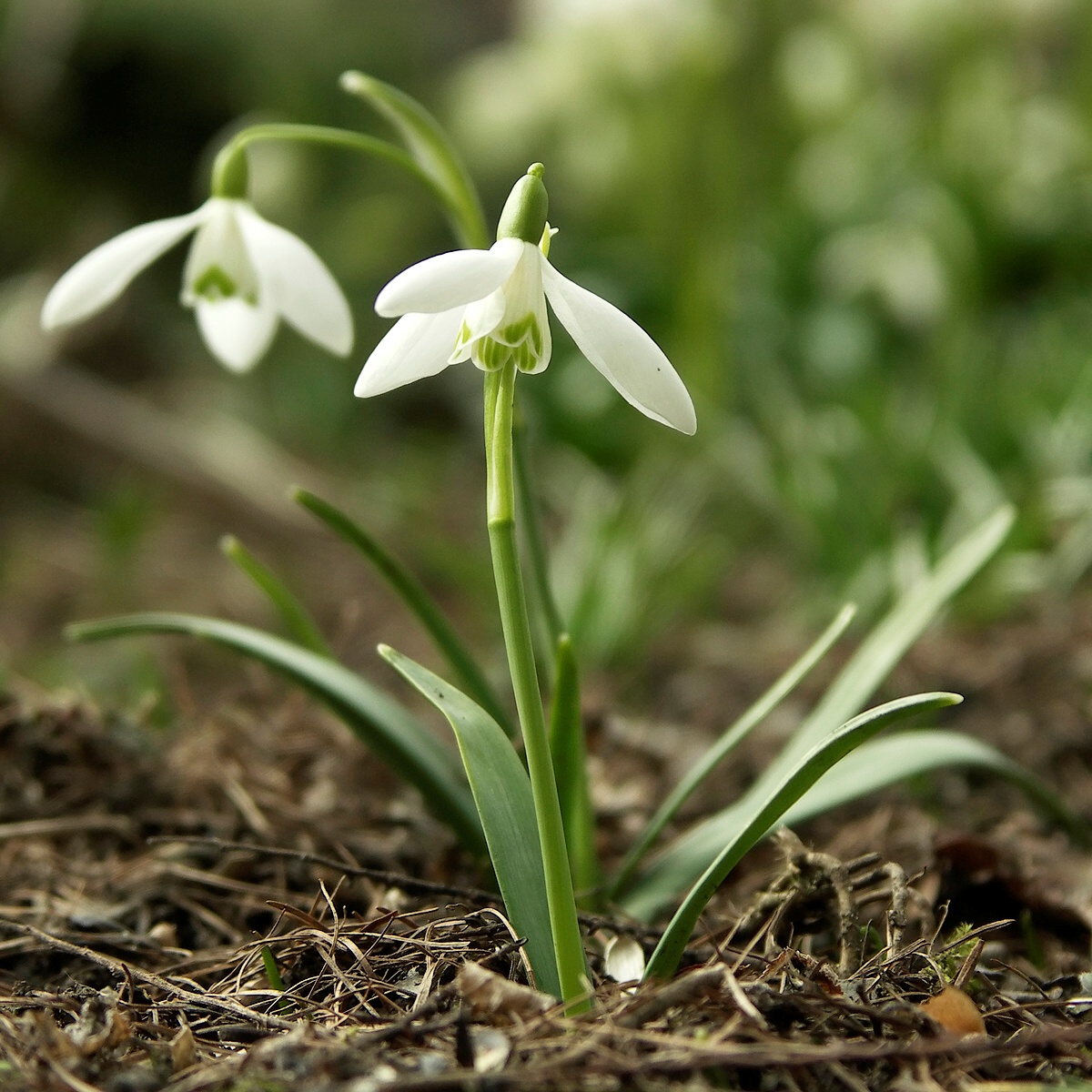
Leucojum plants grow from bulbs and send up strap-shaped leaves that are broader than those of their close relatives, the snowdrops. Their flowers are bell-shaped, white, and dangle from hollow stems. Each flower shows a green or yellow mark at the tip of each tepal (the petal-like parts). The seeds are relatively large for a bulb plant. The two main species differ in size and flowering time, but both bring a fresh look to damp gardens and meadows.
Where does Leucojum come from?
Leucojum comes from a region stretching from much of Europe into Turkey and Iran. The name combines Greek words for 'white' and 'violet.' Over time, botanists have revised which plants belong in this group, moving many species into the separate genus Acis. Today, only two species remain in Leucojum: L. aestivum and L. vernum. Both have spread beyond their native range, becoming established in gardens and wild areas in places like Japan, Australia, North America, and Uruguay.
When and how Leucojum blooms
Leucojum bulbs are planted in moist, shady or partly sunny spots, often in gardens with heavy or clay soils. The bulbs should be replanted soon after lifting, as they do not store well when dry. Plants can be started from seed, but these need a cold period to sprout and may take several years to flower. Division of bulbs is another way to propagate them. The plants are generally tough, but may be affected by bulb flies, slugs, snails, or fungal diseases.


How Leucojum is used
Gardeners grow Leucojum for their early and reliable blooms, especially in damp soils where other bulbs may struggle. The flowers are valued for their gentle appearance and are sometimes used as emblems or symbols in local areas. Both species are recommended for naturalizing in meadows or woodland gardens, and some cultivars have been recognized for their performance by horticultural societies.
Kinds of Leucojum
Notable forms include Leucojum aestivum 'Gravetye Giant', which has larger flowers and is named after an English manor house, and Leucojum vernum 'Podpolozje', which can bear two flowers per stem with yellowish spots. Both main species have received awards for garden merit. Many similar plants once grouped with Leucojum are now classified under Acis.
What Leucojum means
Leucojum has a modest but steady presence in gardens and local traditions. In some regions, it is associated with particular valleys or counties and has been chosen as a floral emblem. The plant's white, nodding blooms are sometimes linked with purity or early spring, and its alternative names recall saints and snow. Its role is mainly horticultural rather than religious or culinary.
Questions people ask about Leucojum
Where does Leucojum come from?
Leucojum is native to a broad area from much of Europe through Turkey to Iran, and has become naturalized in places such as Japan, Australia, North America, and Uruguay.
What do Leucojum flowers look like?
They have white, bell-shaped flowers with a green or yellow mark at the tip of each tepal, and grow on hollow stems above broad, strap-like leaves.
How is Leucojum used?
Leucojum is mainly grown in gardens for its attractive, early-season blooms. It is also used as a local emblem in some places and can be found in damp meadows and woodland gardens.
What makes Leucojum different from similar bulbs?
Leucojum has hollow flower stalks, broader leaves, and marked tepals, while related genera like Acis have solid stems, narrow leaves, and unmarked flowers.
Are there different types of Leucojum?
Yes, the genus now includes only two species, but there are several garden cultivars such as 'Gravetye Giant' and 'Podpolozje', each with unique flower traits.
Good reading and sources
- Encyclopaedia BritannicaArticle
- USDA Plants DatabaseUS Department of Agriculture, Article
- Plants of the World OnlineRoyal Botanic Gardens, Kew, Plant database
- Where it has been recordedGBIF, Plant database
- Sightings and photos by naturalistsiNaturalist, Plant database
The facts on this page come from the Wikipedia article "Leucojum", written by its contributors and used under the CC BY-SA 4.0 licence, and from its Wikidata record (CC0). Phool rewrote the text in its own words, with AI assistance, and compares every page with the article to make sure no passage is copied. It may be reused under the same CC BY-SA 4.0 licence with a link back.
It may contain mistakes. It is not medical or foraging advice: many flowers are poisonous, and traditional uses are reported, not recommended. If something is wrong, tell us. Last refreshed 2026-10-03.
Others in the family Amaryllidaceae
The whole family Narcissus
Spring-flowering bulbs with trumpet-shaped blooms in white, yellow, and orange
🇬🇧 United Kingdom and 7 more · Wildflower
Narcissus
Spring-flowering bulbs with trumpet-shaped blooms in white, yellow, and orange
🇬🇧 United Kingdom and 7 more · Wildflower
 Allium
The genus of onions, garlic, leeks, chives and their wild relatives
Allium · Wildflower
Allium
The genus of onions, garlic, leeks, chives and their wild relatives
Allium · Wildflower
 Wild GarlicAllium ursinum
A wild woodland plant with star-shaped white flowers and edible leaves
🇮🇪 Ireland · Wildflower
Wild GarlicAllium ursinum
A wild woodland plant with star-shaped white flowers and edible leaves
🇮🇪 Ireland · Wildflower
 SnowdropGalanthus
White bell-shaped flowers that bloom at the end of winter
🇹🇷 Turkey and 7 more · Wildflower
SnowdropGalanthus
White bell-shaped flowers that bloom at the end of winter
🇹🇷 Turkey and 7 more · Wildflower
More from Spain
All the flowers of Spain PeachPrunus persica
A flowering fruit tree from China, grown for its pink blossoms and sweet fruit
🇨🇳 China and 7 more · Flowering tree
PeachPrunus persica
A flowering fruit tree from China, grown for its pink blossoms and sweet fruit
🇨🇳 China and 7 more · Flowering tree
 AlmondPrunus amygdalus
A Mediterranean tree grown for its fragrant spring flowers and edible seeds
🇮🇷 Iran and 6 more · Flowering tree
AlmondPrunus amygdalus
A Mediterranean tree grown for its fragrant spring flowers and edible seeds
🇮🇷 Iran and 6 more · Flowering tree
 ApricotPrunus armeniaca
A small fruit tree with early white to pink blossoms and golden-orange fruit
🇨🇳 China and 6 more · Flowering tree
ApricotPrunus armeniaca
A small fruit tree with early white to pink blossoms and golden-orange fruit
🇨🇳 China and 6 more · Flowering tree
 RosemarySalvia rosmarinus
A fragrant evergreen shrub with needle-like leaves and purple, blue, or white flowers
🇪🇸 Spain and 5 more · Flowering shrub
RosemarySalvia rosmarinus
A fragrant evergreen shrub with needle-like leaves and purple, blue, or white flowers
🇪🇸 Spain and 5 more · Flowering shrub