
Lilium ledebourii
In its own language: سوسن چلچراغ
A rare wild lily with white, green and purple flowers from Iran and Azerbaijan
Lilium ledebourii is a rare wild lily found in the Talish region of Azerbaijan and the Amarlu region of Iran. It grows up to 1.5 meters tall and blooms in late spring with fragrant white flowers tinged with green and purple, making it a striking sight in its native mountain habitats.
- Native to mountain regions of Iran and Azerbaijan
- Blooms with fragrant white, green, and purple flowers
- Grows at altitudes around 2,100 meters
- Protected in the Damasch region of Iran
What does Lilium ledebourii look like?
Lilium ledebourii is a tall, perennial herb that reaches between 50 and 150 centimeters in height. Its bulbs are yellow, oval, and segmented. The plant has upright, narrow leaves with fine hairs along the edges. Its flowers are strongly scented and showy, with six tepals that curve back to form a tiara shape. The blooms are mainly white, shading to green at the base and purple at the tips, with green filaments and bright red pollen. Flowers grow in clusters of up to fifteen on each stem.
Where does Lilium ledebourii come from?
This lily is native to the Talish region of Azerbaijan and the Amarlu region of Iran, especially around Damasch. It was named after Carl Friedrich von Ledebour, a German-Estonian botanist. The plant grows wild in mountain areas at elevations around 2,100 meters, but has also been found at lower altitudes such as the Vaz forest in Iran. Its presence is notable in protected areas, and it is considered rare.
When and how Lilium ledebourii blooms
Lilium ledebourii blooms from mid-May to July. It prefers dry, sunny slopes with well-drained soil and is sensitive to excess moisture. The plant grows from segmented bulbs, and its seeds ripen by September. Seedlings emerge with leaves that become green and photosynthetic after sprouting. The plant is not widely cultivated and is mainly found in the wild.
How Lilium ledebourii is used
There are no widely reported uses for Lilium ledebourii in gardens, medicine, or ceremonies. Its main significance is as a rare and protected wildflower, admired for its beauty during its short blooming season. The Damasch region in Iran is protected to conserve this species, and the flower is a notable feature of the local landscape when in bloom.
Kinds of Lilium ledebourii
No distinct varieties or cultivars are mentioned in the sources. The species is recognized for its unique flower coloration and form. It is sometimes found at different altitudes, such as in the Noor region of Iran, but remains rare throughout its range.
What Lilium ledebourii means
Lilium ledebourii is valued for its rarity and striking appearance. In Iran, it is known as Sousan-e Chehel Cheraagh and is a symbol of the Damasch region. The area where it grows is protected by environmental authorities. The flower is not linked to specific festivals or religious practices, but its bloom is a local highlight.
Questions people ask about Lilium ledebourii
Where does Lilium ledebourii come from?
It is native to the Talish region of Azerbaijan and the Amarlu region of Iran, especially around Damasch. It grows wild in mountain areas at high altitudes.
What does the flower of Lilium ledebourii look like?
The flower is white with green at the base and purple at the tips of the petals. It has six curved tepals, green filaments, and bright red pollen, and is strongly fragrant.
When does Lilium ledebourii bloom?
It blooms from mid-May to July in its native range, making late spring and early summer the best time to see its flowers.
Is Lilium ledebourii used for anything?
The sources do not mention any traditional or practical uses. It is mainly valued as a rare and beautiful wildflower, and its habitat is protected.
Why is Lilium ledebourii considered rare?
It is only found in a few mountain regions of Iran and Azerbaijan, and its habitat is limited and protected, making it a rare species.
Good reading and sources
- Plants of the World OnlineRoyal Botanic Gardens, Kew, Plant database
- Where it has been recordedGBIF, Plant database
- Sightings and photos by naturalistsiNaturalist, Plant database
- Lilium ledebourii on WikipediaEncyclopedia
- More photos on Wikimedia CommonsPhotos
- Wikidata recordOpen data
The facts on this page come from the Wikipedia article "Lilium ledebourii", written by its contributors and used under the CC BY-SA 4.0 licence, and from its Wikidata record (CC0). Phool rewrote the text in its own words, with AI assistance, and compares every page with the article to make sure no passage is copied. It may be reused under the same CC BY-SA 4.0 licence with a link back.
It may contain mistakes. It is not medical or foraging advice: many flowers are poisonous, and traditional uses are reported, not recommended. If something is wrong, tell us. Last refreshed 2026-10-03.
Others in the family Liliaceae
The whole family LilyLilium
Tall bulb flowers with large, colourful blooms in many gardens and cultures
Lilium · Wildflower
LilyLilium
Tall bulb flowers with large, colourful blooms in many gardens and cultures
Lilium · Wildflower
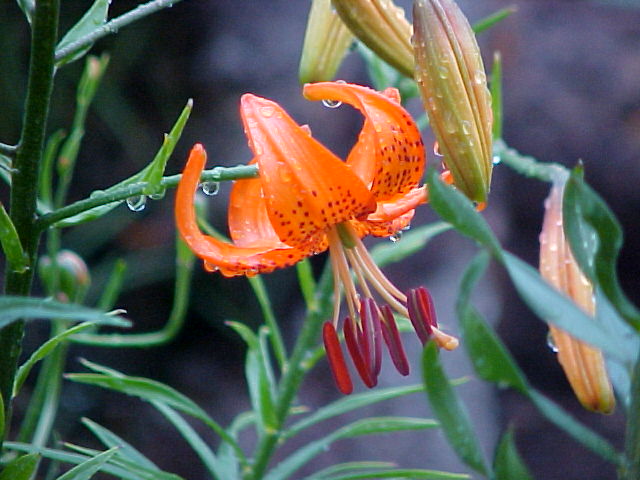 Lilium davidii
A tall Asian lily with edible bulbs and orange recurved flowers
🇨🇳 China and 1 more · Wildflower
Lilium davidii
A tall Asian lily with edible bulbs and orange recurved flowers
🇨🇳 China and 1 more · Wildflower
 Chinese LilyLilium brownii
A wild and cultivated lily from China with edible bulbs
🇨🇳 China and 3 more · Wildflower
Chinese LilyLilium brownii
A wild and cultivated lily from China with edible bulbs
🇨🇳 China and 3 more · Wildflower
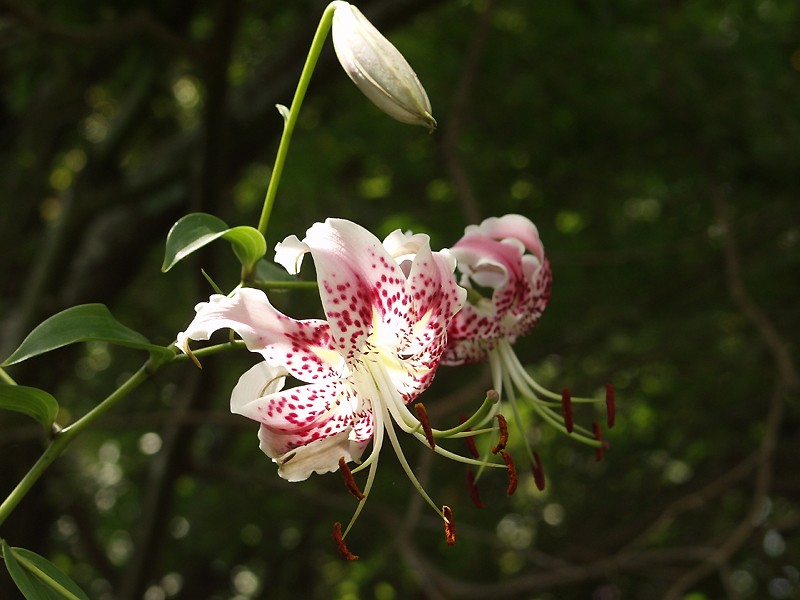 Lilium speciosum
A late-summer lily with fragrant white to pink flowers from East Asia
🇯🇵 Japan and 2 more · Wildflower
Lilium speciosum
A late-summer lily with fragrant white to pink flowers from East Asia
🇯🇵 Japan and 2 more · Wildflower
More from Iran
All the flowers of Iran AlmondPrunus amygdalus
A Mediterranean tree grown for its fragrant spring flowers and edible seeds
🇮🇷 Iran and 6 more · Flowering tree
AlmondPrunus amygdalus
A Mediterranean tree grown for its fragrant spring flowers and edible seeds
🇮🇷 Iran and 6 more · Flowering tree
 TulipTulipa
Spring-blooming bulbs with showy, cup-shaped flowers in many colours
🇳🇱 Netherlands and 7 more · Wildflower
TulipTulipa
Spring-blooming bulbs with showy, cup-shaped flowers in many colours
🇳🇱 Netherlands and 7 more · Wildflower
 JasmineJasminum
A group of fragrant shrubs and vines with white or yellow star-shaped flowers
🇵🇰 Pakistan and 7 more · Wildflower
JasmineJasminum
A group of fragrant shrubs and vines with white or yellow star-shaped flowers
🇵🇰 Pakistan and 7 more · Wildflower
 Wild cherryPrunus avium
A tall flowering tree native to Europe, grown for its sweet fruit and spring blossom
🇮🇹 Italy and 6 more · Flowering tree
Wild cherryPrunus avium
A tall flowering tree native to Europe, grown for its sweet fruit and spring blossom
🇮🇹 Italy and 6 more · Flowering tree