
Mahua
Madhuca longifolia, family Sapotaceae
A tropical tree with sweet edible flowers and oil-rich seeds
Mahua is a fast-growing evergreen or semi-evergreen tree native to the Indian subcontinent and Myanmar. Its sweet, edible flowers are used for food and traditional liquor, while its seeds yield oil for cooking, soap, and fuel. The tree holds cultural and religious significance for many communities.
- Mahua flowers are fermented to make a traditional alcoholic drink.
- The seeds yield oil used for cooking, soap, and fuel.
- It is a sacred tree in several South Indian temples.
- Flowers and fruits are staple foods for many indigenous peoples.
- The tree is native to India, Myanmar, and surrounding regions.
What does Mahua look like?
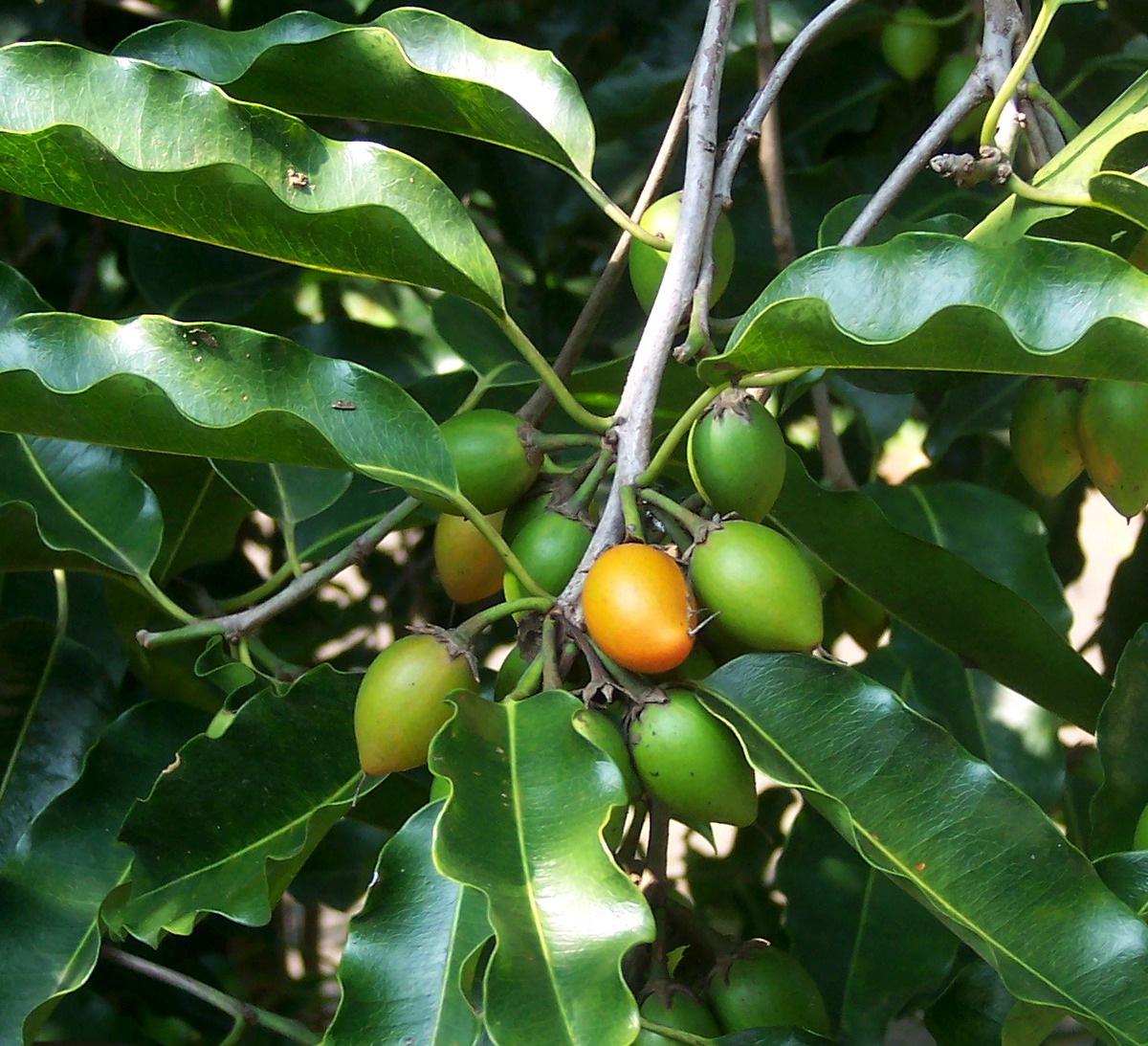
Mahua is a large tropical tree that can reach up to 20 meters in height, with evergreen or semi-evergreen leaves. The tree produces clusters of small, fleshy, sweet flowers that are rich in sugars and edible. Its fruit is also eaten, and the seeds are notable for their high oil content. The bark, leaves, and wood are also used in various ways by local communities.
Where does Mahua come from?
Mahua grows wild across the Indian subcontinent and Myanmar, thriving in tropical mixed deciduous forests and arid regions. It is found in India, Bangladesh, Nepal, Sri Lanka, and Myanmar, especially in states like Maharashtra, Odisha, Chhattisgarh, Jharkhand, and Tamil Nadu. The tree has long been valued by indigenous peoples for its many uses, and its name appears in several local languages.
When and how Mahua blooms
The tree flowers in warm, humid climates. Its flowers are collected and sun-dried for later use, including making flour and syrup. Seeds are gathered for oil extraction, which is then used for cooking, making soap, and as fuel. The flowers are also fermented to produce a traditional alcoholic drink, often prepared in home stills by tribal communities.


How Mahua is used
Mahua flowers are a staple food for many indigenous groups, eaten fresh, dried, or ground into flour for bread. The fermented flower drink is central to celebrations and rituals in tribal regions. Oil from the seeds is used for cooking, skin care, and lighting. The tree is also considered sacred in some Hindu temples and is mentioned in classical literature and Ayurveda.
Kinds of Mahua
There are several botanical varieties, such as M. longifolia var. latifolia and M. longifolia var. longifolia. The tree is known by many regional names, reflecting its wide distribution and cultural importance. Its uses and preparations vary across regions, from syrup and jam to flour and wine.
What Mahua means
Mahua is deeply woven into the culture of central India and neighboring countries. It is a sacred tree in several South Indian temples and is linked to legends, such as the birth of the Tamil saint Thiruvalluvar. The tree and its flower-based wine are mentioned in Hindu, Jain, and Buddhist texts, and it is a symbol of sustenance and celebration for many tribal communities.
Questions people ask about Mahua
Where does the mahua tree come from?
Mahua is native to the Indian subcontinent and Myanmar, growing wild in India, Bangladesh, Nepal, Sri Lanka, and Myanmar, especially in tropical forests and arid regions.
What are mahua flowers used for?
Mahua flowers are eaten fresh or dried, ground into flour, and fermented to make a traditional alcoholic drink. They are also used to make syrup, jam, and as a sweetener.
Why is the mahua tree important to local communities?
The tree provides food, oil, and wood, and its flowers are central to tribal celebrations and rituals. It is also considered sacred in some temples and is mentioned in classical literature.
Is mahua oil used for anything besides cooking?
Yes, mahua oil is used in making soap, detergents, as a fuel, and in traditional skin care. It is also used as a hair fixer and as an illuminant.
Does mahua have any religious or cultural significance?
Mahua is sacred in several Hindu temples, features in Hindu, Jain, and Buddhist literature, and is a symbol of sustenance and celebration for many tribal communities.
Good reading and sources
- As a war of words rages outside, peace reigns inside this templeThe Hindu, Article
- USDA Plants DatabaseUS Department of Agriculture, Article
- Plants of the World OnlineRoyal Botanic Gardens, Kew, Plant database
- Where it has been recordedGBIF, Plant database
- Sightings and photos by naturalistsiNaturalist, Plant database
- Madhuca longifolia on WikipediaEncyclopedia
- More photos on Wikimedia CommonsPhotos
- Wikidata recordOpen data
The facts on this page come from the Wikipedia article "Madhuca longifolia", written by its contributors and used under the CC BY-SA 4.0 licence, and from its Wikidata record (CC0). Phool rewrote the text in its own words, with AI assistance, and compares every page with the article to make sure no passage is copied. It may be reused under the same CC BY-SA 4.0 licence with a link back.
It may contain mistakes. It is not medical or foraging advice: many flowers are poisonous, and traditional uses are reported, not recommended. If something is wrong, tell us. Last refreshed 2026-10-03.
More from India
All the flowers of India PeachPrunus persica
A flowering fruit tree from China, grown for its pink blossoms and sweet fruit
🇨🇳 China and 7 more · Flowering tree
PeachPrunus persica
A flowering fruit tree from China, grown for its pink blossoms and sweet fruit
🇨🇳 China and 7 more · Flowering tree
 FennelFoeniculum vulgare
A tall, aromatic herb with feathery leaves and yellow umbels, used for food and spice
🇨🇳 China and 7 more · Herb or useful flower
FennelFoeniculum vulgare
A tall, aromatic herb with feathery leaves and yellow umbels, used for food and spice
🇨🇳 China and 7 more · Herb or useful flower
 TulipTulipa
Spring-blooming bulbs with showy, cup-shaped flowers in many colours
🇳🇱 Netherlands and 7 more · Wildflower
TulipTulipa
Spring-blooming bulbs with showy, cup-shaped flowers in many colours
🇳🇱 Netherlands and 7 more · Wildflower
 Common flaxLinum usitatissimum
The slender blue-flowered plant grown for linen and linseed
🇨🇳 China and 7 more · Wildflower
Common flaxLinum usitatissimum
The slender blue-flowered plant grown for linen and linseed
🇨🇳 China and 7 more · Wildflower