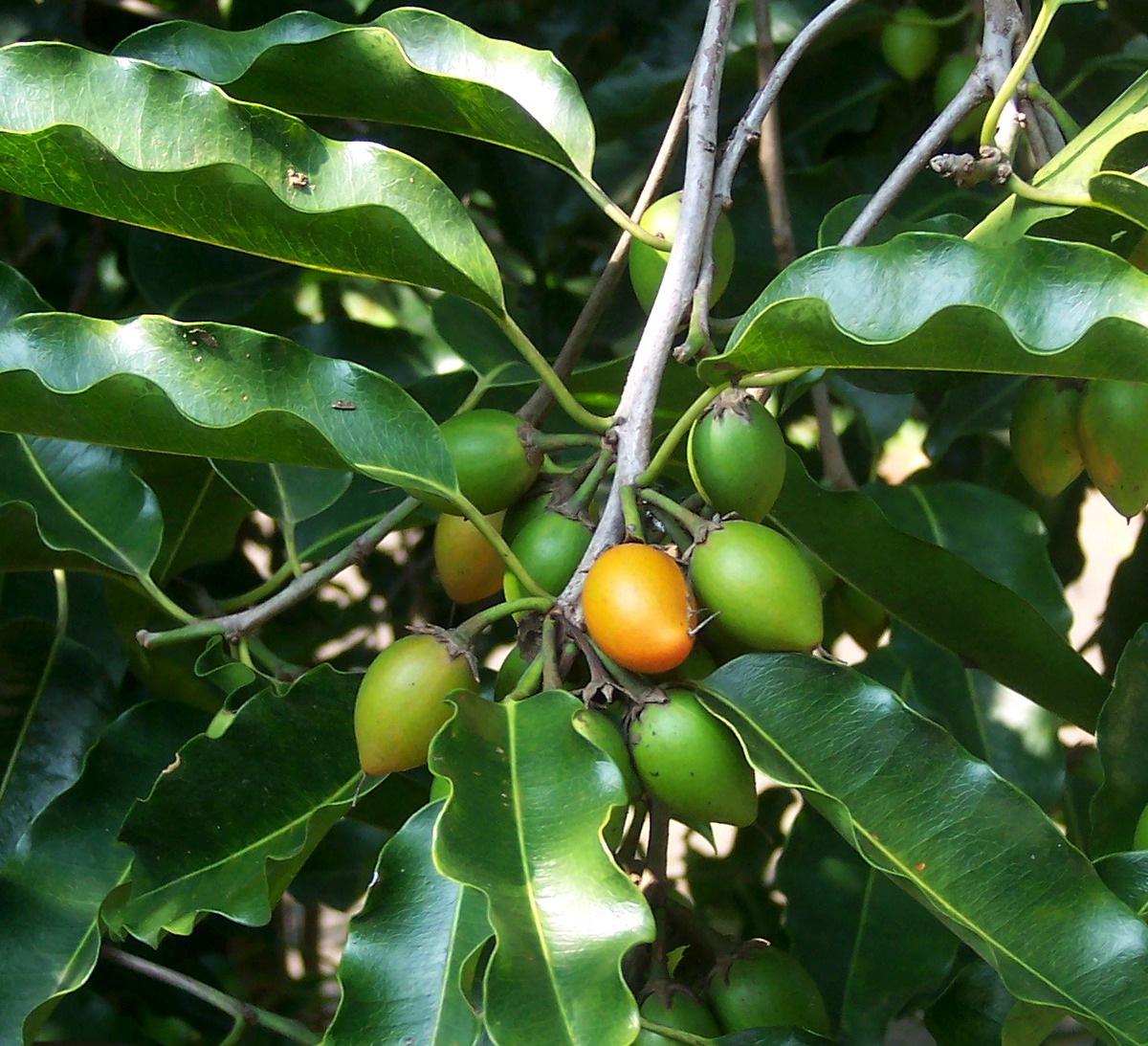
Spanish cherry
Mimusops elengi, family Sapotaceae
A fragrant evergreen tree with cream flowers and edible fruit
Spanish cherry is a medium-sized evergreen tree valued for its scented cream flowers and edible fruit. Native to parts of South and Southeast Asia and northern Australia, it is often planted in gardens for its shade and ornamental appeal. Its flowers are used in teas and perfumes, and the tree is a symbol in some regions.
- The tree's flowers have a strong, sweet scent.
- Its fruit is edible and turns red-orange when ripe.
- Dried flowers are used in tea in Thailand.
- It is the provincial flower of Yala, Thailand.
- The wood is dense and polishes well.
What does Spanish cherry look like?
Spanish cherry is a tree that keeps its leaves all year and can grow up to 18 meters tall. Its leaves are oval, glossy, and dark green. The tree produces clusters of small, creamy flowers that are hairy and have a strong scent. The fruit is oval, yellow to red-orange when ripe, and contains a single hard seed. The bark is thick and dark, with cracks and lines.
Where does Spanish cherry come from?
This tree grows naturally in parts of South and Southeast Asia and extends into northern Australia. It has long been valued in these regions for its shade and beauty. In the 20th century, it was brought to southern China and Taiwan, where it is now cultivated. Its English names, like bullet wood and Spanish cherry, reflect its hard wood and perhaps its fruit.
When and how Spanish cherry blooms
Spanish cherry blooms in spring, with flowers appearing in April. The fruit develops from June to October. The tree prefers full sunlight and grows at a moderate rate. Seeds are easy to sprout, especially if soaked first. It is often grown in gardens and parks for its shade and attractive flowers.


How Spanish cherry is used
People plant Spanish cherry for its thick shade and fragrant blossoms. In Thailand, dried flowers are added to tea or used for their scent. The ripe fruit is edible and has a yellow pulp. Its hard, richly colored wood is sometimes used for fine woodworking. The tree is also chosen as a symbol for certain provinces and cities.
Kinds of Spanish cherry
This species is recognized by its cream-colored, hairy flowers and oval, edible fruit. While the sources do not describe cultivated varieties, the tree is known by several names in different regions, reflecting its wide use and local importance.
What Spanish cherry means
Spanish cherry is the official flower of Yala Province in Thailand and represents the city of Ampang Jaya in Malaysia. Its fragrant flowers are used in traditional drinks and perfumes. The tree is often planted in gardens for its beauty and shade, and its wood is prized for its strength and color.
Questions people ask about Spanish cherry
Where does the Spanish cherry come from?
Spanish cherry is native to parts of South and Southeast Asia, including India, Myanmar, and Vietnam, and also grows naturally in northern Australia.
What does the Spanish cherry tree look like?
It is an evergreen tree that can reach up to 18 meters tall, with glossy dark green leaves and clusters of small, cream-colored, strongly scented flowers.
What is the Spanish cherry used for?
People use it as a shade and ornamental tree, for its fragrant flowers in tea and perfume, and for its edible fruit. Its wood is also valued for its strength and color.
Does the Spanish cherry have any special meaning?
Yes, it is the provincial flower of Yala in Thailand and the city flower of Ampang Jaya in Malaysia, making it a local symbol in those places.
When does the Spanish cherry flower and fruit?
The tree flowers in April, and its fruit ripens from June to October in its native regions.
Good reading and sources
- IUCN Red List of Threatened SpeciesIUCN Red List, Article
- USDA Plants DatabaseUS Department of Agriculture, Article
- NParksNational Parks Board, Singapore, Article
- Plants of the World OnlineRoyal Botanic Gardens, Kew, Plant database
- Where it has been recordedGBIF, Plant database
- Sightings and photos by naturalistsiNaturalist, Plant database
- Mimusops elengi on WikipediaEncyclopedia
- More photos on Wikimedia CommonsPhotos
- Wikidata recordOpen data
The facts on this page come from the Wikipedia article "Mimusops elengi", written by its contributors and used under the CC BY-SA 4.0 licence, and from its Wikidata record (CC0). Phool rewrote the text in its own words, with AI assistance, and compares every page with the article to make sure no passage is copied. It may be reused under the same CC BY-SA 4.0 licence with a link back.
It may contain mistakes. It is not medical or foraging advice: many flowers are poisonous, and traditional uses are reported, not recommended. If something is wrong, tell us. Last refreshed 2026-10-03.

More from India
All the flowers of India PeachPrunus persica
A flowering fruit tree from China, grown for its pink blossoms and sweet fruit
🇨🇳 China and 7 more · Flowering tree
PeachPrunus persica
A flowering fruit tree from China, grown for its pink blossoms and sweet fruit
🇨🇳 China and 7 more · Flowering tree
 PomegranatePunica granatum
A shrub with bright red flowers and a fruit full of edible seeds
🇮🇷 Iran and 9 more · Flowering shrub
PomegranatePunica granatum
A shrub with bright red flowers and a fruit full of edible seeds
🇮🇷 Iran and 9 more · Flowering shrub
 TulipTulipa
Spring-blooming bulbs with showy, cup-shaped flowers in many colours
🇳🇱 Netherlands and 7 more · Wildflower
TulipTulipa
Spring-blooming bulbs with showy, cup-shaped flowers in many colours
🇳🇱 Netherlands and 7 more · Wildflower
 FennelFoeniculum vulgare
A tall, aromatic herb with feathery leaves and yellow umbels, used for food and spice
🇨🇳 China and 7 more · Herb or useful flower
FennelFoeniculum vulgare
A tall, aromatic herb with feathery leaves and yellow umbels, used for food and spice
🇨🇳 China and 7 more · Herb or useful flower