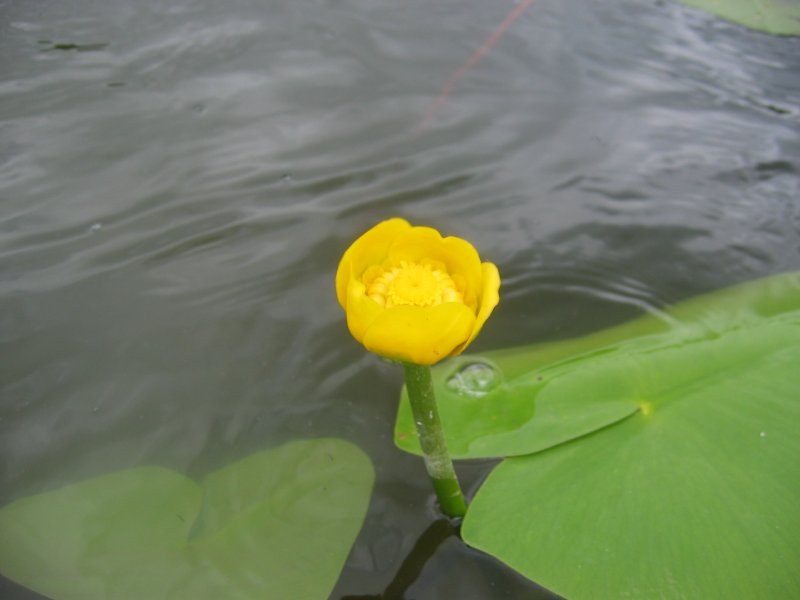
Yellow Water-lily
Nuphar lutea, family Nymphaeaceae
A floating yellow water-lily of lakes and ponds from Europe to western Asia
The yellow water-lily is an aquatic perennial with floating, leathery green leaves and bright yellow, fragrant flowers. Native from Europe to western Asia and northwest Africa, it grows in shallow lakes, ponds, and slow-moving waters, and is cultivated as an ornamental and sometimes used for food.
- Native from Europe to western Asia and northwest Africa
- Bright yellow, fragrant flowers float on lakes and ponds
- Leaves and flowers provide habitat for aquatic life
- Used as a food source since prehistoric times
- Symbolic leaf shapes appear on the flag of Friesland
What does Yellow Water-lily look like?
Nuphar lutea is a perennial aquatic plant with thick, spongy rhizomes anchored in the sediment of shallow waters. Its large, leathery, floating leaves are broadly oval, up to 30 cm long, with a deep notch at the base. The plant produces solitary, bright yellow, rounded flowers that float or rise just above the water, measuring 3–6.5 cm across. The flowers have a light fragrance and are followed by green, bottle-shaped fruits containing many small seeds.
Where does Yellow Water-lily come from?
This species is native to a broad region from Europe through Siberia and Xinjiang in China, reaching into northwest Africa. It grows wild in lakes, ponds, slow rivers, swamps, and ditches, from sea level up to 3,000 metres. The yellow water-lily was described by Linnaeus in 1753 and later placed in the genus Nuphar. It is the type species of its genus. The plant has been introduced to places like Bangladesh, New Zealand, and the Russian Far East.
When and how Yellow Water-lily blooms
Nuphar lutea grows in shallow, still or slow-moving waters, rooting in the muddy bottom. Its leaves and flowers float on the surface, while some leaves remain submerged. The plant spreads by thick rhizomes and can form dense colonies. It is cultivated as an ornamental in water gardens, and its floating leaves help oxygenate the roots in low-oxygen soils.


How Yellow Water-lily is used
People grow the yellow water-lily as an ornamental in ponds and water gardens. It has also been used as a food source since prehistoric times. The plant provides habitat for fish, insects, and other aquatic life. Its leaves and flowers are sometimes featured in art and architecture, and it serves as a symbol in some regions.
Kinds of Yellow Water-lily
Some botanists once grouped all Nuphar species under Nuphar lutea, but now the genus is usually divided into 8–15 species. The yellow water-lily is the type species. Stylised forms of its leaves, called seeblatts or pompeblêden, are used as symbols in Friesland.
What Yellow Water-lily means
The yellow water-lily appears as a symbol in Frisia, with its red stylised leaves shown on the flag of Friesland. In England, its flowers are carved in stone in cathedrals, thought to represent celibacy. The species is listed as Least Concern by the IUCN, and continues to be valued for its ecological role and ornamental use.
Questions people ask about Yellow Water-lily
Where does the yellow water-lily come from?
It is native to a wide region from Europe through Siberia and Xinjiang in China, as well as northwest Africa. It is also found in introduced locations such as Bangladesh and New Zealand.
What does the yellow water-lily look like?
It has large, oval, floating green leaves and produces bright yellow, rounded flowers that float or rise just above the water. The flowers are lightly fragrant and followed by green, bottle-shaped fruits.
How is the yellow water-lily used?
It is grown as an ornamental plant in water gardens and ponds. The species has also been used as a food source and features in regional symbols and art.
What does the yellow water-lily symbolise?
Stylised leaves of the yellow water-lily are used as symbols in Frisia, especially on the flag of Friesland. In English cathedrals, its flowers are carved in stone and thought to encourage celibacy.
Is the yellow water-lily endangered?
No, the yellow water-lily is classified as Least Concern by the IUCN, meaning it is not currently considered at risk.
Good reading and sources
- Encyclopaedia BritannicaArticle
- USDA Plants DatabaseUS Department of Agriculture, Article
- IUCN Red List of Threatened SpeciesIUCN Red List, Article
- Plants of the World OnlineRoyal Botanic Gardens, Kew, Plant database
- Where it has been recordedGBIF, Plant database
- Sightings and photos by naturalistsiNaturalist, Plant database
The facts on this page come from the Wikipedia article "Nuphar lutea", written by its contributors and used under the CC BY-SA 4.0 licence, and from its Wikidata record (CC0). Phool rewrote the text in its own words, with AI assistance, and compares every page with the article to make sure no passage is copied. It may be reused under the same CC BY-SA 4.0 licence with a link back.
It may contain mistakes. It is not medical or foraging advice: many flowers are poisonous, and traditional uses are reported, not recommended. If something is wrong, tell us. Last refreshed 2026-10-03.
Others in the family Nymphaeaceae
The whole family WaterlilyNymphaea
Floating aquatic flowers found in ponds and lakes worldwide
🇪🇬 Egypt and 7 more · Water flower
WaterlilyNymphaea
Floating aquatic flowers found in ponds and lakes worldwide
🇪🇬 Egypt and 7 more · Water flower
 Water-lily familyNymphaeaceae
Floating aquatic plants with showy flowers and round leaves
🇧🇩 Bangladesh and 2 more · Wildflower
Water-lily familyNymphaeaceae
Floating aquatic plants with showy flowers and round leaves
🇧🇩 Bangladesh and 2 more · Wildflower
 White Water-lilyNymphaea alba
A floating white flower of ponds and lakes across Europe and Asia
🇸🇪 Sweden and 5 more · Wildflower
White Water-lilyNymphaea alba
A floating white flower of ponds and lakes across Europe and Asia
🇸🇪 Sweden and 5 more · Wildflower
 Amazon waterlilyNymphaea amazonum
A night-blooming waterlily from Mexico to tropical South America
🇧🇷 Brazil and 4 more · Wildflower
Amazon waterlilyNymphaea amazonum
A night-blooming waterlily from Mexico to tropical South America
🇧🇷 Brazil and 4 more · Wildflower
More from China
All the flowers of China PeachPrunus persica
A flowering fruit tree from China, grown for its pink blossoms and sweet fruit
🇨🇳 China and 7 more · Flowering tree
PeachPrunus persica
A flowering fruit tree from China, grown for its pink blossoms and sweet fruit
🇨🇳 China and 7 more · Flowering tree
 Common sunflowerHelianthus annuus
A tall annual plant grown for its large yellow flower heads and edible seeds
🇨🇦 Canada and 4 more · Wildflower
Common sunflowerHelianthus annuus
A tall annual plant grown for its large yellow flower heads and edible seeds
🇨🇦 Canada and 4 more · Wildflower
 PomegranatePunica granatum
A shrub with bright red flowers and a fruit full of edible seeds
🇮🇷 Iran and 9 more · Flowering shrub
PomegranatePunica granatum
A shrub with bright red flowers and a fruit full of edible seeds
🇮🇷 Iran and 9 more · Flowering shrub
 BirchBetula
Slender trees with papery bark found across the northern world
🇨🇳 China and 7 more · Wildflower
BirchBetula
Slender trees with papery bark found across the northern world
🇨🇳 China and 7 more · Wildflower