
Amazon waterlily
Nymphaea amazonum, family Nymphaeaceae
A night-blooming waterlily from Mexico to tropical South America
The Amazon waterlily (Nymphaea amazonum) is an aquatic plant found from Mexico through tropical South America, and introduced to Bangladesh. Its broad floating leaves and fragrant nocturnal flowers grow in ponds, lagoons, and canals, with edible rhizomes and traditional medicinal uses.
- Flowers open at night and float on water
- Strong fragrance likened to petrol and turpentine
- Rhizomes are edible and used in traditional medicine
- Endangered in Cuba due to habitat loss
- Seeds are dispersed by water and birds
What does Amazon waterlily look like?
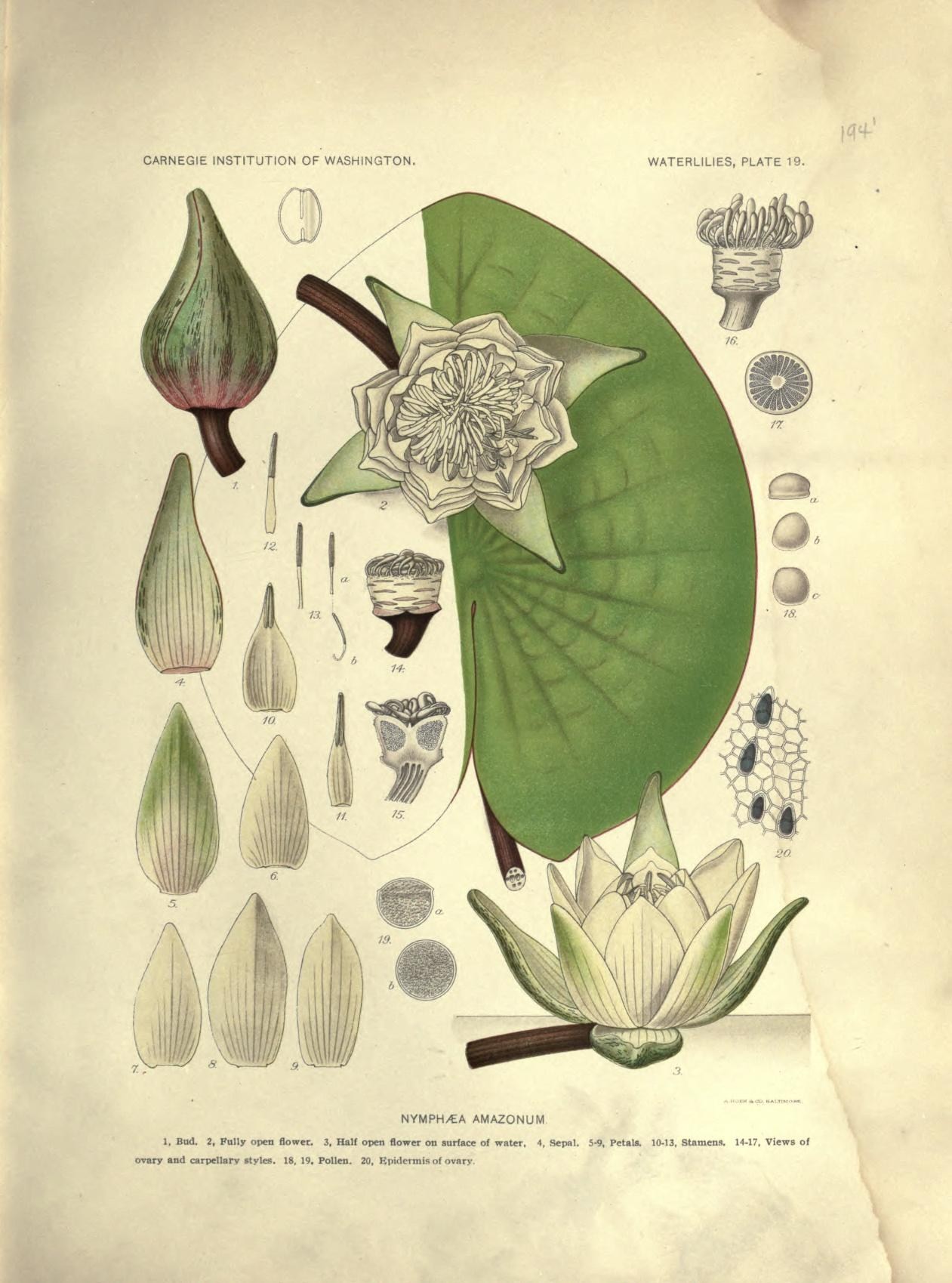
Amazon waterlily is an aquatic herb with broad, oval to elliptical floating leaves up to 32 cm long and 26 cm wide. The leaves have prominent rounded veins underneath and are attached to petioles with a ring of tiny hairs near the tip. Its flowers open at night, float on the water, and give off a strong, complex scent described as both pleasant and reminiscent of chemicals like petrol and turpentine. The plant produces many seeds in ovoid fruits.
Where does Amazon waterlily come from?
Nymphaea amazonum grows wild from Mexico through tropical South America, including regions of Brazil such as Alagoas, Pará, and Rio de Janeiro. It was first described in 1832 from a specimen collected in Brazil. The species is found in permanent ponds, lagoons, and canals, often in clay-sand or sandy-quartzitic soils. Its rhizomes can survive dry periods in moist sediment, and it faces competition from aquatic grasses in the Amazon floodplains.
When and how Amazon waterlily blooms
The Amazon waterlily blooms at night, with flowers that attract beetles for pollination. It reproduces both by seeds, which are dispersed by water and birds, and by stolons, though it does not form new flower clusters from these. The plant is rarely cultivated but can be found in wild aquatic habitats, where it grows from rhizomes in the substrate.


How Amazon waterlily is used
People use the rhizomes of Nymphaea amazonum as food. In traditional medicine, the plant is valued for its antimicrobial properties, especially in treating ulcers, herpes, and erysipelas. It also absorbs certain pesticides from water. The species is not widely grown in gardens or for decoration.
Kinds of Amazon waterlily
Nymphaea amazonum was once divided into two subspecies, but later research separated Nymphaea pedersenii as its own species. It belongs to the Hydrocallis subgroup within the genus Nymphaea.
What Amazon waterlily means
The Amazon waterlily is endangered in Cuba due to habitat loss from agriculture, invasive species, livestock, sedimentation, and pollution. In Puerto Rico, it also faces threats from habitat destruction. In Guadeloupe, its conservation status is unclear. The plant is not noted as a symbol or emblem in the regions where it grows.
Where Amazon waterlily is used and seen

Questions people ask about Amazon waterlily
Where does the Amazon waterlily come from?
It is native to a region stretching from Mexico through tropical South America, including parts of Brazil. It has also been introduced to Bangladesh.
What does the Amazon waterlily look like?
It has broad, oval floating leaves up to 32 cm long and 26 cm wide, and nocturnal flowers that float on the water and emit a strong, complex fragrance.
Is the Amazon waterlily used for anything?
Yes, its rhizomes are edible and it is used in traditional medicine for its antimicrobial properties, including the treatment of ulcers, herpes, and erysipelas.
Is the Amazon waterlily endangered?
It is considered endangered in Cuba due to habitat loss from agriculture, invasive species, and pollution. In Puerto Rico, it also faces habitat destruction.
How does the Amazon waterlily reproduce?
It reproduces by seeds, which are dispersed by water and birds, and by stolons, though it does not form new flower clusters from these.
Good reading and sources
- USDA Plants DatabaseUS Department of Agriculture, Article
- Plants of the World OnlineRoyal Botanic Gardens, Kew, Plant database
- Where it has been recordedGBIF, Plant database
- Sightings and photos by naturalistsiNaturalist, Plant database
- Nymphaea amazonum on WikipediaEncyclopedia
- More photos on Wikimedia CommonsPhotos
- Wikidata recordOpen data
The facts on this page come from the Wikipedia article "Nymphaea amazonum", written by its contributors and used under the CC BY-SA 4.0 licence, and from its Wikidata record (CC0). Phool rewrote the text in its own words, with AI assistance, and compares every page with the article to make sure no passage is copied. It may be reused under the same CC BY-SA 4.0 licence with a link back.
It may contain mistakes. It is not medical or foraging advice: many flowers are poisonous, and traditional uses are reported, not recommended. If something is wrong, tell us. Last refreshed 2026-10-03.
Others in the family Nymphaeaceae
The whole family WaterlilyNymphaea
Floating aquatic flowers found in ponds and lakes worldwide
🇪🇬 Egypt and 7 more · Water flower
WaterlilyNymphaea
Floating aquatic flowers found in ponds and lakes worldwide
🇪🇬 Egypt and 7 more · Water flower
 Water-lily familyNymphaeaceae
Floating aquatic plants with showy flowers and round leaves
🇧🇩 Bangladesh and 2 more · Wildflower
Water-lily familyNymphaeaceae
Floating aquatic plants with showy flowers and round leaves
🇧🇩 Bangladesh and 2 more · Wildflower
 White Water-lilyNymphaea alba
A floating white flower of ponds and lakes across Europe and Asia
🇸🇪 Sweden and 5 more · Wildflower
White Water-lilyNymphaea alba
A floating white flower of ponds and lakes across Europe and Asia
🇸🇪 Sweden and 5 more · Wildflower
 Egyptian white water-lilyNymphaea lotus
A night-blooming white water-lily and the national flower of Egypt
🇪🇬 Egypt and 5 more · Water flower
Egyptian white water-lilyNymphaea lotus
A night-blooming white water-lily and the national flower of Egypt
🇪🇬 Egypt and 5 more · Water flower
More from Brazil
All the flowers of Brazil CactusCactaceae
Succulent plants with spines, native to the Americas
🇲🇽 Mexico and 7 more · Wildflower
CactusCactaceae
Succulent plants with spines, native to the Americas
🇲🇽 Mexico and 7 more · Wildflower
 Eucalyptus
The tall, aromatic trees and shrubs known as gum trees or eucalypts
🇦🇺 Australia and 7 more · Flowering tree
Eucalyptus
The tall, aromatic trees and shrubs known as gum trees or eucalypts
🇦🇺 Australia and 7 more · Flowering tree
 AmaranthAmaranthus
A tall, colourful plant grown for its flowers, leaves and edible seeds
🇲🇽 Mexico and 7 more · Wildflower
AmaranthAmaranthus
A tall, colourful plant grown for its flowers, leaves and edible seeds
🇲🇽 Mexico and 7 more · Wildflower
 Sensitive PlantMimosa pudica
A touch-sensitive plant whose leaves fold up when disturbed
🇧🇷 Brazil and 8 more · Wildflower
Sensitive PlantMimosa pudica
A touch-sensitive plant whose leaves fold up when disturbed
🇧🇷 Brazil and 8 more · Wildflower