
Oxera
A Pacific island genus of flowering shrubs, trees and climbers
Oxera is a group of flowering plants found across islands in the southwestern Pacific and parts of Australia. Its members grow as lianas, shrubs or small trees, bearing large, showy flowers that may bloom directly from the trunk.
- Most species grow on New Caledonia’s main island, Grande Terre
- Flowers can emerge directly from the trunk (cauliflory)
- One species is cultivated in Vanuatu and called harongmau
- Trunk flowering is believed to predict a good yam harvest
- The genus was named in 1824 from a New Caledonian specimen
What does Oxera look like?
Plants in the Oxera genus vary in form, they can be climbing vines, upright shrubs, or small trees. Their leaves are simple and usually sit on short stalks, with smooth or gently wavy edges. The flowers are large and noticeable, growing either where leaves meet the stem or straight from the trunk. Each flower has a radially symmetrical calyx but a two-lipped, often strongly asymmetrical corolla.
Where does Oxera come from?
The genus Oxera was first described in 1824 by French botanist Jacques Labillardière, based on a specimen he gathered in New Caledonia. It belongs to the mint family, Lamiaceae, and is closely related to Faradaya. Together, they form a lineage near Clerodendrum and several related genera. Most species are native to New Caledonia’s main island, with others scattered across nearby islands and Vanuatu.
When and how Oxera blooms
Oxera species grow naturally in island habitats across the southwestern Pacific. In Vanuatu, villagers cultivate Oxera vanuatuensis by sowing seeds, moving young plants, or using cuttings. The plant sometimes flowers directly from its trunk, a trait known as cauliflory, which local people associate with agricultural omens.
How Oxera is used
On Pentecost Island in Vanuatu, the tree called harongmau (Oxera vanuatuensis) is grown and used in traditional practices. It is linked to beliefs about health and harvests: abundant trunk-flowering is seen as a sign of a coming good yam crop, and the plant is used in remedies tied to spiritual causes of illness.
Kinds of Oxera
Twenty-one species are currently recognised, grouped informally into five sets. Most, twenty out of twenty-one, are found on Grande Terre in New Caledonia. Others occur on smaller nearby islands, including three on Île des Pins, two on Lifou, one on Maré, and two in Vanuatu, one of which is only known from cultivated plants.
What Oxera means
In parts of Vanuatu, Oxera vanuatuensis holds cultural significance. Known locally as harongmau, it is maintained through active propagation by communities on Pentecost and Maewo islands. Its flowering pattern is interpreted as an omen for yam harvests, and it plays a role in traditional healing practices connected to spiritual well-being.
Questions people ask about Oxera
Where does Oxera come from?
It is native to islands in the southwestern Pacific, especially New Caledonia, with some species in Vanuatu and Australia.
What does Oxera look like?
It includes shrubs, small trees and climbers with simple leaves and large, two-lipped flowers that may grow from the trunk or leaf joints.
How is Oxera used in Vanuatu?
On Pentecost Island, it is cultivated as harongmau; its trunk flowers are seen as predicting yam harvests and it is used in traditional remedies.
Who named the genus Oxera?
French botanist Jacques Labillardière described it in 1824 based on a plant he collected in New Caledonia.
How many Oxera species exist?
Twenty-one species are recognised, with twenty found on New Caledonia’s main island and the rest on nearby islands and Vanuatu.
Good reading and sources
- IUCN Red List of Threatened SpeciesIUCN Red List, Article
- Plants of the World OnlineRoyal Botanic Gardens, Kew, Plant database
- Where it has been recordedGBIF, Plant database
- Sightings and photos by naturalistsiNaturalist, Plant database
The facts on this page come from the Wikipedia article "Oxera", written by its contributors and used under the CC BY-SA 4.0 licence, and from its Wikidata record (CC0). Phool rewrote the text in its own words, with AI assistance, and compares every page with the article to make sure no passage is copied. It may be reused under the same CC BY-SA 4.0 licence with a link back.
It may contain mistakes. It is not medical or foraging advice: many flowers are poisonous, and traditional uses are reported, not recommended. If something is wrong, tell us. Last refreshed 2026-10-03.
Others in the family Lamiaceae
The whole family RosemarySalvia rosmarinus
A fragrant evergreen shrub with needle-like leaves and purple, blue, or white flowers
🇪🇸 Spain and 5 more · Flowering shrub
RosemarySalvia rosmarinus
A fragrant evergreen shrub with needle-like leaves and purple, blue, or white flowers
🇪🇸 Spain and 5 more · Flowering shrub
 Salvia
A vast group of aromatic herbs and shrubs known for their flowers and uses
Salvia · Wildflower
Salvia
A vast group of aromatic herbs and shrubs known for their flowers and uses
Salvia · Wildflower
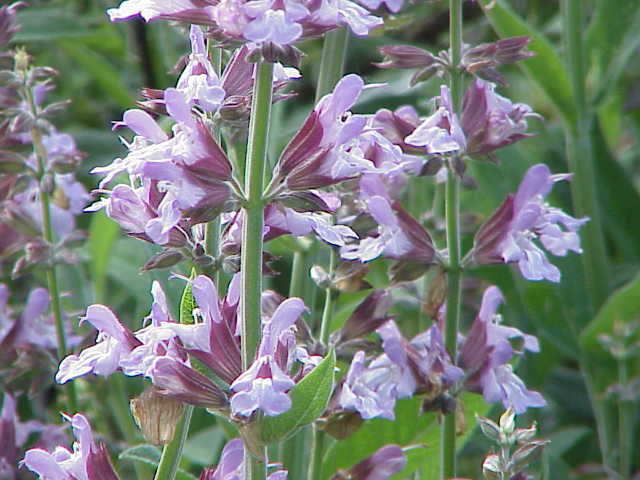 Common sageSalvia officinalis
A Mediterranean herb with grey-green leaves and blue to purple flowers
🇨🇳 China and 1 more · Herb or useful flower
Common sageSalvia officinalis
A Mediterranean herb with grey-green leaves and blue to purple flowers
🇨🇳 China and 1 more · Herb or useful flower
 Holy basilOcimum tenuiflorum
A fragrant herb central to Hindu worship and Southeast Asian cooking
🇲🇲 Myanmar and 6 more · Herb or useful flower
Holy basilOcimum tenuiflorum
A fragrant herb central to Hindu worship and Southeast Asian cooking
🇲🇲 Myanmar and 6 more · Herb or useful flower
More from Vanuatu
All the flowers of Vanuatu MaileAlyxia stellata
A fragrant Hawaiian vine used in lei and local tradition
🇦🇺 Australia and 5 more · Wildflower
MaileAlyxia stellata
A fragrant Hawaiian vine used in lei and local tradition
🇦🇺 Australia and 5 more · Wildflower
 Wonga wonga vinePandorea pandorana
A climbing Australian vine with white, purple-marked flowers
🇦🇺 Australia and 5 more · Climber
Wonga wonga vinePandorea pandorana
A climbing Australian vine with white, purple-marked flowers
🇦🇺 Australia and 5 more · Climber
 Metrosideros
A Pacific genus of trees and shrubs with vivid flowers
🇳🇿 New Zealand and 5 more · Flowering tree
Metrosideros
A Pacific genus of trees and shrubs with vivid flowers
🇳🇿 New Zealand and 5 more · Flowering tree
 KouCordia subcordata
A coastal flowering tree with orange blooms and buoyant fruit
🇦🇺 Australia and 7 more · Flowering tree
KouCordia subcordata
A coastal flowering tree with orange blooms and buoyant fruit
🇦🇺 Australia and 7 more · Flowering tree