![Common name : Scarlet Sage, Moroklei (Manipuri) Botanical name : Salvia splendens - [ (SAL-vee-uh) referring to helping, saving, healing; (SPLEN-denz) meaning splendid ] Cultivar : Empire Red Family : Lamiaceae (mint fam](https://thumb.wikimedia.org/wikipedia/commons/thumb/0/0d/Salvia_splendens_%28357118788%29.jpg/1280px-Salvia_splendens_%28357118788%29.jpg)
Salvia
A vast group of aromatic herbs and shrubs known for their flowers and uses
Salvia is the largest genus in the sage family, with nearly 1,000 species of herbs and shrubs found in the Americas, Mediterranean, and Asia. Its members range from culinary sage and rosemary to colorful garden plants, with flowers in blue, red, white, and yellow, often aromatic and attractive to pollinators.
- Salvia is the largest genus in the sage family, with nearly 1,000 species.
- Flowers come in blue, red, purple, white, pink, and yellow.
- Includes culinary herbs like sage and rosemary, and ornamentals for gardens.
- Some species, like chia, are grown for their edible seeds.
- Salvia has a unique pollination lever mechanism.
What does Salvia look like?
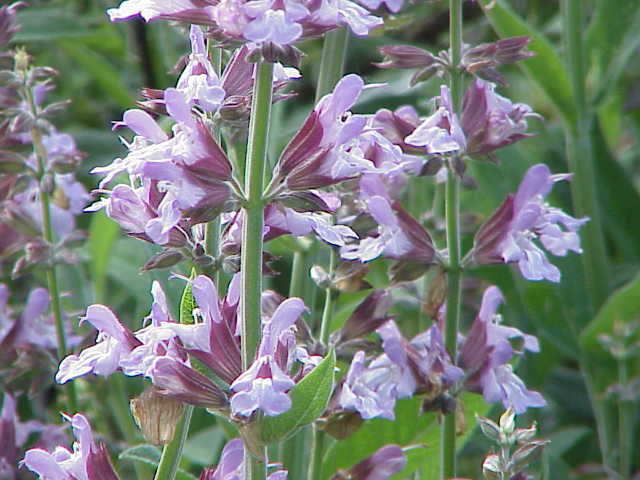
Salvia plants can be annuals, perennials, or small shrubs. Their leaves are often entire or sometimes divided, and many species have hairy or aromatic foliage. The flowers grow in spikes or clusters, with a wide range of colors including blue, red, purple, white, pink, and yellow. The blooms are usually two-lipped and showy, attracting bees and birds. Many salvias have a strong aroma, especially when touched, due to oil glands on their leaves and stems.
Where does Salvia come from?
Salvia grows wild across much of the world, with the greatest diversity in Central and South America, the Mediterranean, and parts of Asia. The name comes from Latin, meaning health or healing, and was first used by the Romans for what is now called common sage. Over time, the genus expanded as botanists discovered new species and grouped related plants like rosemary into Salvia. Its unusual pollination system, involving a lever-like stamen, has helped the genus diversify widely.
When and how Salvia blooms
Salvia species bloom at different times depending on the species and climate, often in spring or summer. They grow in a variety of soils and habitats, from dry hillsides to woodlands. Many are grown from seed or cuttings, and some, like culinary sage, are cultivated for their leaves. Ornamental salvias are popular in gardens for their colorful flowers and ability to attract pollinators.



How Salvia is used
People use different salvias in many ways. Common sage and rosemary are well-known kitchen herbs, while others are grown for their attractive flowers in gardens or as cut flowers. Some species, like chia, are valued for their edible seeds. Certain salvias are used in traditional herbal medicine or for their aromatic oils. A few, such as white sage, have ceremonial uses among Native American groups.
Kinds of Salvia
There are nearly 1,000 species of Salvia, including culinary sage (Salvia officinalis), rosemary (Salvia rosmarinus), white sage (Salvia apiana), and chia (Salvia hispanica). Some, like Salvia leucantha and Salvia nemorosa, are popular ornamentals. The genus also includes rare local species, such as Salvia fairuziana in Lebanon and Salvia jurisicii in North Macedonia.
What Salvia means
Salvia species have long been valued for their culinary, medicinal, and ornamental qualities. Common sage is linked to health and well-being in its name and history. White sage is sacred to some Native American peoples. Several species are regional emblems or have local significance, and the diversity of the genus makes it important in gardens and traditional practices worldwide.
Where Salvia is used and seen


Questions people ask about Salvia
Where does Salvia come from?
Salvia species are native to many regions, with the greatest diversity in Central and South America, the Mediterranean, and parts of Asia.
What is Salvia used for?
Salvia includes culinary herbs like sage and rosemary, ornamental garden plants, and species grown for edible seeds or traditional medicine.
What do Salvia flowers look like?
Salvia flowers are often two-lipped, showy, and come in blue, red, purple, white, pink, and yellow. They grow in spikes or clusters.
Why is Salvia important?
Salvia is valued for its uses in cooking, traditional medicine, and gardens. Some species have ceremonial roles or are regional emblems.
What makes Salvia flowers unique?
Salvia flowers have a special lever-like stamen mechanism that helps with pollination and has contributed to the genus's diversity.
Good reading and sources
- Encyclopaedia BritannicaArticle
- Salvia 'Dyson's Joy'Royal Horticultural Society, Article
- Plants of the World OnlineRoyal Botanic Gardens, Kew, Plant database
- Where it has been recordedGBIF, Plant database
- Sightings and photos by naturalistsiNaturalist, Plant database
The facts on this page come from the Wikipedia article "Salvia", written by its contributors and used under the CC BY-SA 4.0 licence, and from its Wikidata record (CC0). Phool rewrote the text in its own words, with AI assistance, and compares every page with the article to make sure no passage is copied. It may be reused under the same CC BY-SA 4.0 licence with a link back.
It may contain mistakes. It is not medical or foraging advice: many flowers are poisonous, and traditional uses are reported, not recommended. If something is wrong, tell us. Last refreshed 2026-10-03.
Others in the family Lamiaceae
The whole family RosemarySalvia rosmarinus
A fragrant evergreen shrub with needle-like leaves and purple, blue, or white flowers
🇪🇸 Spain and 5 more · Flowering shrub
Common sageSalvia officinalis
A Mediterranean herb with grey-green leaves and blue to purple flowers
🇨🇳 China and 1 more · Herb or useful flower
RosemarySalvia rosmarinus
A fragrant evergreen shrub with needle-like leaves and purple, blue, or white flowers
🇪🇸 Spain and 5 more · Flowering shrub
Common sageSalvia officinalis
A Mediterranean herb with grey-green leaves and blue to purple flowers
🇨🇳 China and 1 more · Herb or useful flower
 Holy basilOcimum tenuiflorum
A fragrant herb central to Hindu worship and Southeast Asian cooking
🇲🇲 Myanmar and 6 more · Herb or useful flower
Holy basilOcimum tenuiflorum
A fragrant herb central to Hindu worship and Southeast Asian cooking
🇲🇲 Myanmar and 6 more · Herb or useful flower
 French lavenderLavandula stoechas
A Mediterranean lavender with purple bracts atop its flower spikes
🇪🇸 Spain and 2 more · Wildflower
French lavenderLavandula stoechas
A Mediterranean lavender with purple bracts atop its flower spikes
🇪🇸 Spain and 2 more · Wildflower