
Pōhutukawa
Metrosideros excelsa, family Myrtaceae
A coastal tree from New Zealand with vivid red summer flowers
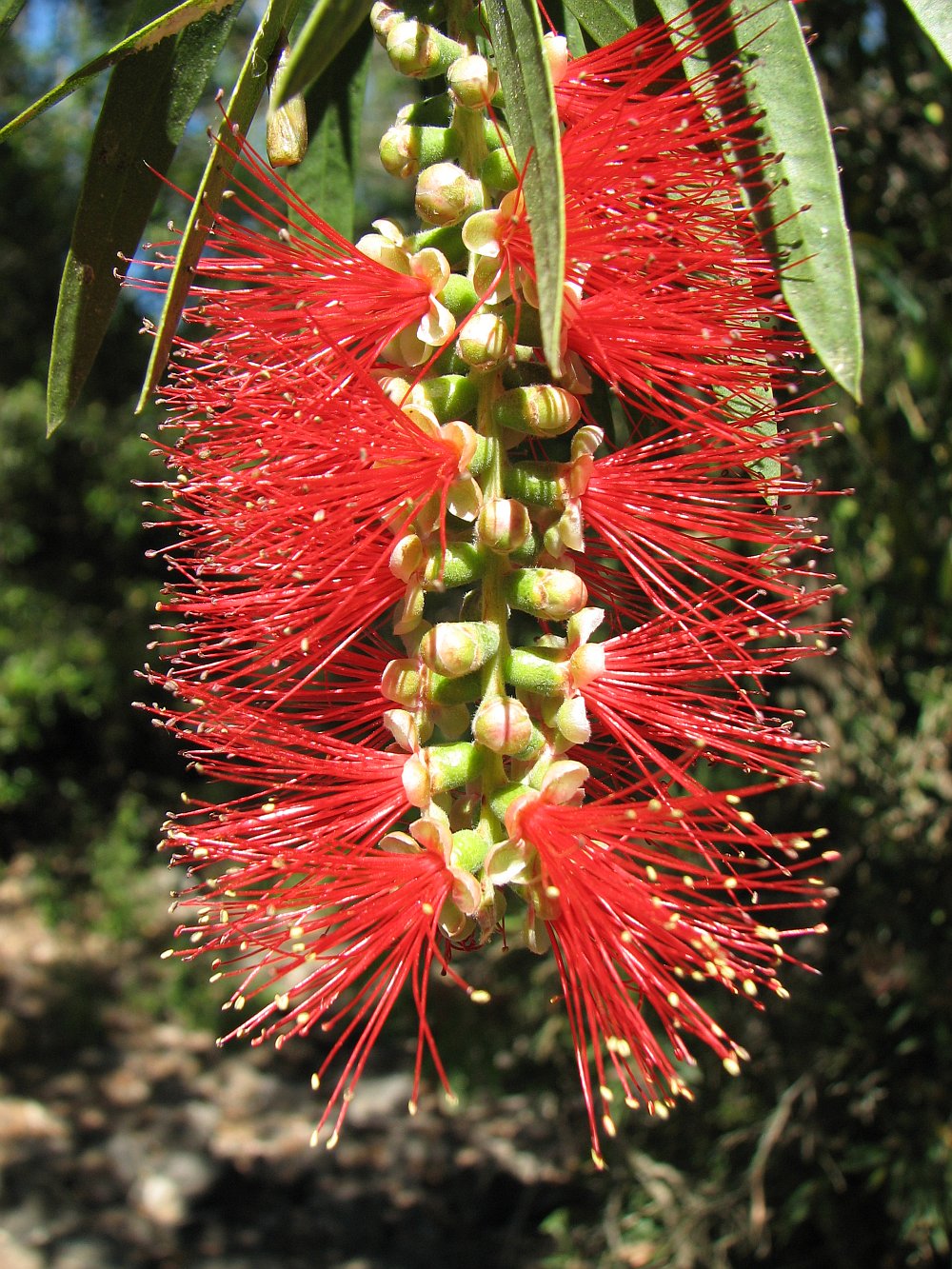
Pōhutukawa is a spreading evergreen tree native to New Zealand, known for its bright red, brush-like flowers that bloom in early summer. It is valued for its resilience on rocky shores, its role in Māori tradition, and its striking presence in coastal landscapes and city plantings.
- Blooms with vivid red flowers from November to January
- Grows naturally on cliffs and rocky shores in northern New Zealand
- Regarded as a chiefly tree in Māori tradition
- Used for honey, woodwork, and traditional medicine
- Over 39 cultivated varieties exist, including yellow and white forms
What does Pōhutukawa look like?
Pōhutukawa is a large, evergreen tree that can reach up to 25 metres in height. Its branches often spread wide and may carry tangled aerial roots. The leaves are leathery, oblong, and pale underneath due to dense white hairs. The tree is best known for its clusters of bright crimson flowers, made up mainly of long stamens, though some trees have orange, yellow, white, or pink blooms. These flowers appear in early summer and can cover the tree in colour.
Where does Pōhutukawa come from?
This tree is native to the northern coastal parts of New Zealand's North Island, where it once formed dense forests along the shore. It is one of several Metrosideros species found only in New Zealand. Pōhutukawa is adapted to grow on rocky cliffs and even volcanic ground. Over time, it has been introduced to other countries with mild climates, and it has become naturalised in places like Australia, California, and South Africa. The Māori name reflects links to other Polynesian plant names.
When and how Pōhutukawa blooms
Pōhutukawa flowers mainly from November to January, with the peak in mid to late December. It thrives in mild, coastal climates and can grow in poor, rocky soils. The tree is usually grown from seed or cuttings, and many cultivated varieties exist, including those with unusual flower colours. In gardens and cities, it is planted for shade and its showy display.


How Pōhutukawa is used
Māori have used the wood for making tools and the inner bark and nectar in traditional healing. The tree's curved branches were valued in shipbuilding. Pōhutukawa honey is made where the trees are plentiful. Its flowers and form make it a favourite for parks and gardens, and it is a symbol of summer and celebration in New Zealand.
Kinds of Pōhutukawa
There are at least 39 named cultivars, with differences in flower colour and growth habit. Some trees in Rotorua have pinkish flowers, and a yellow-flowered form called 'Aurea' comes from Mōtītī Island. White-flowered trees are rare. The species is closely related to other New Zealand Metrosideros, such as northern and southern rātā.
What Pōhutukawa means
Pōhutukawa is deeply woven into New Zealand identity and Māori tradition, seen as a tree of chiefs. Its red flowers are linked to stories of early Polynesian arrivals. The tree is celebrated for its resilience and beauty, but has faced threats from habitat loss and possums. Conservation groups work to restore its wild populations.
Questions people ask about Pōhutukawa
Where does pōhutukawa come from?
Pōhutukawa is native to the northern coastal parts of New Zealand's North Island, where it grows wild on cliffs and near the sea.
What does the pōhutukawa tree look like?
It is a large, spreading evergreen tree with leathery leaves and clusters of bright red, brush-like flowers that bloom in early summer. Some trees may have orange, yellow, white, or pink flowers.
How is pōhutukawa used?
The tree is valued for its wood, used in tools and shipbuilding, and its nectar and bark are used in traditional Māori healing. It is also planted in gardens and parks, and its honey is collected.
What does pōhutukawa mean in New Zealand culture?
Pōhutukawa is a symbol of summer and is important in Māori tradition, seen as a chiefly tree and celebrated for its beauty and resilience.
Are there different types of pōhutukawa?
Yes, there are many cultivated forms, with some trees showing pink, yellow, or even white flowers. These varieties are grown in gardens and parks.
Good reading and sources
- Library of Congress CatalogLibrary of Congress, Article
- Metrosideros excelsaRoyal Horticultural Society, Article
- Plants of the World OnlineRoyal Botanic Gardens, Kew, Plant database
- Where it has been recordedGBIF, Plant database
- Sightings and photos by naturalistsiNaturalist, Plant database
The facts on this page come from the Wikipedia article "Pōhutukawa", written by its contributors and used under the CC BY-SA 4.0 licence, and from its Wikidata record (CC0). Phool rewrote the text in its own words, with AI assistance, and compares every page with the article to make sure no passage is copied. It may be reused under the same CC BY-SA 4.0 licence with a link back.
It may contain mistakes. It is not medical or foraging advice: many flowers are poisonous, and traditional uses are reported, not recommended. If something is wrong, tell us. Last refreshed 2026-10-03.
Others in the family Myrtaceae
The whole family Eucalyptus
The tall, aromatic trees and shrubs known as gum trees or eucalypts
🇦🇺 Australia and 7 more · Flowering tree
Eucalyptus
The tall, aromatic trees and shrubs known as gum trees or eucalypts
🇦🇺 Australia and 7 more · Flowering tree
 BottlebrushCallistemon
Shrubs with brush-shaped flowers native to Australia
🇦🇺 Australia · Flowering shrub
BottlebrushCallistemon
Shrubs with brush-shaped flowers native to Australia
🇦🇺 Australia · Flowering shrub
 Darwinia
Australian shrubs with bell-like flowers wrapped in colourful bracts
🇦🇺 Australia · Flowering shrub
Darwinia
Australian shrubs with bell-like flowers wrapped in colourful bracts
🇦🇺 Australia · Flowering shrub
 Weeping bottlebrushMelaleuca viminalis
A red-flowered Australian tree with weeping branches and bottlebrush blooms
🇦🇺 Australia and 5 more · Flowering tree
Weeping bottlebrushMelaleuca viminalis
A red-flowered Australian tree with weeping branches and bottlebrush blooms
🇦🇺 Australia and 5 more · Flowering tree
More from New Zealand
All the flowers of New Zealand Wild cherryPrunus avium
A tall flowering tree native to Europe, grown for its sweet fruit and spring blossom
🇮🇹 Italy and 6 more · Flowering tree
Wild cherryPrunus avium
A tall flowering tree native to Europe, grown for its sweet fruit and spring blossom
🇮🇹 Italy and 6 more · Flowering tree
 YarrowAchillea millefolium
A wild, fern-leaved plant with flat clusters of white or pink flowers and a spicy scent
🇨🇳 China and 6 more · Wildflower
YarrowAchillea millefolium
A wild, fern-leaved plant with flat clusters of white or pink flowers and a spicy scent
🇨🇳 China and 6 more · Wildflower
 Common poppyPapaver rhoeas
The vivid red wildflower of fields and remembrance
🇨🇳 China and 7 more · Wildflower
Common poppyPapaver rhoeas
The vivid red wildflower of fields and remembrance
🇨🇳 China and 7 more · Wildflower
 Dog roseRosa canina
A wild climbing rose with pale pink flowers and bright red hips
🇮🇪 Ireland and 7 more · Wildflower
Dog roseRosa canina
A wild climbing rose with pale pink flowers and bright red hips
🇮🇪 Ireland and 7 more · Wildflower