
Weeping bottlebrush
Melaleuca viminalis, family Myrtaceae
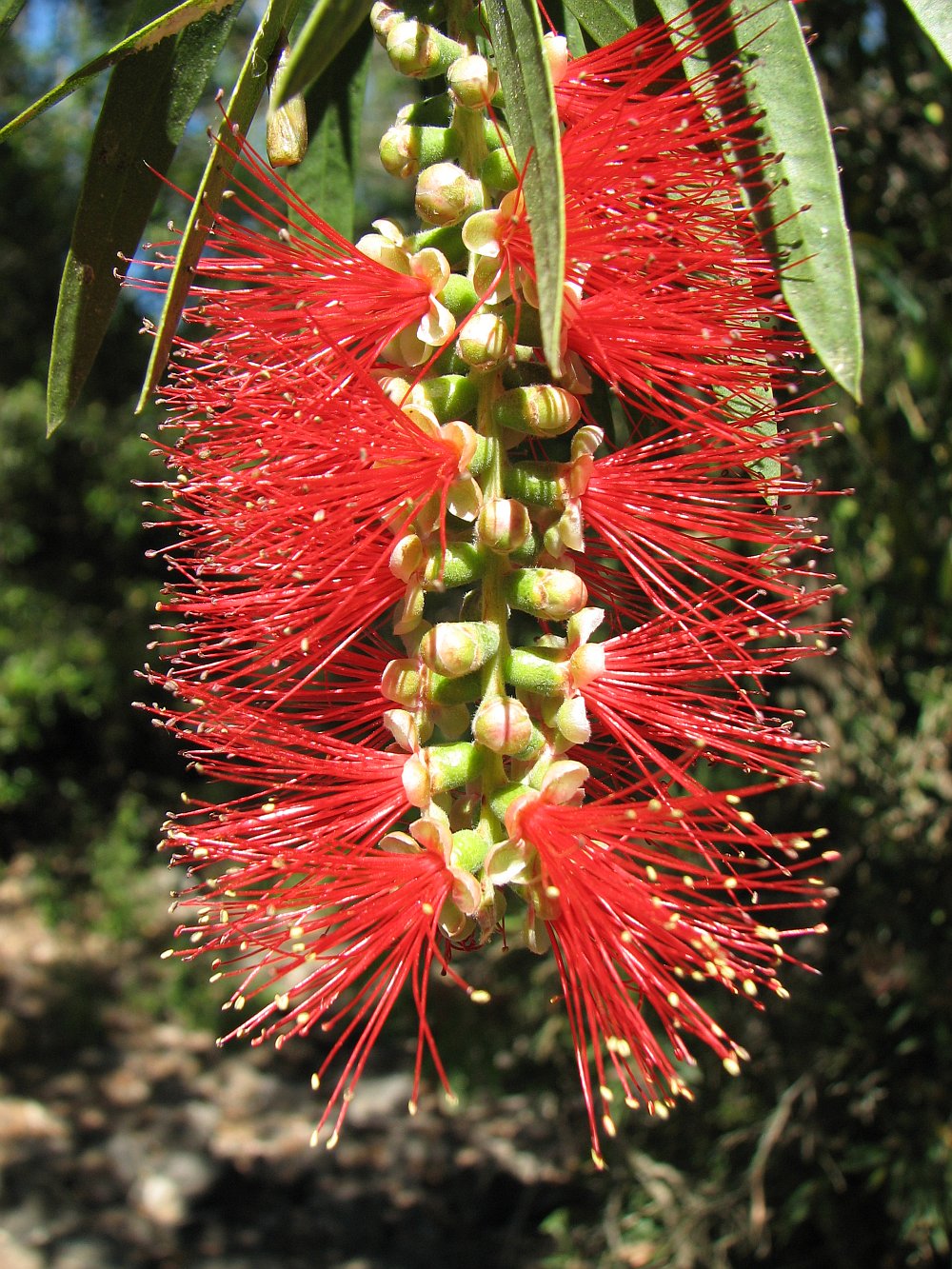
A red-flowered Australian tree with weeping branches and bottlebrush blooms
Weeping bottlebrush is a shrub or small tree native to eastern Australia, known for its bright red cylindrical flower spikes and drooping foliage. It grows along watercourses and is widely planted in gardens and as a street tree in many countries.
- Bright red cylindrical flower spikes resemble bottle brushes
- Grows naturally along streams in eastern Australia
- Helps prevent riverbank erosion with its dense root mat
- Flowers mainly September to December in its native range
- Many garden cultivars bred for compact or weeping forms
What does Weeping bottlebrush look like?
This plant grows as a multi-trunked shrub or small tree up to 10 metres tall, with hard, furrowed bark and long, narrow leaves. Its most striking feature is the bright red flower spikes, shaped like bottle brushes, 4 to 10 centimetres long, made of dense clusters of stamens. The branches often hang downward, giving it a weeping appearance.
Where does Weeping bottlebrush come from?
First described in 1788 as Metrosideros viminalis, it was later moved to the genus Melaleuca. Though now accepted under that name by some authorities, it is still widely known as Callistemon viminalis in Australia. It originates from stream banks and river edges in eastern Australia, from Queensland down into northern New South Wales.
When and how Weeping bottlebrush blooms
It flowers mainly in spring and summer, from September to December in Australia, but may bloom at other times too. It thrives in full sun and most soil types, tolerates shade with fewer flowers, needs regular water when young, and handles drought once mature. It does not survive frost or salty sea winds.


How Weeping bottlebrush is used
Commonly grown in gardens and used as a street tree, it serves well as a screen or windbreak. Its dense roots help stabilise riverbanks and reduce erosion. Many cultivated forms exist, selected for size, shape, or flowering, and it is planted far beyond its native range, including in parts of Africa, India, and the Americas.
Kinds of Weeping bottlebrush
Two subspecies are recognised. The typical form is multi-trunked and often flowers year-round. The other, subsp. rhodendron, is a single-stemmed tree reaching 35 metres, found only near Injune in Queensland, and flowers mostly in September and October.
What Weeping bottlebrush means
Its name comes from the Latin 'viminalis', meaning long and slender branches. Though not tied to specific festivals or faiths, it is valued in landscaping and environmental planting for its hardiness and role in protecting waterways. It supports nectar-feeding birds and insects.
Where Weeping bottlebrush is used and seen
 Australian National Botanic GardensAustralia’s largest living collection of native plants in Canberra
 Hòn non bộVietnamese miniature landscapes of mountains and islands in trays or basins
 Lisbon Tropical Botanical GardenA historic garden in Lisbon with tropical and subtropical plants from around the world
Questions people ask about Weeping bottlebrush
Where does weeping bottlebrush come from?
It is native to eastern Australia, growing from Cape York Peninsula in Queensland south to northern New South Wales, usually along rivers and creeks.
Why is it called 'weeping' bottlebrush?
Its branches often hang downward in a pendulous or weeping habit, especially in certain cultivated forms.
Is it grown outside Australia?
Yes, it has been introduced to many countries including India, Kenya, Tanzania, the Bahamas, El Salvador, and parts of the United States and Mediterranean islands.
What is it used for in landscaping?
It is planted as a street tree, garden specimen, and screening plant due to its dense growth, adaptability, and showy red flowers.
Does it have ecological benefits?
Yes, its roots stabilise riverbanks, slow floodwaters, reduce erosion, and improve stream water quality while providing nectar for wildlife.
Good reading and sources
- Callistemon viminalisAustralian National Botanic Gardens, Article
- IUCN Red List of Threatened SpeciesIUCN Red List, Article
- Plants of the World OnlineRoyal Botanic Gardens, Kew, Plant database
- Where it has been recordedGBIF, Plant database
- Sightings and photos by naturalistsiNaturalist, Plant database
- Melaleuca viminalis on WikipediaEncyclopedia
- More photos on Wikimedia CommonsPhotos
- Wikidata recordOpen data
The facts on this page come from the Wikipedia article "Melaleuca viminalis", written by its contributors and used under the CC BY-SA 4.0 licence, and from its Wikidata record (CC0). Phool rewrote the text in its own words, with AI assistance, and compares every page with the article to make sure no passage is copied. It may be reused under the same CC BY-SA 4.0 licence with a link back.
It may contain mistakes. It is not medical or foraging advice: many flowers are poisonous, and traditional uses are reported, not recommended. If something is wrong, tell us. Last refreshed 2026-10-03.
Others in the family Myrtaceae
The whole family Darwinia
Australian shrubs with bell-like flowers wrapped in colourful bracts
🇦🇺 Australia · Flowering shrub
Darwinia
Australian shrubs with bell-like flowers wrapped in colourful bracts
🇦🇺 Australia · Flowering shrub
 Common red bottlebrushMelaleuca citrina
A hardy Australian shrub with bright red brush-like flowers
🇦🇺 Australia · Flowering shrub
Common red bottlebrushMelaleuca citrina
A hardy Australian shrub with bright red brush-like flowers
🇦🇺 Australia · Flowering shrub
 WaxflowerChamelaucium
Evergreen shrubs with waxy, aromatic flowers from Western Australia
🇦🇺 Australia and 1 more · Wildflower
WaxflowerChamelaucium
Evergreen shrubs with waxy, aromatic flowers from Western Australia
🇦🇺 Australia and 1 more · Wildflower
 BottlebrushCallistemon
Shrubs with brush-shaped flowers native to Australia
🇦🇺 Australia · Flowering shrub
BottlebrushCallistemon
Shrubs with brush-shaped flowers native to Australia
🇦🇺 Australia · Flowering shrub
More from Australia
All the flowers of Australia AlmondPrunus amygdalus
A Mediterranean tree grown for its fragrant spring flowers and edible seeds
🇮🇷 Iran and 6 more · Flowering tree
AlmondPrunus amygdalus
A Mediterranean tree grown for its fragrant spring flowers and edible seeds
🇮🇷 Iran and 6 more · Flowering tree
 FennelFoeniculum vulgare
A tall, aromatic herb with feathery leaves and yellow umbels, used for food and spice
🇨🇳 China and 7 more · Herb or useful flower
FennelFoeniculum vulgare
A tall, aromatic herb with feathery leaves and yellow umbels, used for food and spice
🇨🇳 China and 7 more · Herb or useful flower
 RosemarySalvia rosmarinus
A fragrant evergreen shrub with needle-like leaves and purple, blue, or white flowers
🇪🇸 Spain and 5 more · Flowering shrub
RosemarySalvia rosmarinus
A fragrant evergreen shrub with needle-like leaves and purple, blue, or white flowers
🇪🇸 Spain and 5 more · Flowering shrub
 Eucalyptus
The tall, aromatic trees and shrubs known as gum trees or eucalypts
🇦🇺 Australia and 7 more · Flowering tree
Eucalyptus
The tall, aromatic trees and shrubs known as gum trees or eucalypts
🇦🇺 Australia and 7 more · Flowering tree