
Alpine rose
Rosa pendulina, family Rosaceae
A nearly thornless wild rose with deep pink blooms from Europe’s high mountains
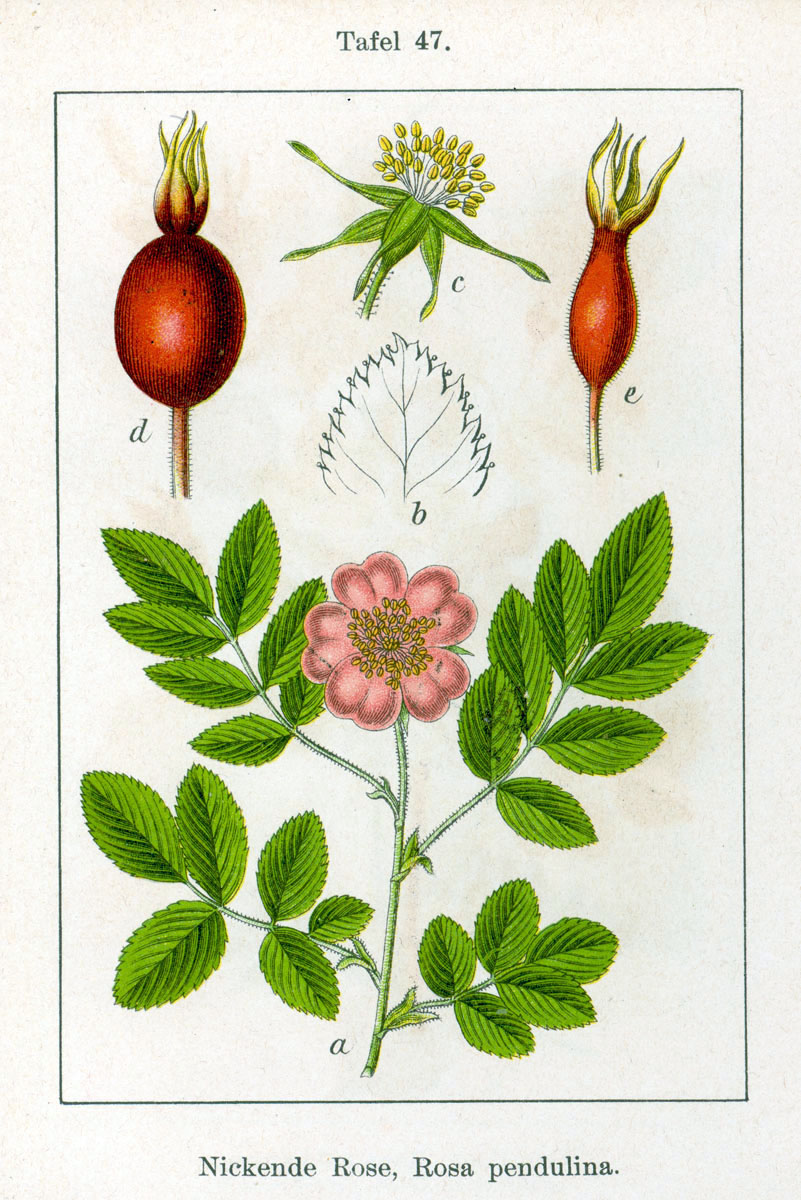
Alpine rose is a climbing wild rose native to mountainous regions of central and southern Europe. It bears deep pink, semi-double flowers, smooth stems, few thorns, and downward-hanging red hips, and has been grown in gardens since the 17th century.
- Flowers are deep pink to fuchsia and semi-double
- Stems are smooth and carry very few thorns
- Fruits (hips) hang downward, giving the species its name
- Grown in gardens since about 1683
- Hardy to USDA Zone 4a
What does Alpine rose look like?
Alpine rose grows as a climbing shrub up to 2 metres tall, occasionally reaching 3. Its flowers are semi-double and range from deep pink to fuchsia, often brighter at the centre. The plant has smooth stems, very few thorns, especially on upper branches, and produces oblong, hanging red hips. Its leaf stalks and flower stems are bristly to the touch.
Where does Alpine rose come from?
This species likely survived the last ice age in sheltered spots in the Alps and Carpathians, then spread across Europe’s mountain ranges. It occurs naturally from the Pyrenees through the Alps, Carpathians, and Balkans, up to 2,500 metres elevation. It was introduced to parts of North America and can appear outside gardens where planted.
When and how Alpine rose blooms
It thrives in cool, moist, partly shaded sites such as forest clearings, stream banks, or rocky slopes between 350 and 2,500 m altitude. Gardeners have cultivated it since around 1683 for its early bloom, strong scent, and sparse thorns. It is hardy down to USDA Zone 4a and flowers once per season.


How Alpine rose is used
Alpine rose has long been valued as an ornamental plant in gardens. Its genetics contributed to many modern rose varieties, including some Boursault roses. Though not tied to specific rituals, its attractive, fragrant blooms and unusual lack of thorns make it a distinctive choice for home planting and breeding.
Kinds of Alpine rose
Many historical forms once named as separate varieties or subspecies, often under the synonym Rosa alpina, are now grouped into a single species. Some old garden types like 'Inermis' and 'Plena' trace their origins to this rose, though most early classifications mixed natural variants, hybrids, and chance seedlings.
What Alpine rose means
Known for its role in rose breeding, Alpine rose passed on desirable traits like fragrance and low prickliness. Its pendulous fruit gives it the name 'pendulina'. While not a national emblem, it symbolises mountain flora in parts of Europe and appears in botanical records as a hardy, ancient wild rose.
Questions people ask about Alpine rose
Where does Alpine rose come from?
It is native to mountainous areas of central and southern Europe, including the Alps, Carpathians, Pyrenees, Apennines, and Balkans.
What does Alpine rose look like?
It is a climbing shrub up to 2 m tall with deep pink semi-double flowers, smooth stems, few thorns, and red hips that hang down.
Is Alpine rose fragrant?
Yes, it has a strong, pleasing fragrance, which made it valuable to rose breeders.
How is it used by people?
It has been grown as an ornamental plant since the 17th century and contributed genes to many cultivated rose varieties.
Does it have thorns?
It has very few thorns, especially on the upper parts of the plant, making it unusually smooth among wild roses.
Good reading and sources
- IUCN Red List of Threatened SpeciesIUCN Red List, Article
- Rosa pendulina 'Harstad'Royal Horticultural Society, Article
- USDA Plants DatabaseUS Department of Agriculture, Article
- Plants of the World OnlineRoyal Botanic Gardens, Kew, Plant database
- Where it has been recordedGBIF, Plant database
- Sightings and photos by naturalistsiNaturalist, Plant database
- Rosa pendulina on WikipediaEncyclopedia
- More photos on Wikimedia CommonsPhotos
- Wikidata recordOpen data
The facts on this page come from the Wikipedia article "Rosa pendulina", written by its contributors and used under the CC BY-SA 4.0 licence, and from its Wikidata record (CC0). Phool rewrote the text in its own words, with AI assistance, and compares every page with the article to make sure no passage is copied. It may be reused under the same CC BY-SA 4.0 licence with a link back.
It may contain mistakes. It is not medical or foraging advice: many flowers are poisonous, and traditional uses are reported, not recommended. If something is wrong, tell us. Last refreshed 2026-10-03.
Others in the family Rosaceae
The whole family RoseRosa
Woody perennial plants with showy, often fragrant flowers in many colours
Rosa · Wildflower
RoseRosa
Woody perennial plants with showy, often fragrant flowers in many colours
Rosa · Wildflower
 PeachPrunus persica
A flowering fruit tree from China, grown for its pink blossoms and sweet fruit
🇨🇳 China and 7 more · Flowering tree
PeachPrunus persica
A flowering fruit tree from China, grown for its pink blossoms and sweet fruit
🇨🇳 China and 7 more · Flowering tree
 AlmondPrunus amygdalus
A Mediterranean tree grown for its fragrant spring flowers and edible seeds
🇮🇷 Iran and 6 more · Flowering tree
AlmondPrunus amygdalus
A Mediterranean tree grown for its fragrant spring flowers and edible seeds
🇮🇷 Iran and 6 more · Flowering tree
 ApricotPrunus armeniaca
A small fruit tree with early white to pink blossoms and golden-orange fruit
🇨🇳 China and 6 more · Flowering tree
ApricotPrunus armeniaca
A small fruit tree with early white to pink blossoms and golden-orange fruit
🇨🇳 China and 6 more · Flowering tree
More from Bulgaria
All the flowers of Bulgaria BlackthornPrunus spinosa
A spiny shrub with white spring flowers and tart blue-black fruit
🇬🇧 United Kingdom and 7 more · Wildflower
BlackthornPrunus spinosa
A spiny shrub with white spring flowers and tart blue-black fruit
🇬🇧 United Kingdom and 7 more · Wildflower
 Dog roseRosa canina
A wild climbing rose with pale pink flowers and bright red hips
🇮🇪 Ireland and 7 more · Wildflower
Dog roseRosa canina
A wild climbing rose with pale pink flowers and bright red hips
🇮🇪 Ireland and 7 more · Wildflower
 Horse-chestnutAesculus hippocastanum
A large flowering tree known for its white spring blooms and shiny brown conkers
🇦🇱 Albania and 7 more · Flowering tree
Horse-chestnutAesculus hippocastanum
A large flowering tree known for its white spring blooms and shiny brown conkers
🇦🇱 Albania and 7 more · Flowering tree
 EdelweissLeontopodium nivale
A woolly white star-shaped flower of the European mountains
🇦🇹 Austria and 5 more · Wildflower
EdelweissLeontopodium nivale
A woolly white star-shaped flower of the European mountains
🇦🇹 Austria and 5 more · Wildflower