Stanhopea
Fragrant, short-lived orchids from Central and South America
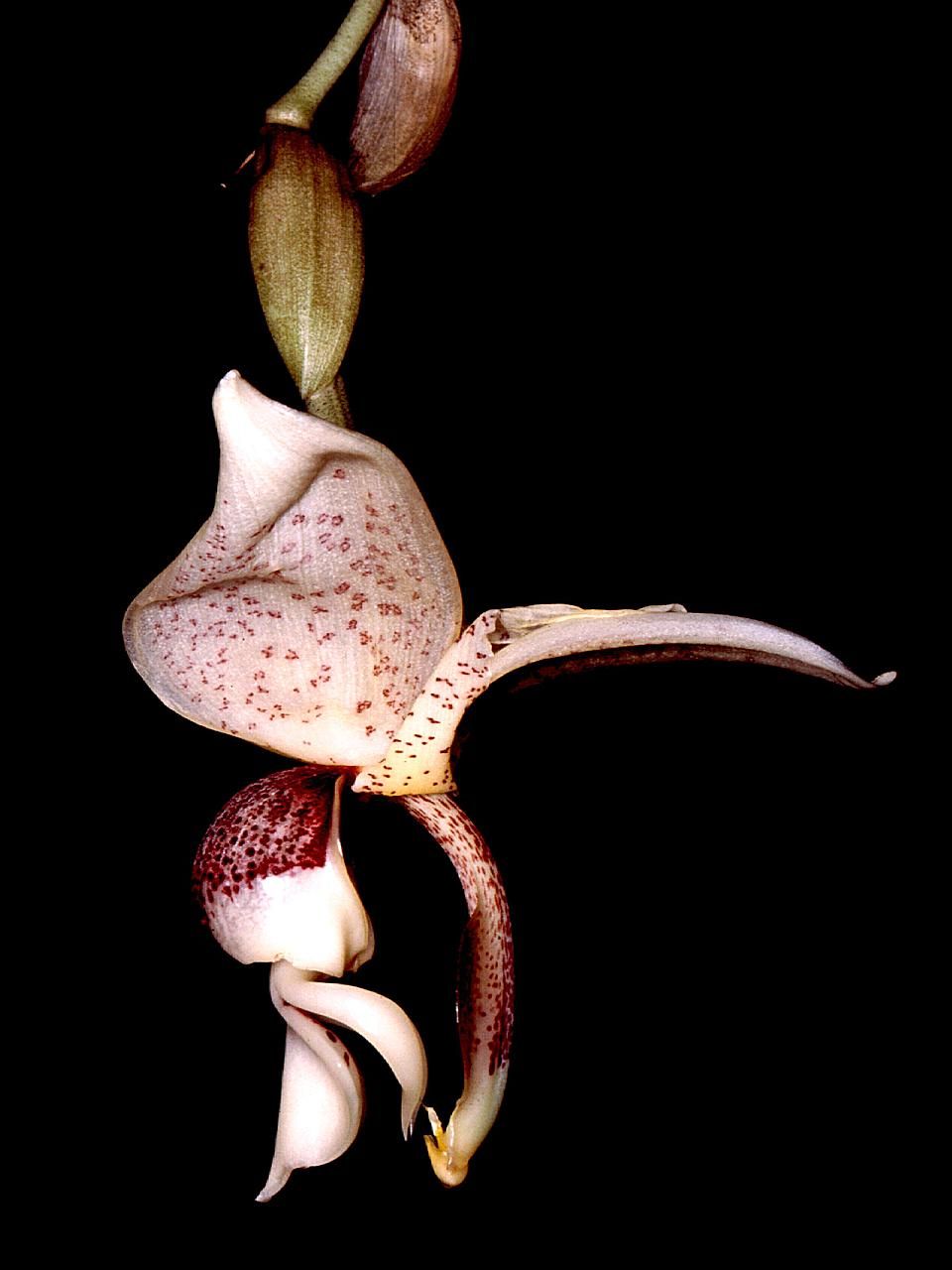
Stanhopea is a genus of orchids found in damp forests from Mexico to Argentina. Known for their large, complex, and often fragrant flowers that last only a few days, these orchids are mostly epiphytes and are sometimes called upside-down orchids because their blooms emerge downward through basket containers.
- Stanhopea flowers last only about three days
- Blooms hang downward, often through basket bottoms
- Pollinated by male euglossine bees attracted to strong scents
- Found from Mexico to Argentina in damp forests
- Named after British botanist Philip Henry Stanhope
What does Stanhopea look like?
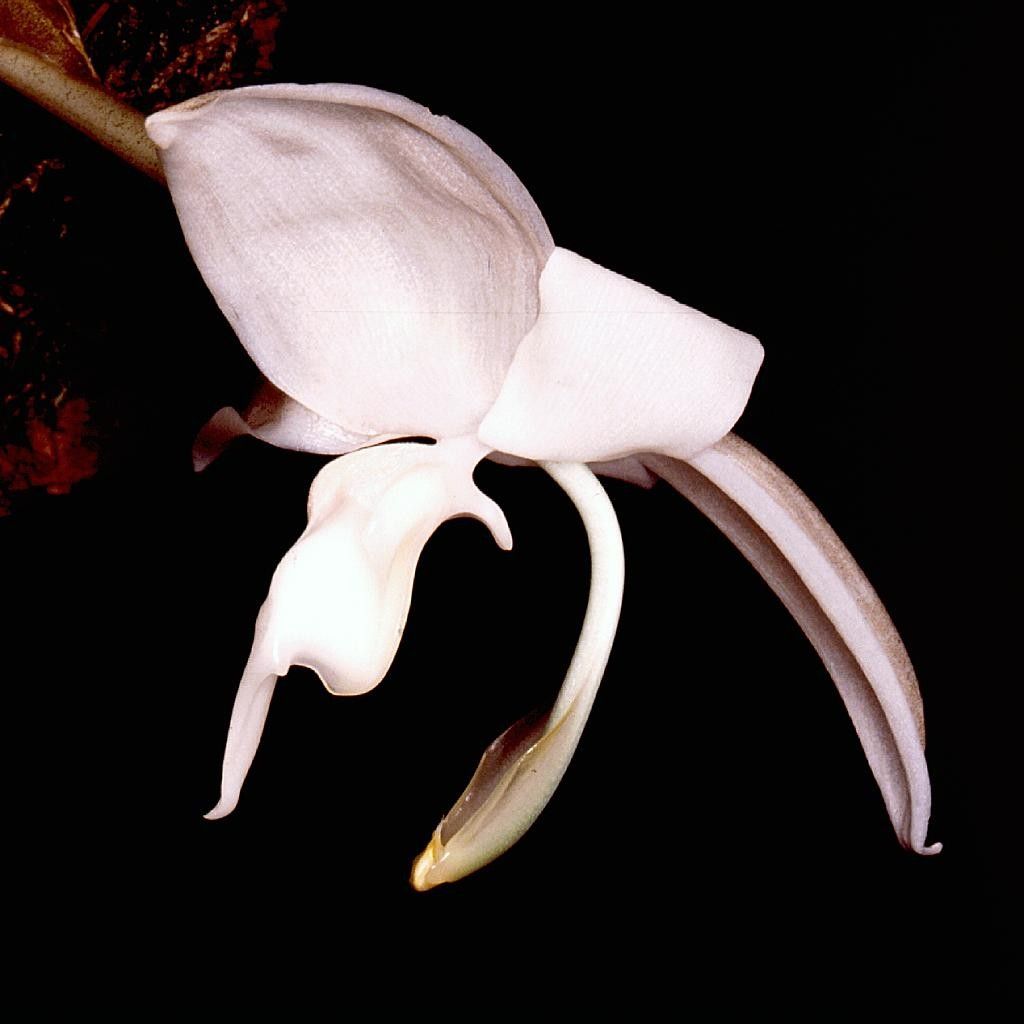
Stanhopea orchids are robust plants, usually growing on trees (epiphytic) but sometimes on the ground. Each plant has oval-shaped pseudobulbs topped with a single long, pleated, elliptic leaf. The flowers are large, complex, and often highly fragrant, but last only about three days. Many species have striking horn-like structures on the lip of the flower. The blooms hang down from the plant, often pushing through the bottom of baskets, which is why they are sometimes called upside-down orchids.
Where does Stanhopea come from?
Stanhopea is native to damp forests stretching from Mexico through Central America to Trinidad and as far south as northwestern Argentina. The genus was named after Philip Henry Stanhope, a 19th-century British botanist. With about 55 species and several natural hybrids, Stanhopea orchids have adapted to a range of forest environments, mostly as epiphytes. Their spread in cultivation is helped by their striking appearance and strong scent.
When and how Stanhopea blooms
Stanhopea orchids bloom with pendant inflorescences that push down through their growing medium, so they are often grown in baskets with open bottoms. The flowers are short-lived, usually lasting less than three days. The plants thrive in humid, shaded environments typical of their forest homes. Most are grown from seed or division and need good air circulation and moisture.



How Stanhopea is used
These orchids are mainly grown by enthusiasts and collectors for their unusual, fragrant flowers and dramatic appearance. Their short-lived blooms make them less common as cut flowers, but they are prized in orchid collections and botanical gardens. The strong scent and unique flower structure attract orchid lovers and pollinators alike.
Kinds of Stanhopea
The genus includes about 55 species and 5 natural hybrids, with notable species such as Stanhopea tigrina (Mexico), S. grandiflora (Trinidad and South America), and S. wardii (Nicaragua to Venezuela). Some species lack the prominent horns seen in most Stanhopea flowers, while others have shorter or simpler floral structures. There are also intergeneric hybrids with related genera.
What Stanhopea means
Stanhopea orchids are admired for their complex flowers and strong fragrance. Their pollination relies on male euglossine bees, which are drawn by the flowers’ chemical scents. The genus is popular among orchid growers for its unusual blooming habit and the challenge of cultivating its short-lived but spectacular flowers.
Questions people ask about Stanhopea
Where do Stanhopea orchids come from?
Stanhopea orchids are native to damp forests in Central and South America, ranging from Mexico and Trinidad south to northwestern Argentina.
What do Stanhopea flowers look like?
Stanhopea flowers are large, complex, and often have horn-like structures on the lip. They are usually fragrant and hang downward, emerging through the bottom of their containers.
How long do Stanhopea flowers last?
The flowers of Stanhopea orchids are short-lived, typically lasting three days or less before wilting.
Why are Stanhopea orchids called upside-down orchids?
They are called upside-down orchids because their flower spikes grow downward, often pushing through the bottom of baskets, making the blooms hang below the plant.
What pollinates Stanhopea orchids?
Stanhopea orchids are pollinated by male euglossine bees, which are attracted by the strong scents produced by the flowers.
Good reading and sources
- USDA Plants DatabaseUS Department of Agriculture, Article
- Plants of the World OnlineRoyal Botanic Gardens, Kew, Plant database
- Where it has been recordedGBIF, Plant database
- Sightings and photos by naturalistsiNaturalist, Plant database
The facts on this page come from the Wikipedia article "Stanhopea", written by its contributors and used under the CC BY-SA 4.0 licence, and from its Wikidata record (CC0). Phool rewrote the text in its own words, with AI assistance, and compares every page with the article to make sure no passage is copied. It may be reused under the same CC BY-SA 4.0 licence with a link back.
It may contain mistakes. It is not medical or foraging advice: many flowers are poisonous, and traditional uses are reported, not recommended. If something is wrong, tell us. Last refreshed 2026-10-03.
Others in the family Orchidaceae
The whole family OrchidOrchidaceae
A vast family of colourful, often fragrant flowers found almost everywhere on earth
Orchidaceae · Wildflower
OrchidOrchidaceae
A vast family of colourful, often fragrant flowers found almost everywhere on earth
Orchidaceae · Wildflower
 Vanilla
Climbing orchids with pods used for the world’s most popular flavor
🇲🇽 Mexico and 7 more · Wildflower
Vanilla
Climbing orchids with pods used for the world’s most popular flavor
🇲🇽 Mexico and 7 more · Wildflower
 Orchis
A group of wild orchids with tuberous roots from Europe, North Africa and Asia
🇹🇷 Turkey and 7 more · Wildflower
Orchis
A group of wild orchids with tuberous roots from Europe, North Africa and Asia
🇹🇷 Turkey and 7 more · Wildflower
 Pansy orchidMiltoniopsis
An orchid with flowers that resemble garden pansies
🇨🇷 Costa Rica and 5 more · Orchid
Pansy orchidMiltoniopsis
An orchid with flowers that resemble garden pansies
🇨🇷 Costa Rica and 5 more · Orchid
More from Mexico
All the flowers of Mexico Common sunflowerHelianthus annuus
A tall annual plant grown for its large yellow flower heads and edible seeds
🇨🇦 Canada and 4 more · Wildflower
Common sunflowerHelianthus annuus
A tall annual plant grown for its large yellow flower heads and edible seeds
🇨🇦 Canada and 4 more · Wildflower
 CactusCactaceae
Succulent plants with spines, native to the Americas
🇲🇽 Mexico and 7 more · Wildflower
CactusCactaceae
Succulent plants with spines, native to the Americas
🇲🇽 Mexico and 7 more · Wildflower
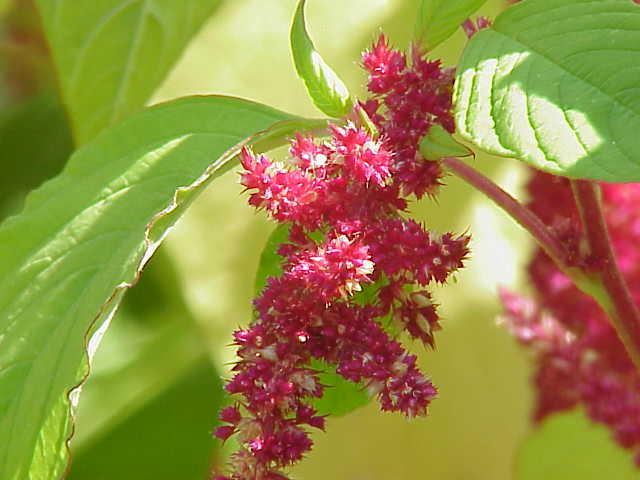 AmaranthAmaranthus
A tall, colourful plant grown for its flowers, leaves and edible seeds
🇲🇽 Mexico and 7 more · Wildflower
AmaranthAmaranthus
A tall, colourful plant grown for its flowers, leaves and edible seeds
🇲🇽 Mexico and 7 more · Wildflower
 HawthornCrataegus
A thorny shrub or tree with white or pink spring flowers and small edible fruits
🇮🇪 Ireland and 7 more · Wildflower
HawthornCrataegus
A thorny shrub or tree with white or pink spring flowers and small edible fruits
🇮🇪 Ireland and 7 more · Wildflower