
Nasturtium
Tropaeolum majus, family Tropaeolaceae
A bright edible flower with round leaves and trailing stems
Nasturtium is a fast-growing plant with round, shield-like leaves and vivid flowers in shades of yellow, orange, or red. Native to the Andes from Bolivia to Colombia, it is grown worldwide for its edible flowers and leaves, which add a peppery flavor to salads and other dishes.
- All above-ground parts are edible with a peppery flavor
- Flowers range from cream and yellow to orange, red, and maroon
- Native to the Andes, now grown worldwide
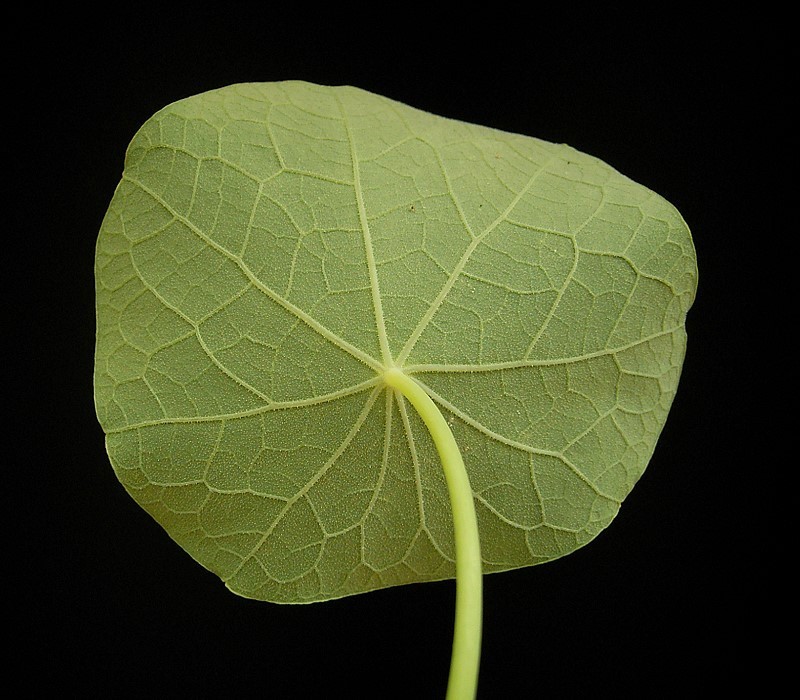
- Leaves repel water, showing the 'lotus effect'
- Recognized with garden awards for ornamental value
What does Nasturtium look like?
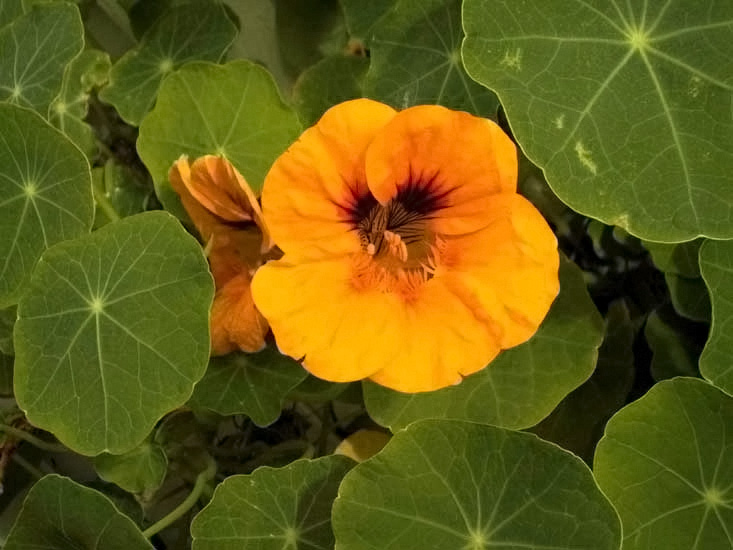
Nasturtium is a trailing or climbing plant, reaching up to 1.8 meters in length. Its leaves are nearly round, with veins radiating from the center and a smooth or slightly lobed edge. The flowers are funnel-shaped, 2.5 to 6 cm across, with five frilled petals and a long nectar spur. They come in warm colors from cream and yellow to orange, red, and maroon. The plant has a mild scent and produces three-parted fruits with large seeds.
Where does Nasturtium come from?
Nasturtium comes from the Andes mountains, stretching from Bolivia up to Colombia. Though its exact origins are mixed, it is thought to be a hybrid developed through cultivation. Over time, it has spread far beyond its original home, becoming a familiar garden plant in many parts of the world. It is now naturalized in the United States, Europe, Asia, Africa, and Australia, and has become invasive in some places such as Hawaii and Lord Howe Island.
When and how Nasturtium blooms
Nasturtium grows quickly from large, easy-to-handle seeds. It thrives in poor, moist soil and prefers full sunlight. In areas with frost, seeds are started indoors and transplanted after the last frost, while in milder climates, they can be sown directly outside. The plant blooms from spring through summer, offering a range of flower colors. Some varieties have leaves with decorative marbling.



How Nasturtium is used
People grow nasturtium for its bright flowers and edible parts. The leaves and flowers are added to salads or stir-fries for their peppery taste, similar to watercress. Unripe seed pods are sometimes pickled as a substitute for capers. Traditionally, some South American groups used the plant for its medicinal properties, and in Europe, it was eaten for urinary and genital health.
Kinds of Nasturtium
There are many cultivated forms of nasturtium, offering a broad palette of flower colors and leaf patterns. Notable groups include the Whirlybird Series and Alaska Series, both recognized for their garden performance. Some types have striking marbled leaves, adding extra interest to gardens.
What Nasturtium means
Nasturtium is valued for its edible and ornamental qualities. Its flowers demonstrate the 'lotus effect,' where water beads and rolls off the leaves. The orange blossoms can appear to flash at dusk, an effect named after Elisabeth Linné. The plant is not related to true watercress, despite its common names. It is also a food source for certain butterfly and moth larvae.
Where to see Nasturtium

Questions people ask about Nasturtium
Where does nasturtium come from?
Nasturtium is originally from the Andes mountains, especially the region stretching from Bolivia to Colombia. It has since spread through cultivation and now grows in gardens around the world.
What does nasturtium look like?
It has round, shield-shaped leaves and trailing stems. The flowers are funnel-shaped, with five frilled petals, and come in shades of yellow, orange, red, maroon, and cream.
Can you eat nasturtium?
Yes, the leaves, flowers, and unripe seed pods are all edible. The flowers and leaves have a peppery taste and are often used in salads or as garnishes. The seed pods can be pickled and used like capers.
What is nasturtium used for?
Besides being grown for its bright flowers, nasturtium is used as an edible plant. It has also been used in traditional medicine by some South American peoples and in Europe.
Does nasturtium have any special features?
The leaves repel water, causing droplets to roll off. At dusk, the orange flowers may appear to flash, an effect linked to how our eyes see the color contrast.
Good reading and sources
- Encyclopaedia BritannicaArticle
- Das Elisabeth Linné-Phänomen (sogenanntes Blitzen der Blüten) und seine DeutungenNature, Article
- USDA Plants DatabaseUS Department of Agriculture, Article
- Plants of the World OnlineRoyal Botanic Gardens, Kew, Plant database
- Where it has been recordedGBIF, Plant database
- Sightings and photos by naturalistsiNaturalist, Plant database
- Tropaeolum majus on WikipediaEncyclopedia
- More photos on Wikimedia CommonsPhotos
- Wikidata recordOpen data
The facts on this page come from the Wikipedia article "Tropaeolum majus", written by its contributors and used under the CC BY-SA 4.0 licence, and from its Wikidata record (CC0). Phool rewrote the text in its own words, with AI assistance, and compares every page with the article to make sure no passage is copied. It may be reused under the same CC BY-SA 4.0 licence with a link back.
It may contain mistakes. It is not medical or foraging advice: many flowers are poisonous, and traditional uses are reported, not recommended. If something is wrong, tell us. Last refreshed 2026-10-03.
Others in the family Tropaeolaceae
The whole family
More from Bolivia
All the flowers of Bolivia CactusCactaceae
Succulent plants with spines, native to the Americas
🇲🇽 Mexico and 7 more · Wildflower
CactusCactaceae
Succulent plants with spines, native to the Americas
🇲🇽 Mexico and 7 more · Wildflower
 MarigoldTagetes
A group of bright annual and perennial flowers known worldwide as marigolds
🇲🇽 Mexico and 7 more · Wildflower
MarigoldTagetes
A group of bright annual and perennial flowers known worldwide as marigolds
🇲🇽 Mexico and 7 more · Wildflower
 BromeliadsBromeliaceae
A family of tropical flowering plants from the Americas, including the pineapple
🇨🇱 Chile and 7 more · Wildflower
BromeliadsBromeliaceae
A family of tropical flowering plants from the Americas, including the pineapple
🇨🇱 Chile and 7 more · Wildflower
 DogwoodCornus
Woody trees and shrubs with showy bracts and colorful berries
🇨🇳 China and 7 more · Wildflower
DogwoodCornus
Woody trees and shrubs with showy bracts and colorful berries
🇨🇳 China and 7 more · Wildflower