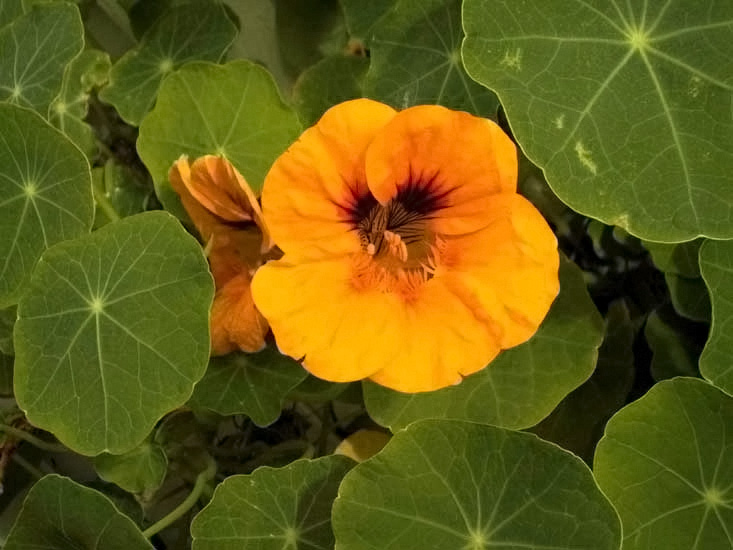
Nasturtium
Tropaeolum, family Tropaeolaceae
A South American genus with bright, edible flowers and rounded leaves
Nasturtium is a group of about 80 species of flowering plants native to South and Central America. Known for their vivid flowers and round, shield-like leaves, they are popular in gardens and as edible flowers, with some species grown for their tuberous roots in the Andes.
- All parts of T. majus are edible, with a peppery taste.
- Some species, like mashua, are grown for their tuberous roots in the Andes.
- Flowers come in many bright colors, including yellow, orange, red, and blue.
- Nasturtiums are used as companion plants to control pests.
- Introduced to Europe in the 16th century by Spanish botanists.
What does Nasturtium look like?
Nasturtiums are annual or perennial plants with soft, sometimes succulent stems and rounded, shield-shaped leaves. The leaves are hairless and often have long stalks that can twine for support. Their flowers are showy, usually with five petals, and come in bright shades of yellow, orange, red, cream, and sometimes blue or purple. Many have a funnel-shaped nectar spur at the back. Some species have deeply lobed or silvery leaves, and the plants can be bushy or trailing.
Where does Nasturtium come from?
Tropaeolum is native to South and Central America, especially the Andes and coastal regions. The genus was named by Carl Linnaeus, inspired by the plant's leaf and flower shapes, which reminded him of Roman trophies. Nasturtiums were brought to Europe in the 16th century, first described by Spanish botanist Nicolás Monardes and later grown in English gardens. The genus includes species adapted to a range of climates, from lowland coasts to high mountain slopes.
When and how Nasturtium blooms
Most garden nasturtiums are grown from seed as annuals, thriving in sun and poor, well-drained soil. Some species are perennials with tuberous roots, able to survive cold by staying dormant underground. Seeds of winter-growing species are sown in autumn, while summer growers are started in spring. Some forms are bushy, while others climb or trail, making them useful for covering fences or awkward spots.


How Nasturtium is used
Nasturtium flowers, leaves, and unripe seed pods are all edible, often added to salads for their peppery taste or pickled as a condiment. In the Andes, the tubers of some species are a traditional food. Nasturtiums are also grown as companion plants to deter pests and attract beneficial insects. T. majus has been used in herbal medicine, and in Germany, it is an ingredient in a licensed herbal antibiotic.
Kinds of Nasturtium
The genus includes many species and cultivars. T. majus and its hybrids are common in gardens, with varieties like 'Alaska Series' and 'Whirlybird Series'. T. speciosum, the flame flower, is known for its red blooms in cool climates. T. tuberosum, or mashua, is grown for its edible tubers in the Andes. Other species include the blue-flowered T. azureum and the yellow-flowered T. brachyceras.
What Nasturtium means
Nasturtiums were once called 'Indian cress' in Europe, valued as salad plants. Their introduction to Europe was recorded in the 16th century, and they have since become popular ornamentals and food plants. The genus name and common names reflect both their appearance and culinary uses. Some cultivars have received awards from horticultural societies for their garden value.
Questions people ask about Nasturtium
Where do nasturtiums come from?
Nasturtiums are native to South and Central America, especially the Andes and coastal regions. They were brought to Europe in the 16th century and have since become popular garden plants worldwide.
What do nasturtiums look like?
They have rounded, shield-shaped leaves and bright, showy flowers in yellow, orange, red, cream, and sometimes blue or purple. Some species are bushy, while others climb or trail.
Are nasturtiums edible?
Yes, all parts of T. majus are edible. The flowers and leaves have a peppery flavor and are used in salads, while the unripe seed pods can be pickled. Some species produce edible tubers.
How are nasturtiums used in gardens?
Nasturtiums are grown for their colorful flowers and as companion plants to help control pests. They can be used to cover fences, trellises, or awkward garden spots.
What do nasturtiums symbolize or mean?
The sources do not mention a specific symbolism, but their name and history are linked to their appearance and culinary use.
Good reading and sources
- Encyclopaedia BritannicaArticle
- USDA Plants DatabaseUS Department of Agriculture, Article
- Plants of the World OnlineRoyal Botanic Gardens, Kew, Plant database
- Where it has been recordedGBIF, Plant database
- Sightings and photos by naturalistsiNaturalist, Plant database
The facts on this page come from the Wikipedia article "Tropaeolum", written by its contributors and used under the CC BY-SA 4.0 licence, and from its Wikidata record (CC0). Phool rewrote the text in its own words, with AI assistance, and compares every page with the article to make sure no passage is copied. It may be reused under the same CC BY-SA 4.0 licence with a link back.
It may contain mistakes. It is not medical or foraging advice: many flowers are poisonous, and traditional uses are reported, not recommended. If something is wrong, tell us. Last refreshed 2026-10-03.
Others in the family Tropaeolaceae
The whole family

More from Chile
All the flowers of Chile CactusCactaceae
Succulent plants with spines, native to the Americas
🇲🇽 Mexico and 7 more · Wildflower
CactusCactaceae
Succulent plants with spines, native to the Americas
🇲🇽 Mexico and 7 more · Wildflower
 PoinsettiaEuphorbia pulcherrima
The red-bracted shrub of Christmas displays, native to Mexico and Central America
🇲🇽 Mexico and 8 more · Wildflower
PoinsettiaEuphorbia pulcherrima
The red-bracted shrub of Christmas displays, native to Mexico and Central America
🇲🇽 Mexico and 8 more · Wildflower
 MarigoldTagetes
A group of bright annual and perennial flowers known worldwide as marigolds
🇲🇽 Mexico and 7 more · Wildflower
MarigoldTagetes
A group of bright annual and perennial flowers known worldwide as marigolds
🇲🇽 Mexico and 7 more · Wildflower
 BromeliadsBromeliaceae
A family of tropical flowering plants from the Americas, including the pineapple
🇨🇱 Chile and 7 more · Wildflower
BromeliadsBromeliaceae
A family of tropical flowering plants from the Americas, including the pineapple
🇨🇱 Chile and 7 more · Wildflower