
Armenian tulip
Tulipa armena, family Liliaceae
A wild tulip from the Armenian Highlands with many forms and colours
The Armenian tulip is a wild tulip species from the Armenian Highlands, found in Armenia, Turkey, Iran, Azerbaijan, and Georgia. Its flowers vary in colour and pattern, and it grows in mountain meadows and rocky slopes. Gardeners value it for its striking blooms and adaptability to dry, sunny spots.
- Native to the Armenian Highlands and nearby regions
- Flowers can be red, yellow, or patterned with dark blotches
- Grows on mountain slopes and steppe at high elevations
- First described in 1859 by Edmund Boissier
What does Armenian tulip look like?
The Armenian tulip grows from a bulb with a thin, papery covering. Its stems reach up to 25 cm, and it has several broad, curved leaves that may feel smooth or slightly hairy, often with a reddish tint. The plant produces a single large flower, which can be cup- or bowl-shaped. Flower colours range from red with a dark blotch at the base, sometimes edged in yellow, to pure yellow forms. Some flowers show stripes or mottling. The inner parts of the flower are also varied, with black or purple filaments and either yellow or black anthers.
Where does Armenian tulip come from?
This tulip is native to the Armenian Highlands, stretching into parts of Turkey, Iran, Azerbaijan, and Georgia. It thrives in mountain grasslands, rocky slopes, and steppe regions, often at elevations from 1,000 to 2,700 meters. The species was first described in 1859 by Edmund Boissier, based on plants from Northeast Turkey. Over time, several similar tulips from nearby areas were named as separate species, but most are now considered forms of Tulipa armena.
When and how Armenian tulip blooms
The Armenian tulip blooms in spring, usually from April to June. In gardens, it prefers soil that drains well and a spot with full sunlight. It does best where summers are hot and dry, mimicking its natural mountain habitat. Gardeners plant the bulbs in autumn, and the plant will flower the following spring.
How Armenian tulip is used
People mainly grow the Armenian tulip as an ornamental plant in gardens. Its range of flower colours and patterns makes it attractive for collectors and those interested in wild species. It is not widely used in other traditions or for cut flowers, but its adaptability to dry, sunny places makes it a valued garden plant.
Kinds of Armenian tulip
Tulipa armena is highly variable. Some forms have red flowers with a dark base, while others are yellow, sometimes without a blotch. Plants from different regions may have hairier bulbs or longer stems. Names like T. karabachensis and T. willmottiae have been used for these forms, but they are now included under T. armena. The yellow form without a blotch has been called T. galatica.
What Armenian tulip means
The Armenian tulip takes its name from the region where it grows wild. It is not listed as a national or state symbol, but its presence in the mountains of Armenia and neighbouring countries connects it to the natural heritage of the area. Gardeners value it for its diversity and its ability to thrive in tough, dry conditions.
Questions people ask about Armenian tulip
Where does the Armenian tulip come from?
It grows wild in the Armenian Highlands and nearby parts of Turkey, Iran, Azerbaijan, and Georgia, mostly in mountain meadows and rocky slopes.
What does the Armenian tulip look like?
It has a single large flower on a short stem. The flower can be red or yellow, often with a dark blotch at the base, and the leaves are broad and sometimes reddish.
How is the Armenian tulip used?
People mainly grow it in gardens for its colourful and varied flowers. It is not widely used in ceremonies or as a cut flower.
When does Tulipa armena flower?
It blooms in spring, usually from April to June in its native regions.
Are there different forms of this tulip?
Yes, Tulipa armena is very variable. Some forms are red with a dark base, others are yellow, and there are differences in bulb hairiness and stem length.
Good reading and sources
- Plants of the World OnlineRoyal Botanic Gardens, Kew, Plant database
- Where it has been recordedGBIF, Plant database
- Sightings and photos by naturalistsiNaturalist, Plant database
The facts on this page come from the Wikipedia article "Tulipa armena", written by its contributors and used under the CC BY-SA 4.0 licence, and from its Wikidata record (CC0). Phool rewrote the text in its own words, with AI assistance, and compares every page with the article to make sure no passage is copied. It may be reused under the same CC BY-SA 4.0 licence with a link back.
It may contain mistakes. It is not medical or foraging advice: many flowers are poisonous, and traditional uses are reported, not recommended. If something is wrong, tell us. Last refreshed 2026-10-03.
Others in the family Liliaceae
The whole family TulipTulipa
Spring-blooming bulbs with showy, cup-shaped flowers in many colours
🇳🇱 Netherlands and 7 more · Wildflower
TulipTulipa
Spring-blooming bulbs with showy, cup-shaped flowers in many colours
🇳🇱 Netherlands and 7 more · Wildflower
 LilyLilium
Tall bulb flowers with large, colourful blooms in many gardens and cultures
Lilium · Wildflower
LilyLilium
Tall bulb flowers with large, colourful blooms in many gardens and cultures
Lilium · Wildflower
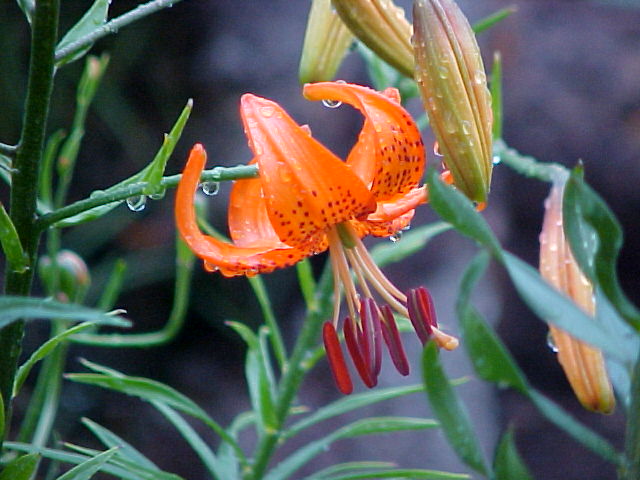 Lilium davidii
A tall Asian lily with edible bulbs and orange recurved flowers
🇨🇳 China and 1 more · Wildflower
Lilium davidii
A tall Asian lily with edible bulbs and orange recurved flowers
🇨🇳 China and 1 more · Wildflower
 Chinese LilyLilium brownii
A wild and cultivated lily from China with edible bulbs
🇨🇳 China and 3 more · Wildflower
Chinese LilyLilium brownii
A wild and cultivated lily from China with edible bulbs
🇨🇳 China and 3 more · Wildflower
More from Armenia
All the flowers of Armenia ApricotPrunus armeniaca
A small fruit tree with early white to pink blossoms and golden-orange fruit
🇨🇳 China and 6 more · Flowering tree
ApricotPrunus armeniaca
A small fruit tree with early white to pink blossoms and golden-orange fruit
🇨🇳 China and 6 more · Flowering tree
 Forget-me-notMyosotis
Small blue wildflowers known for remembrance and love
🇳🇿 New Zealand and 7 more · Wildflower
Forget-me-notMyosotis
Small blue wildflowers known for remembrance and love
🇳🇿 New Zealand and 7 more · Wildflower
 White Water-lilyNymphaea alba
A floating white flower of ponds and lakes across Europe and Asia
🇸🇪 Sweden and 5 more · Wildflower
White Water-lilyNymphaea alba
A floating white flower of ponds and lakes across Europe and Asia
🇸🇪 Sweden and 5 more · Wildflower
 Sprenger's tulipTulipa sprengeri
A bright red wild tulip from Amasya, Turkey, once thought extinct
🇹🇷 Turkey and 2 more · Wildflower
Sprenger's tulipTulipa sprengeri
A bright red wild tulip from Amasya, Turkey, once thought extinct
🇹🇷 Turkey and 2 more · Wildflower