
Cyprus tulip
Tulipa cypria, family Liliaceae
In its own language: Kıbrıs lalesi
A rare blood-red tulip found only in Cyprus
The Cyprus tulip is a perennial bulb with striking blood-red flowers, found only on the island of Cyprus. It grows in limestone pastures and cereal fields, flowering in March and April, and is strictly protected due to its rarity.
- Endemic to Cyprus and found nowhere else in the wild
- Features a single blood-red flower with a black and yellow center
- Blooms in spring, mainly March and April
- Strictly protected due to its rarity
- Grows in limestone pastures and cereal fields
What does Cyprus tulip look like?
The Cyprus tulip is an upright perennial plant that grows from a bulb and reaches 15–40 cm in height when in bloom. It has four smooth, bluish-green leaves: two large, wavy-edged lower leaves and two smaller, almost straight upper leaves. Each plant produces a single, cup-shaped flower with six petal-like segments. The flower is a deep blood-red with a black blotch at its center, edged by a yellow ring. Its fruit is a capsule.
Where does Cyprus tulip come from?
Tulipa cypria is native and unique to Cyprus, meaning it is not found naturally anywhere else. It grows wild in specific regions such as Akamas, Kormakitis, and parts of the Pentadaktylos range. The plant thrives in limestone soils, often in maquis pastures with juniper bushes or in cereal fields, at elevations between 100 and 300 meters. Its rarity has led to strict protection measures.
When and how Cyprus tulip blooms
The Cyprus tulip blooms in spring, mainly during March and April. It grows from bulbs that lie dormant until the right season. The plant prefers limestone-rich soils and open pastures or fields. It is not widely cultivated and is mostly seen in the wild, where it depends on the local climate and soil conditions for growth.
How Cyprus tulip is used
There are no traditional or modern uses for the Cyprus tulip mentioned in the sources. Its main significance is its rarity and its role as a protected wildflower. People may visit its habitats to see it in bloom, but picking or disturbing the plant is prohibited due to its endangered status.
Kinds of Cyprus tulip
No other species or varieties of Tulipa cypria are mentioned in the sources. It is a distinct species, separate from other tulips, and is only found in certain regions of Cyprus.
What Cyprus tulip means
The Cyprus tulip is a symbol of the island's unique natural heritage. Its rarity and striking appearance have made it a subject of local interest and conservation. It is strictly protected by law, and its habitats are monitored to prevent further decline. The plant is sometimes featured in local festivals and awareness campaigns about Cyprus's endemic flora.
Questions people ask about Cyprus tulip
Where does the Cyprus tulip come from?
The Cyprus tulip is native only to Cyprus. It grows wild in regions such as Akamas, Kormakitis, and parts of the Pentadaktylos range, usually in limestone pastures and cereal fields.
What does the Cyprus tulip look like?
It is a small, upright plant with four smooth leaves and a single, cup-shaped flower. The flower is deep blood-red with a black blotch at the center, bordered by a yellow ring.
When does the Cyprus tulip bloom?
The Cyprus tulip flowers in spring, mainly during March and April, depending on the local climate in Cyprus.
Is the Cyprus tulip endangered?
Yes, the Cyprus tulip is very rare and strictly protected by law. Its habitats are monitored to ensure its survival.
Does the Cyprus tulip have any special meaning or use?
The Cyprus tulip is valued mainly for its rarity and beauty as a wildflower. It is a symbol of Cyprus’s unique plant life and is sometimes featured in local festivals and conservation efforts.
Good reading and sources
- IUCN Red List of Threatened SpeciesIUCN Red List, Article
- Plants of the World OnlineRoyal Botanic Gardens, Kew, Plant database
- Where it has been recordedGBIF, Plant database
- Sightings and photos by naturalistsiNaturalist, Plant database
- Tulipa cypria on WikipediaEncyclopedia
- More photos on Wikimedia CommonsPhotos
- Wikidata recordOpen data
The facts on this page come from the Wikipedia article "Tulipa cypria", written by its contributors and used under the CC BY-SA 4.0 licence, and from its Wikidata record (CC0). Phool rewrote the text in its own words, with AI assistance, and compares every page with the article to make sure no passage is copied. It may be reused under the same CC BY-SA 4.0 licence with a link back.
It may contain mistakes. It is not medical or foraging advice: many flowers are poisonous, and traditional uses are reported, not recommended. If something is wrong, tell us. Last refreshed 2026-10-03.
Others in the family Liliaceae
The whole family TulipTulipa
Spring-blooming bulbs with showy, cup-shaped flowers in many colours
🇳🇱 Netherlands and 7 more · Wildflower
TulipTulipa
Spring-blooming bulbs with showy, cup-shaped flowers in many colours
🇳🇱 Netherlands and 7 more · Wildflower
 LilyLilium
Tall bulb flowers with large, colourful blooms in many gardens and cultures
Lilium · Wildflower
LilyLilium
Tall bulb flowers with large, colourful blooms in many gardens and cultures
Lilium · Wildflower
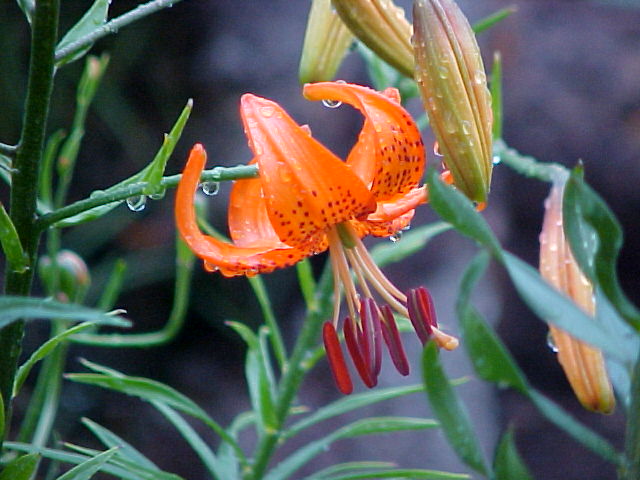 Lilium davidii
A tall Asian lily with edible bulbs and orange recurved flowers
🇨🇳 China and 1 more · Wildflower
Lilium davidii
A tall Asian lily with edible bulbs and orange recurved flowers
🇨🇳 China and 1 more · Wildflower
 Chinese LilyLilium brownii
A wild and cultivated lily from China with edible bulbs
🇨🇳 China and 3 more · Wildflower
Chinese LilyLilium brownii
A wild and cultivated lily from China with edible bulbs
🇨🇳 China and 3 more · Wildflower
More from Cyprus
All the flowers of Cyprus Orchis
A group of wild orchids with tuberous roots from Europe, North Africa and Asia
🇹🇷 Turkey and 7 more · Wildflower
Orchis
A group of wild orchids with tuberous roots from Europe, North Africa and Asia
🇹🇷 Turkey and 7 more · Wildflower
 Fritillaria persica
A tall bulb plant with deep purple to greenish-brown bell flowers from the Middle East
🇹🇷 Turkey and 7 more · Wildflower
Fritillaria persica
A tall bulb plant with deep purple to greenish-brown bell flowers from the Middle East
🇹🇷 Turkey and 7 more · Wildflower
 Tulipa agenensis
A wild red tulip from the eastern Mediterranean and Middle East
🇹🇷 Turkey and 6 more · Wildflower
Tulipa agenensis
A wild red tulip from the eastern Mediterranean and Middle East
🇹🇷 Turkey and 6 more · Wildflower
 Cyclamen cyprium
A tuberous wildflower with heart-shaped leaves, native to the mountains of Cyprus
🇨🇾 Cyprus · Wildflower
Cyclamen cyprium
A tuberous wildflower with heart-shaped leaves, native to the mountains of Cyprus
🇨🇾 Cyprus · Wildflower