
Water-lily tulip
Tulipa kaufmanniana, family Liliaceae
A dwarf tulip from Central Asia with star-shaped flowers
The water-lily tulip is a small tulip species from Central Asia, known for its wide-opening, star-like blooms that resemble water lilies. It grows on rocky slopes and steppes, and its flowers come in various shades with striking petal patterns, making it a favourite for early spring gardens.
- Native to the mountains and steppes of Central Asia
- Flowers open wide in sunlight, resembling water lilies
- Blooms from February to April, earlier than many tulips
- Leaves may have purple streaks or dashes
- Featured on stamps in Russia and Uzbekistan
What does Water-lily tulip look like?
This tulip stays low to the ground, reaching about 20 to 25 cm tall. Its leaves are slim and pointed, sometimes plain green or blue-green, and often show purple streaks. The flowers have six pointed petals that spread wide in sunlight, forming a star or water-lily shape. Colours vary, with combinations of red, orange, pink, yellow, white, and purple, sometimes with contrasting marks or blotches inside and out.
Where does Water-lily tulip come from?
Tulipa kaufmanniana grows wild in Central Asia, especially in the mountains and steppes of Kyrgyzstan, Kazakhstan, and Tajikistan, including the Tien-Shan, Pamir, and Hindu Kush ranges. It was first collected in Turkestan and described in the late 1800s. The species name honours Konstantin von Kaufman, a Russian governor in the region where the plant was discovered. Over time, it has spread and naturalised in parts of Europe, North Africa, and Asia.
When and how Water-lily tulip blooms
This tulip blooms early in the year, from late winter to early spring. It prefers sunny spots with well-drained or moderately moist soil. In gardens, it is often grown from bulbs, and can be used in rock gardens, borders, or beds. Seeds need a period of cold before they will sprout, with longer cold treatments helping more seeds to grow.

How Water-lily tulip is used
Gardeners value the water-lily tulip for its early flowers and compact size, making it suitable for small spaces and rockeries. Several cultivated varieties are grown for their unique colours and patterns. The flower has also appeared on postage stamps in Russia and Uzbekistan, reflecting its cultural presence.
Kinds of Water-lily tulip
Many hybrids and cultivars belong to the Kaufmanniana Group, some showing purple streaks on their leaves from breeding with other tulip species. Popular garden forms include 'Ancilla', 'Early Harvest', 'Showwinner', 'Stresa', 'Alfred Cortot', and 'Glück', each with distinct flower colours. In the US, 'Johann Strauss' and 'Chopin' are also grown.
What Water-lily tulip means
The water-lily tulip has been featured on stamps in Russia and Uzbekistan, showing its recognition beyond gardens. Its early bloom and striking form have made it a favourite among tulip enthusiasts. The species is named after a Russian official, linking it to the history of Central Asia.
Where to see Water-lily tulip

Questions people ask about Water-lily tulip
Where does the water-lily tulip come from?
It is native to Central Asia, especially the mountains and steppes of Kyrgyzstan, Kazakhstan, and Tajikistan, and has also spread to other regions.
What does the water-lily tulip look like?
It is a small tulip with pointed petals that open wide to form a star shape. The flowers can be red, orange, pink, yellow, white, or purple, often with contrasting markings.
When does this tulip flower?
It blooms early in the year, usually from February to April, making it one of the first tulips to flower in spring.
Are there different varieties of this tulip?
Yes, there are many cultivated forms, including 'Ancilla', 'Showwinner', 'Stresa', and others, each with unique colours and patterns.
Has the water-lily tulip been used as a symbol?
It has appeared on postage stamps in Russia and Uzbekistan, showing its cultural significance in those countries.
Good reading and sources
- Tulipa kaufmanniana (12)Royal Horticultural Society, Article
- USDA Plants DatabaseUS Department of Agriculture, Article
- IUCN Red List of Threatened SpeciesIUCN Red List, Article
- Plants of the World OnlineRoyal Botanic Gardens, Kew, Plant database
- Where it has been recordedGBIF, Plant database
- Sightings and photos by naturalistsiNaturalist, Plant database
- Tulipa kaufmanniana on WikipediaEncyclopedia
- More photos on Wikimedia CommonsPhotos
- Wikidata recordOpen data
The facts on this page come from the Wikipedia article "Tulipa kaufmanniana", written by its contributors and used under the CC BY-SA 4.0 licence, and from its Wikidata record (CC0). Phool rewrote the text in its own words, with AI assistance, and compares every page with the article to make sure no passage is copied. It may be reused under the same CC BY-SA 4.0 licence with a link back.
It may contain mistakes. It is not medical or foraging advice: many flowers are poisonous, and traditional uses are reported, not recommended. If something is wrong, tell us. Last refreshed 2026-10-03.
Others in the family Liliaceae
The whole family TulipTulipa
Spring-blooming bulbs with showy, cup-shaped flowers in many colours
🇳🇱 Netherlands and 7 more · Wildflower
TulipTulipa
Spring-blooming bulbs with showy, cup-shaped flowers in many colours
🇳🇱 Netherlands and 7 more · Wildflower
 LilyLilium
Tall bulb flowers with large, colourful blooms in many gardens and cultures
Lilium · Wildflower
LilyLilium
Tall bulb flowers with large, colourful blooms in many gardens and cultures
Lilium · Wildflower
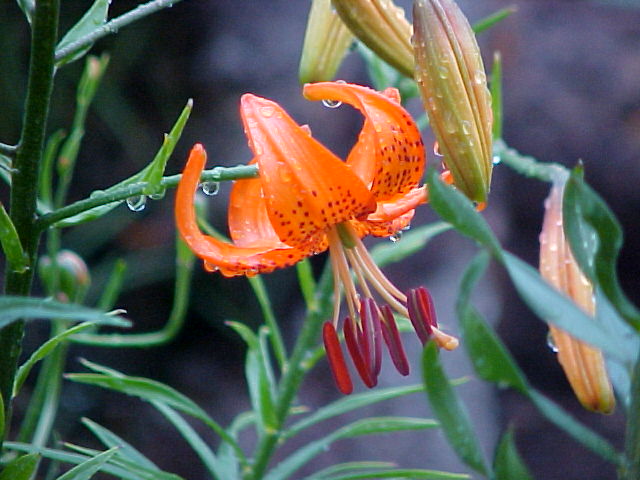 Lilium davidii
A tall Asian lily with edible bulbs and orange recurved flowers
🇨🇳 China and 1 more · Wildflower
Lilium davidii
A tall Asian lily with edible bulbs and orange recurved flowers
🇨🇳 China and 1 more · Wildflower
 Chinese LilyLilium brownii
A wild and cultivated lily from China with edible bulbs
🇨🇳 China and 3 more · Wildflower
Chinese LilyLilium brownii
A wild and cultivated lily from China with edible bulbs
🇨🇳 China and 3 more · Wildflower
More from Kyrgyzstan
All the flowers of Kyrgyzstan ApricotPrunus armeniaca
A small fruit tree with early white to pink blossoms and golden-orange fruit
🇨🇳 China and 6 more · Flowering tree
ApricotPrunus armeniaca
A small fruit tree with early white to pink blossoms and golden-orange fruit
🇨🇳 China and 6 more · Flowering tree
 Albert's tulipTulipa alberti
A wild tulip with reddish, orange or pink flowers from Central Asia's mountains
🇰🇿 Kazakhstan and 2 more · Wildflower
Albert's tulipTulipa alberti
A wild tulip with reddish, orange or pink flowers from Central Asia's mountains
🇰🇿 Kazakhstan and 2 more · Wildflower
 Crocus alatavicus
A white-flowered crocus from the mountains of Central Asia and Xinjiang
🇰🇿 Kazakhstan and 3 more · Wildflower
Crocus alatavicus
A white-flowered crocus from the mountains of Central Asia and Xinjiang
🇰🇿 Kazakhstan and 3 more · Wildflower
 Tulipa fosteriana
A wild tulip from Central Asia with large red spring flowers
🇦🇫 Afghanistan and 3 more · Wildflower
Tulipa fosteriana
A wild tulip from Central Asia with large red spring flowers
🇦🇫 Afghanistan and 3 more · Wildflower